


The legislative caucuses of the Chinese Nationalist Party (KMT) and the People First Party (PFP) said yesterday that they will support the Cabinet-drafted bill on the expansion of public investment in infrastructure construction, but will strictly screen the budgets for each project.
Several legislators from the KMT and PFP legislative caucuses made the remarks after the Legislative Yuan decided to discuss the investment bill at a plenary session slated for Friday, in order to provide the legal basis for the government's ambitious "10 New Major Public Construction Projects" program that calls for an outlay of NT$500 billion (US$15.15 billion) over the next five years.
The projects, which epitomize the essence of the "Challenge 2008" six-year development plan launched by the government, include programs for building a third freeway in central Taiwan, nurturing top-notch universities and research centers and expanding Kaohsiung's harbor into an intercontinental container center.
Liao Fung-te (廖風德), secretary-general of the KMT legislative caucus, said that to avoid being branded by the Democratic Progressive Party (DPP) as opponents of the program, the KMT and PFP will throw their support behind the public construction investment bill next Friday.
In addition, Liao stressed that the opposition will not insist that budget plans for the 10 construction projects be discussed and passed only after the new Cabinet is sworn in on May 20, when President Chen Shui-bian (陳水扁) is inaugurated to start his second four-year term.
Liao said that both the KMT and the PFP will cooperate with county magistrates and city mayors to come up with "counter-projects" detailing outlays required for local infrastructure construction.
"Once the Cabinet-drafted bill clears the legislature, budgets will not be completely used, contrary to the DPP government's plans, so that they will not become a scheme for the ruling party to win the year-end legislative elections," he said.
Meanwhile, Hsieh Chang-chieh (謝章捷) and Hsu Yuan-kuo (許淵國), both conveners of the PFP legislative caucus, said that as the "10 New Major Construction Projects" program has become a "political issue," PFP lawmakers cannot but support the program but will do their utmost to supervise the use of relevant budget allocations.
The government has so far not given a clear explanation of the contents of the new major construction programs or the source of the required fund, but has nevertheless pushed the opposition parties to render their support, they said.
Citing as an example one of the construction projects aimed at "promoting a local university to be among the world's top 100 over the next five years," Hsu claimed that several of the projects are impractical and controversial.
"National Taiwan University is ranked 160th in the world at the moment, but that institution would find it difficult to climb within the world's top 100 within five years, even if other world-renowned universities were to remain static during the period," he said.
Against this backdrop, the legislative caucuses of the KMT and the PFP are expected to come up with their own amendment versions for the public construction investment expansion bill.
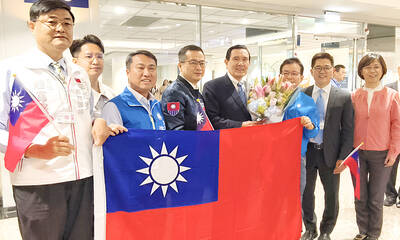
Former president Ma Ying-jeou’s (馬英九) mention of Taiwan’s official name during a meeting with Chinese President Xi Jinping (習近平) on Wednesday was likely a deliberate political play, academics said. “As I see it, it was intentional,” National Chengchi University Graduate Institute of East Asian Studies professor Wang Hsin-hsien (王信賢) said of Ma’s initial use of the “Republic of China” (ROC) to refer to the wider concept of “the Chinese nation.” Ma quickly corrected himself, and his office later described his use of the two similar-sounding yet politically distinct terms as “purely a gaffe.” Given Ma was reading from a script, the supposed slipup
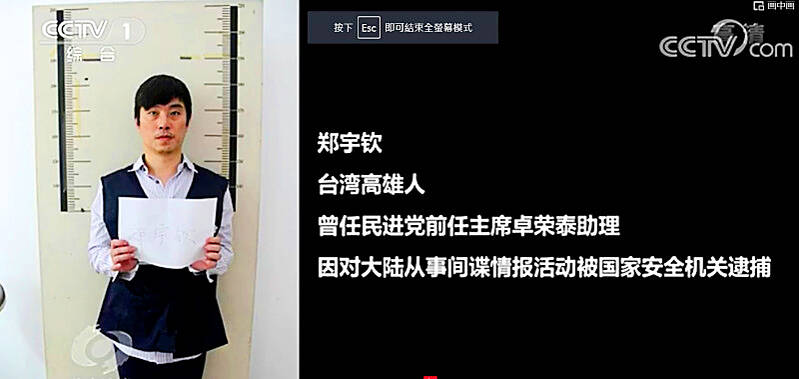
Former Czech Republic-based Taiwanese researcher Cheng Yu-chin (鄭宇欽) has been sentenced to seven years in prison on espionage-related charges, China’s Ministry of State Security announced yesterday. China said Cheng was a spy for Taiwan who “masqueraded as a professor” and that he was previously an assistant to former Cabinet secretary-general Cho Jung-tai (卓榮泰). President-elect William Lai (賴清德) on Wednesday last week announced Cho would be his premier when Lai is inaugurated next month. Today is China’s “National Security Education Day.” The Chinese ministry yesterday released a video online showing arrests over the past 10 years of people alleged to be
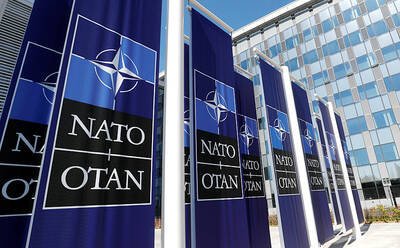
THE HAWAII FACTOR: While a 1965 opinion said an attack on Hawaii would not trigger Article 5, the text of the treaty suggests the state is covered, the report says NATO could be drawn into a conflict in the Taiwan Strait if Chinese forces attacked the US mainland or Hawaii, a NATO Defense College report published on Monday says. The report, written by James Lee, an assistant research fellow at Academia Sinica’s Institute of European and American Studies, states that under certain conditions a Taiwan contingency could trigger Article 5 of NATO, under which an attack against any member of the alliance is considered an attack against all members, necessitating a response. Article 6 of the North Atlantic Treaty specifies that an armed attack in the territory of any member in Europe,
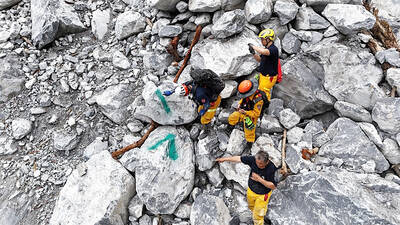
The bodies of two individuals were recovered and three additional bodies were discovered on the Shakadang Trail (砂卡礑) in Taroko National Park, eight days after the devastating earthquake in Hualien County, search-and-rescue personnel said. The rescuers reported that they retrieved the bodies of a man and a girl, suspected to be the father and daughter from the Yu (游) family, 500m from the entrance of the trail on Wednesday. The rescue team added that despite the discovery of the two bodies on Friday last week, they had been unable to retrieve them until Wednesday due to the heavy equipment needed to lift


 RSS
RSS