


What course should the Chinese Nationalist Party (KMT) take following its second defeat in its attempt to claim the keys to the Presidential Office?
Such was the question lingering in the minds of many pan-blue politicians, many of whom have openly and vocally voiced their anxiety and concerns about the party's political ideology and leadership in the past few days.
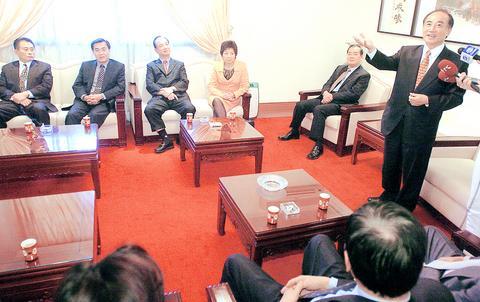
PHOTO: GEORGE TSORNG, TAIPEI TIMES
"The declining approval ratings in the polls suggest that the weekly demonstrations are no longer approved of by our supporters," KMT Legislator Hsu Chung-hsiung (
Hsu was referring to the weekly demonstrations spearheaded by the KMT-People First Party (PFP) alliance since the presidential election on March 20.
President Chen Shui-bian (
Lien refused to concede defeat, and claiming voting irregularities -- although he has not been able to produce proof -- filed a lawsuit demanding a recount. Lien also raised questions about the assassination attempt on Chen and Vice President Annette Lu (
Lien claimed that it was an attempt to win sympathy votes, as well as charging that the implementation of a "national security mechanism" following the shooting prevented a large number of military personnel from voting.
Saturday's demonstration in front of the Presidential Office was the latest in a series of protests staged by the KMT-PFP alliance in its effort to challenge the election result.
The demonstration turned ugly and violent, spiraling out of control after some protesters refused to leave the site when the event's permit expired. Clashes and scuffles broke out between riot police and the angry demonstrators in which 127 people were injured, including 86 police officers, 27 protesters and 14 reporters, according to a report by the Taipei City Police Bureau's Chungcheng First Precinct Chief We Su-lu (吳思陸).
A number of KMT legislators have questioned the wisdom of holding further street demonstrations to increase the pressure on Chen.
"The [violent clashes] have done a lot of damage to the KMT," Hsu said. "The pain I feel is more than I can put into words. I truly hope that the KMT, having existed for more than a century, will not be vaporized in such a short time."
Saying that the KMT can not afford to lose another presidential election, Hsu, a committee member known for his "pro-localization" stance, said that the party should now start considering issues such as a possible merger with the PFP, nominations for the year-end legislative elections and introspection as to why the party lost its presidential bid on March 20.
Voices urging the party to engage post-election reflection have surfaced since Wednesday's weekly Central Standing Committee meeting.
Hung Yu-chin (
Hung's remarks was echoed by KMT Legislator Chen Ken-teh (
"The presidential election is over," Hsu said. "Whether or not it was fair, the KMT must admit its defeat in order to start again."
Stressing that "the roof of the KMT must not fall apart," Hsu said that for the sake of the party's continued development, it must cease its radical street demonstrations and hold steady on the "middle path" (
"The party must quickly and return to the `middle path,' or otherwise it may face a lethal blow from its supporters in the year-end legislative elections," Hsu said.
Echoing Hsu's remarks, KMT Legislator Tseng Tsai Mei-tso (曾蔡美佐) said that the party was facing a very depressing result in the year-end legislative elections if it continued with its street protests.
KMT Legislator Chen Hung-chang (
"The two parties are of different political natures," Chen Hung-chang said, drawing attention to the fact that PFP legislators have been seen spending noticeably more time behind the microphone at the demonstrations than KMT members. "The PFP is welcome to do whatever its wants in being daring and radical. But the KMT should stick to its moderate nature."
In the midst of deliberations over the party's policy positions, the issue of changing leadership has also emerged.
"I know there are two voices within the party concerning the issue of leadership," KMT Legislator Apollo Chen (
At the party's first Central Standing Committee meeting convened on March 24 after the March 20 election, senior officials of the KMT, including Vice Chairman Vincent Siew (
Despite such remarks, there are a number of party members who face the risk of losing their nominations for the year-end legislative elections, and have been openly calling for the resignation of Lien's chairmanship in order to pave the way for new leadership.
"Chairman Lien and [KMT] Secretary-General Lin Fong-cheng (
"The KMT must transfer its leadership to the new generation," Chang said, suggesting the party undertake a vote for a new KMT chairman.
Saying that party leaders should shoulder the responsibility for the election defeat, Chen Hung-chang echoed that "it is time to transfer party leadership to the new generation."
"The KMT belongs not just to one or two people alone but to everyone, if Lien feels the election was unfair and refuses to concede defeat, then [he] should present a clear way of approaching the issue and tell party members what their next step should be," Chen Hung-chang said.
This does not mean that no one can take care of the party if Lien were to step down, as "there are still people like Wang and Taipei Mayor Ma Ying-jeou (馬英九)," KMT Legislator Huang Chien-ting (
"While it is arguable as to whether or not the chairman should be replaced, the transference of leadership to the new generation is the road [the party] must take sooner or later," Huang said.
While agreeing that the party needs to re-examine its policy platform and political ideology, Tseng Tsai however stated that it is "too cruel" to talk about who should resign.
KMT Secretary-General Lin Fong-cheng had said yesterday that Lien was never against transferring leadership to the new generation, and had stressed that such was the direction the party was working toward.
Apollo Chen commented that "it is unfair to place all the blame on the candidate, as all party officials involved in the campaign should share responsibility as well."
"Even if some people stepped down from their leadership positions, that still doesn't solve the problem the party is facing. The urgent issue is ascertaining the party's development prospect and its political ideology," he said. Apollo Chen is also a member of the party's Central Standing Committee.
He made a suggestion which he thought would make a great compromise on the issue of party leadership.
"Lien and Soong do not need to step down from their chairmanship positions. By staying where they are, they can unify the pan-blue camp. But then let Wang and Ma be in charged of intra-party reform," Chen said, adding that his idea had received support from a number of fellow KMT members.
"Given both Wang and Ma's abilities and charisma, I believe it would help the party find new opportunities if the two were to cooperate," he said.
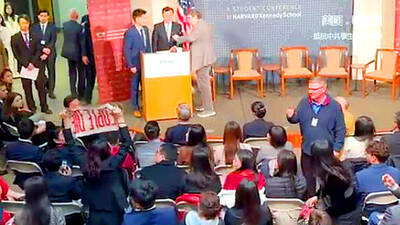
A group of Taiwanese-American and Tibetan-American students at Harvard University on Saturday disrupted Chinese Ambassador to the US Xie Feng’s (謝鋒) speech at the school, accusing him of being responsible for numerous human rights violations. Four students — two Taiwanese Americans and two from Tibet — held up banners inside a conference hall where Xie was delivering a speech at the opening ceremony of the Harvard Kennedy School China Conference 2024. In a video clip provided by the Coalition of Students Resisting the CCP (Chinese Communist Party), Taiwanese-American Cosette Wu (吳亭樺) and Tibetan-American Tsering Yangchen are seen holding banners that together read:

UNAWARE: Many people sit for long hours every day and eat unhealthy foods, putting them at greater risk of developing one of the ‘three highs,’ an expert said More than 30 percent of adults aged 40 or older who underwent a government-funded health exam were unaware they had at least one of the “three highs” — high blood pressure, high blood lipids or high blood sugar, the Health Promotion Administration (HPA) said yesterday. Among adults aged 40 or older who said they did not have any of the “three highs” before taking the health exam, more than 30 percent were found to have at least one of them, Adult Preventive Health Examination Service data from 2022 showed. People with long-term medical conditions such as hypertension or diabetes usually do not
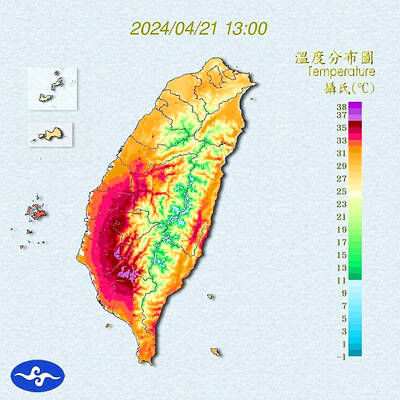
Heat advisories were in effect for nine administrative regions yesterday afternoon as warm southwesterly winds pushed temperatures above 38°C in parts of southern Taiwan, the Central Weather Administration (CWA) said. As of 3:30pm yesterday, Tainan’s Yujing District (玉井) had recorded the day’s highest temperature of 39.7°C, though the measurement will not be included in Taiwan’s official heat records since Yujing is an automatic rather than manually operated weather station, the CWA said. Highs recorded in other areas were 38.7°C in Kaohsiung’s Neimen District (內門), 38.2°C in Chiayi City and 38.1°C in Pingtung’s Sandimen Township (三地門), CWA data showed. The spell of scorching
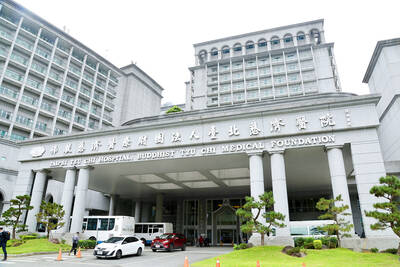
POLICE INVESTIGATING: A man said he quit his job as a nurse at Taipei Tzu Chi Hospital as he had been ‘disgusted’ by the behavior of his colleagues A man yesterday morning wrote online that he had witnessed nurses taking photographs and touching anesthetized patients inappropriately in Taipei Tzu Chi Hospital’s operating theaters. The man surnamed Huang (黃) wrote on the Professional Technology Temple bulletin board that during his six-month stint as a nurse at the hospital, he had seen nurses taking pictures of patients, including of their private parts, after they were anesthetized. Some nurses had also touched patients inappropriately and children were among those photographed, he said. Huang said this “disgusted” him “so much” that “he felt the need to reveal these unethical acts in the operating theater


 RSS
RSS