


Over the past four years, the military has experienced a series of reforms made possible by the Democratic Progressive Party (DPP) government, but the progress is still far from satisfactory, military analysts said yesterday.
The military has been most successful in eradicating the influence of political parties, which had been entrenched during the rule of the Chinese Nationalist Party (KMT) over the past decades.
neutrality
Holmes Liao (
"But except for this, the military has yet to make progress on the reforms pushed by the DPP after taking power [four years ago]," Liao said.
One of the main reforms that the DPP has sought from the military is to establish a civilian-led defense system.
The past four years saw a total of three defense ministers, including Tang Fei (
no connections
"The DPP was unable to make the military conform to its reform demands, mainly because it had no previous connections with the KMT-controlled military and could thus find no leverage to make the military follow its orders," Liao said.
"The condition also had a lot to do with the fact that the DPP did not have enough military experts on its side," he said.
"If President Chen Shui-bian (
Liao said that he was disappointed at the military's exclusion of all outsiders from discussing or participating in military affairs, especially those related to policy-making or arms purchases.
doubts
He doubted whether the military has enough expertise to decide all the tough issues on its own and without getting advice.
Erich Shih (
"Strictly speaking, I do not think that the military has made any reforms at all over the past four years. If there has been any reform at all, eradicating influences from political parties could be counted as one," Shih said.
greatest failure
"The military's greatest failure was in the enhancement of career officers' competence and knowledge levels. If it could not get its personnel to improve themselves, it should at least try not to make the situation worse," he said.
"The real problem was that the most talented military personnel chose to retire over the past few years because of certain factors, such as a sense of instability caused by poor leadership from the Ministry of National Defense," he said.
"The military might have introduced certain new systems from the US, but it did not know or refused to learn how to integrate these systems into the existing structure," he said.
The new systems that the military imported from the US include a net assessment system that could be used for the analysis of weaponry procurement.

Former president Ma Ying-jeou’s (馬英九) mention of Taiwan’s official name during a meeting with Chinese President Xi Jinping (習近平) on Wednesday was likely a deliberate political play, academics said. “As I see it, it was intentional,” National Chengchi University Graduate Institute of East Asian Studies professor Wang Hsin-hsien (王信賢) said of Ma’s initial use of the “Republic of China” (ROC) to refer to the wider concept of “the Chinese nation.” Ma quickly corrected himself, and his office later described his use of the two similar-sounding yet politically distinct terms as “purely a gaffe.” Given Ma was reading from a script, the supposed slipup
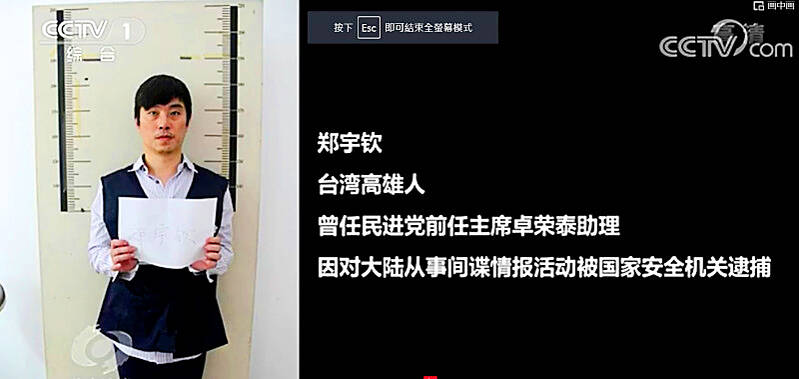
Former Czech Republic-based Taiwanese researcher Cheng Yu-chin (鄭宇欽) has been sentenced to seven years in prison on espionage-related charges, China’s Ministry of State Security announced yesterday. China said Cheng was a spy for Taiwan who “masqueraded as a professor” and that he was previously an assistant to former Cabinet secretary-general Cho Jung-tai (卓榮泰). President-elect William Lai (賴清德) on Wednesday last week announced Cho would be his premier when Lai is inaugurated next month. Today is China’s “National Security Education Day.” The Chinese ministry yesterday released a video online showing arrests over the past 10 years of people alleged to be
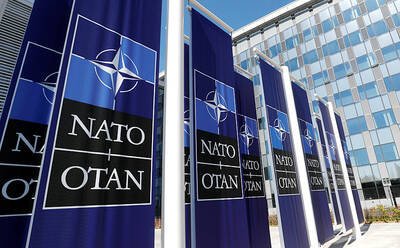
THE HAWAII FACTOR: While a 1965 opinion said an attack on Hawaii would not trigger Article 5, the text of the treaty suggests the state is covered, the report says NATO could be drawn into a conflict in the Taiwan Strait if Chinese forces attacked the US mainland or Hawaii, a NATO Defense College report published on Monday says. The report, written by James Lee, an assistant research fellow at Academia Sinica’s Institute of European and American Studies, states that under certain conditions a Taiwan contingency could trigger Article 5 of NATO, under which an attack against any member of the alliance is considered an attack against all members, necessitating a response. Article 6 of the North Atlantic Treaty specifies that an armed attack in the territory of any member in Europe,
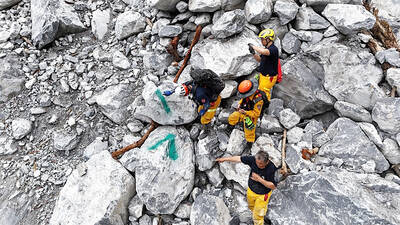
The bodies of two individuals were recovered and three additional bodies were discovered on the Shakadang Trail (砂卡礑) in Taroko National Park, eight days after the devastating earthquake in Hualien County, search-and-rescue personnel said. The rescuers reported that they retrieved the bodies of a man and a girl, suspected to be the father and daughter from the Yu (游) family, 500m from the entrance of the trail on Wednesday. The rescue team added that despite the discovery of the two bodies on Friday last week, they had been unable to retrieve them until Wednesday due to the heavy equipment needed to lift


 RSS
RSS