


A recent controversy stirred up by Buddhist Master Wei Chueh (惟覺) about the link between religion and politics led to severe criticism not only from other Buddhist leaders, but also conservationists, who said unregulated temples run by arbitrary religious groups are the most devastating killers of fragile ecological systems in mountainous areas.
"All stakeholders' efforts to preserve the environment here will be eventually neutralized if the government tolerates eco-unfriendly activities cloaked by religious purposes," said Lai Wei-chieh (賴偉傑), secretary-general of the Green Citizens' Action Alliance (GCAA).

PHOTO: WANG MIN-WEI, TAIPEI TIMES
Huge temples and ossuary towers built on hills are common in Taiwan.
For decades it has been widely known that temple managers tend to have private roads to monasteries or cement retaining walls constructed without applying for permits from the government.
An old accusation that religious groups are damaging natural resources all over Taiwan was raised again last week -- this time by a religious leader. Last Tuesday, Wei Chueh, who heads the Chung Tai Chan Monastery (中台禪寺) in Puli, Nantou County, gave a hearty welcome to the pan-blue camp's presidential candidate, Chinese Nationalist Party (KMT) Chairman Lien Chan (連戰), and his running mate, People First Party (PFP) Chairman James Soong (宋楚瑜).
Wei Chueh not only called on Buddhists to vote for Lien and Soong on March 20, but also encouraged his followers to boycott the referendum to express their opposition to the Democratic Progressive Party (DPP).
In addition, Wei Chueh said the proposed Religious Groups Act (
Two days later, Buddhist Master Shih Chao-hui (
"Wei Chueh arbitrarily carried out constructions illegally and refused to be swayed by the government, because he disregards all laws and regulations," said Shih, who is also an associate professor at Hsuan Chuang University (
Shih said that Wei Chueh harbored a burning animosity toward the proposed law, because it would regulate privileges that religious groups have enjoyed for too long.
According to Lin Pen-hsuan (
"We have never known how much they charge people for entrusting them with cinerary caskets, and how many people are involved, or how much money disciples dedicate," Lin said.
The Religious Groups Act, which is aimed at regulating "religious corporate organizations," would help to tackle problems such as illegal construction, occupation of state-owned lands and exemption from taxation, according to Lin, who helped draft the law along with representatives from five major religions about three years ago.
The current draft of the law, which is awaiting the approval of the Legislative Yuan, is based on common sense and has been endorsed by members of a religious counsel under the Ministry of the Interior, Lin said.
The Legislative Yuan's evaluation of the proposed act has been suspended because some opposition lawmakers would like to see another version of the bill implemented, which would enable dishonest religious groups to dodge the requirements of financial transparency and illegal construction, Lin said.
"No matter what, society needs sound regulations to watch over non-profit religious groups, whose actions have been tolerated by both the public and the government beyond logical thinking," Lin said.
Before sound regulations can be set up, attention must be given to religious groups lacking concern for the environment, said Yang Ping-yu (
Yang said a huge temple on Takao Hill (
"The result came after years of residents' persistent fighting against those religious overlords, who have good political connections," Yang said.
For decades the hill has been popular among hikers due to its accessibility and the antics of a large population of Formosan rock macaque monkeys that live on the hill. Since the early 1990s, residents of Kaohsiung have been urging the local government to designate a clear scope inside which all development activities are prohibited. This goal was reached in 1999, when the local government issued regulations on an area that includes the temple.
"People's silence might assist in an environmental crime," Yang said.
Activists of the Taipei-based Green Formosa Front (GFF) carried out many community-based reconstruction projects in areas affected by the 921 earthquake in Nantou County.
GFF chairman Wu Tung-jye (
"Their inappropriate development activities inadvertently hurt ecological systems. Ironically, safety can't be assured at all," Wu said.
Wu said environmentalists look forward to the establishment of the Religious Groups Act, which is based on the promotion of sustainable development.
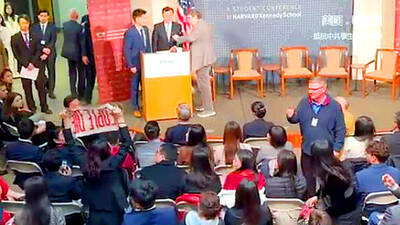
A group of Taiwanese-American and Tibetan-American students at Harvard University on Saturday disrupted Chinese Ambassador to the US Xie Feng’s (謝鋒) speech at the school, accusing him of being responsible for numerous human rights violations. Four students — two Taiwanese Americans and two from Tibet — held up banners inside a conference hall where Xie was delivering a speech at the opening ceremony of the Harvard Kennedy School China Conference 2024. In a video clip provided by the Coalition of Students Resisting the CCP (Chinese Communist Party), Taiwanese-American Cosette Wu (吳亭樺) and Tibetan-American Tsering Yangchen are seen holding banners that together read:

UNAWARE: Many people sit for long hours every day and eat unhealthy foods, putting them at greater risk of developing one of the ‘three highs,’ an expert said More than 30 percent of adults aged 40 or older who underwent a government-funded health exam were unaware they had at least one of the “three highs” — high blood pressure, high blood lipids or high blood sugar, the Health Promotion Administration (HPA) said yesterday. Among adults aged 40 or older who said they did not have any of the “three highs” before taking the health exam, more than 30 percent were found to have at least one of them, Adult Preventive Health Examination Service data from 2022 showed. People with long-term medical conditions such as hypertension or diabetes usually do not
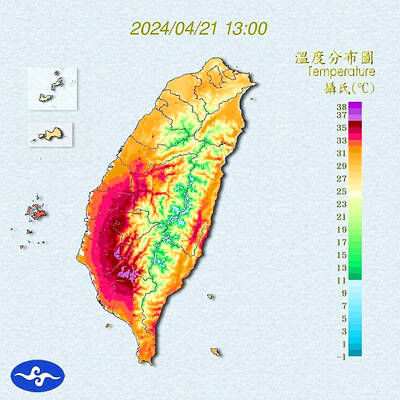
Heat advisories were in effect for nine administrative regions yesterday afternoon as warm southwesterly winds pushed temperatures above 38°C in parts of southern Taiwan, the Central Weather Administration (CWA) said. As of 3:30pm yesterday, Tainan’s Yujing District (玉井) had recorded the day’s highest temperature of 39.7°C, though the measurement will not be included in Taiwan’s official heat records since Yujing is an automatic rather than manually operated weather station, the CWA said. Highs recorded in other areas were 38.7°C in Kaohsiung’s Neimen District (內門), 38.2°C in Chiayi City and 38.1°C in Pingtung’s Sandimen Township (三地門), CWA data showed. The spell of scorching
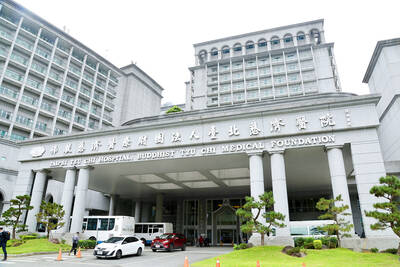
POLICE INVESTIGATING: A man said he quit his job as a nurse at Taipei Tzu Chi Hospital as he had been ‘disgusted’ by the behavior of his colleagues A man yesterday morning wrote online that he had witnessed nurses taking photographs and touching anesthetized patients inappropriately in Taipei Tzu Chi Hospital’s operating theaters. The man surnamed Huang (黃) wrote on the Professional Technology Temple bulletin board that during his six-month stint as a nurse at the hospital, he had seen nurses taking pictures of patients, including of their private parts, after they were anesthetized. Some nurses had also touched patients inappropriately and children were among those photographed, he said. Huang said this “disgusted” him “so much” that “he felt the need to reveal these unethical acts in the operating theater


 RSS
RSS