


The government hopes the referendum proposed by President Chen Shui-bian (陳水扁) can revive dialogue with the regime in China, Mainland Affairs Council Chair-woman Tsai Ing-wen (蔡英文) said yesterday.
On Tuesday, Chen suggested establishing a demilitarized zone between Taiwan and China and appointing special envoys to each other's capitals.
His remarks relate to the second question in the referendum, which asks if the public wants the government to negotiate with China on a "peace and stability" framework.
Over the past four years, Tsai said at a press conference yesterday to explain Chen's speech, cross-strait talks have been frozen by the political precondition set by China, which demands Taiwan accept the "one China" principle if it wants to have dialogue.
Stressing that Taiwan cannot accept the "one China" principle no matter which political party is in power, Tsai said the government now hopes that "the power of the people's will" displayed in the March referendum will bring the leaders in Beijing to the negotiating table with their Taiwanese counterparts.
Tsai did not confirm whether the council had informed the Chinese authorities of Taiwan's plans to establish demilitarized zones and send special envoys before Chen unveiled the "peace and stability framework" on Tuesday.
Tsai reassured China and the international society that the referendum was neither a step toward Taiwan's independence nor an act to unilaterally change the status quo in the Taiwan Strait.
Another vital aim of the vote, Tsai said, was to correct China's misunderstanding of the differences between the Democratic Progressive Party (DPP) and its blue-camp rivals, the Chinese Nationalist Party (KMT) and the People First Party (PFP).
But she did not say when asked what differences she was referring to, nor how the referendum might reveal what these differences were.
She neither confirmed nor denied the suggestion that the fundamental difference between the DPP and the blue camp was in their views of Taiwan's independence.
The DPP has a long history of campaigning for Taiwan's independence, while the KMT and the PFP have been more pro-China.
"If China has unrealistic expectations about the scale of the differences between the blue camp and the green camp, the referendum will show that its expectations have been wrong," Tsai said.
Although most voters are likely to give positive answers to the referendum questions, Tsai said the government would be prepared to review the wording and the ideas behind the referendum if the vote does not go as expected.
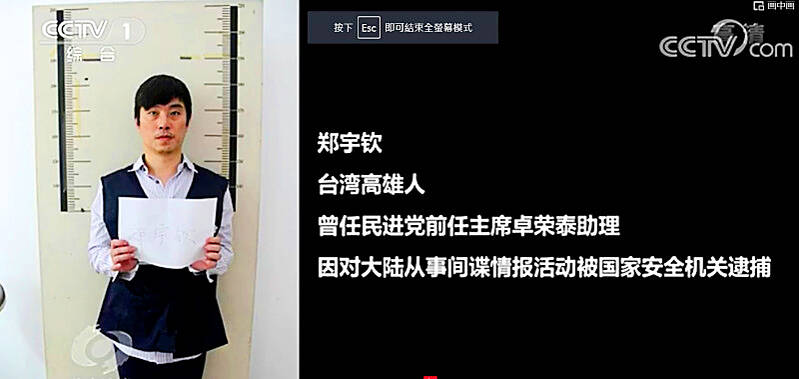
Former Czech Republic-based Taiwanese researcher Cheng Yu-chin (鄭宇欽) has been sentenced to seven years in prison on espionage-related charges, China’s Ministry of State Security announced yesterday. China said Cheng was a spy for Taiwan who “masqueraded as a professor” and that he was previously an assistant to former Cabinet secretary-general Cho Jung-tai (卓榮泰). President-elect William Lai (賴清德) on Wednesday last week announced Cho would be his premier when Lai is inaugurated next month. Today is China’s “National Security Education Day.” The Chinese ministry yesterday released a video online showing arrests over the past 10 years of people alleged to be
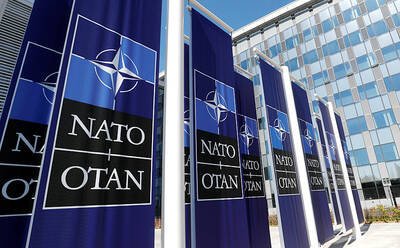
THE HAWAII FACTOR: While a 1965 opinion said an attack on Hawaii would not trigger Article 5, the text of the treaty suggests the state is covered, the report says NATO could be drawn into a conflict in the Taiwan Strait if Chinese forces attacked the US mainland or Hawaii, a NATO Defense College report published on Monday says. The report, written by James Lee, an assistant research fellow at Academia Sinica’s Institute of European and American Studies, states that under certain conditions a Taiwan contingency could trigger Article 5 of NATO, under which an attack against any member of the alliance is considered an attack against all members, necessitating a response. Article 6 of the North Atlantic Treaty specifies that an armed attack in the territory of any member in Europe,
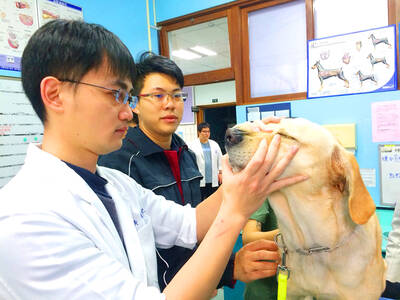
LIKE FAMILY: People now treat dogs and cats as family members. They receive the same medical treatments and tests as humans do, a veterinary association official said The number of pet dogs and cats in Taiwan has officially outnumbered the number of human newborns last year, data from the Ministry of Agriculture’s pet registration information system showed. As of last year, Taiwan had 94,544 registered pet dogs and 137,652 pet cats, the data showed. By contrast, 135,571 babies were born last year. Demand for medical care for pet animals has also risen. As of Feb. 29, there were 5,773 veterinarians in Taiwan, 3,993 of whom were for pet animals, statistics from the Animal and Plant Health Inspection Agency showed. In 2022, the nation had 3,077 pediatricians. As of last
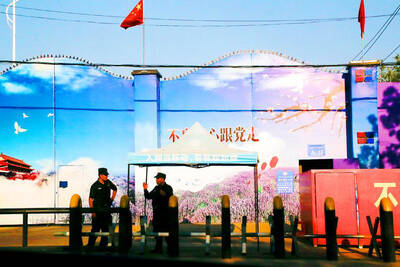
XINJIANG: Officials are conducting a report into amending an existing law or to enact a special law to prohibit goods using forced labor Taiwan is mulling an amendment prohibiting the importation of goods using forced labor, similar to the Uyghur Forced Labor Prevention Act (UFLPA) passed by the US Congress in 2021 that imposed limits on goods produced using forced labor in China’s Xinjiang region. A government official who wished to remain anonymous said yesterday that as the US customs law explicitly prohibits the importation of goods made using forced labor, in 2021 it passed the specialized UFLPA to limit the importation of cotton and other goods from China’s Xinjiang Uyghur region. Taiwan does not have the legal basis to prohibit the importation of goods


 RSS
RSS