


The contribution of foreign workers to Taiwan's industry and households is often overlooked when the nation's economic "miracle" is discussed, and while some earn tidy sums to send home to relatives, others suffer at the hands of unscrupulous employment brokers.
According to the Council of Labor Affairs (CLA), there were a total of 299,263 foreign laborers or maids in Taiwan at the end of November last year. Of these, 58,928 came from Indonesia, 80,395 from Thailand and 54,976 from Vietnam.
On Jan. 19, the CLA announced it was inviting Mongolian workers to Taiwan, and the first 3,000 are expected to arrive in Taiwan in the next three months, according to Suhkhbaatar Dolgoryn, director-general of Mongolia's Labor Force Mediation Bureau.

TAIPEI TIMES FILE PHOTO
The Mongolians's arrival will further diversify Taiwanese society with the introduction of new languages, cultures and new businesses. Before they get here, the workers will have gone through a two-to-three month language and professional training session in their home country.
The Filipinas
In Taipei City, St. Christopher's Catholic Church on Zhongshan North Road is a popular gathering spot for Philippine workers, especially on Sundays, when they typically get a day off from work to attend church. The church provides two Tagalog worship services on Sundays and a desk has been set up to assist migrant workers in trouble.
According to Father Christmar Daguno, a priest at St. Christ-opher's, about 500 to 600 Filipinos attend church regularly.
"Over the Lunar New Year, their employers usually give them a couple of days off and take them on trips to other parts of Taiwan," said Daguno, who is from the Philippines and has been working in Taipei for six months.
Foreign workers who are not aware of the resources available to them might feel helpless when problems arise.
Norma Medina, a 40-year-old domestic worker, has been working in Taipei for the past four years. When her three-year contract expired last year, she managed to get a renewal to work in the same family. Medina has four children who live in northern Luzon Island.
"The eldest is 20 years old and the youngest is nine. The two oldest children, who are 20 and 17, are already married and with children. In others words, I am already a grandmother," Medina said.
Medina works for a family in Taipei's Hsichih district, where she takes care of a 17-year-old girl who has a brain injury and walks on crutches. Medina also cooks meals for the family.
According to Medina, the family she works for treats her well. However, her niece, who arrived in Taiwan two months ago, was not as fortunate and repatriated immediately.
"I only learned of my niece's repatriation two days after her departure. It came as such a shock and I still don't know the details," Medina said.
Medina said that her niece had borrowed money to pay her employment agency in the Philippines and would not be able to pay back her money if she had lost her job here in Taiwan.
"What my niece said while she was in Taiwan was that she had to take care of five children in the family she works for. In addition, she also has to perform housekeeping tasks. Her responsibilities really added up and she hardly got any rest. However, her employer thought she worked too slowly and considered her performance poor. Without any notice, she was sent back two days ago," Medina said on Sunday while sitting alone outside St. Christopher's Catholic Church.
Medina had been crying the night before over her niece's sudden departure as she knew the challenges her niece would face when trying to pay back the money.
"I wanted to ask for help to get my niece to work here again, but I have no idea who to turn to," she said.
Father Edwin Corro, a Filipino who has been working for St. Christopher's Catholic Church for nine years, said Filipino workers faced various employment problems here.
"First, there is an overall structural problem regarding the brokerage employment system as foreign workers can often be exploited by employment agencies or even by their employers," Corro said.
According to Corro, once in Taiwan, Filipino workers have to pay their brokers about NT$1,800 a month in their first year, NT$1,700 per month in the second year and NT$1,500 per month in the third year.
"Let's say a worker earns the minimum wage of NT$15,840 per month, one-10th of his salary will go to the broker. Furthermore, 20 percent of their monthly income, which is about NT$3,000, goes in income taxes. In addition, NT$1,000 to NT$1,500 per month goes toward boarding fees to the employer. After all these deductions, what is really left for a worker?" Corro said.
According to Corro, the migrant workers are supposed to get tax refunds once they have honored their employment contracts in Taiwan.
"After three years of employment, a worker's tax payments can amount to about NT$108,000, which is a significant amount of money. However, very often, employment agencies or employers never forward the tax refund checks to workers once they have returned home," he said.
Corro also said that Philippine workers normally signed two employment contracts before arriving in Taiwan. The first contract was used to apply for employment through the CLA.
"They usually sign a second contract the day before they board the plane to Taiwan. In this second contract, they are often asked to relinquish their rights, such as the one day off per week. The terms stated in the second contract usually supersede the first one should any legal issues arise when they are in Taiwan. These workers are very often being exploited by their employment agents," Corro said.
Last year, the migrant workers concerns desk helped more than 1,200 workers.
"That comes down to about 100 cases per month. Some less fortunate situations faced by some Filipino workers are domestic workers being abused by their employers or workers asked to sleep in garages although they pay their lodging costs on a monthly basis," Corro said.
The help desk at St. Christopher's is linked to many governmental units and legal experts, who provide free resources and professional assistance to those in need. The number for the desk is (02) 2311-7764.
The Indonesians
On the second floor of Taipei Railway Station, one can find a dozen Indonesian grocery stores selling everything from Indonesian food to pop music. These stores are mostly managed by Indonesian Chinese and aim to serve Indonesians who work in Taiwan. However, since the ban on the importation of Indonesia workers which took effect on Aug. 1, 2002, these stores have suffered.
"The entire second floor used to be packed with Indonesian workers on Sundays. However, there are a lot fewer of them here now since the ban. Our business is going downhill and we are just getting by day by day," said Huang Lan-huei (
Tauhid, Hadi, Hartono are three Indonesia migrant workers who work at the same cable wire manufacturing factory in Hsinchuang, Taipei County. There are 80 Indonesians working at the factory. Tauhid is married with one child and Hartono is married but has no children. The trio works 12 hours per day, including four hours of overtime, for which they get paid extra. Once a year, they are given a few days off to visit their homes.
"Our employer has arranged a trip for all of us to go to Hualien and Kaohsiung during our days off," said Hadi. Hadi said that his employer treated the Indonesia workers well.
The three have been working in Taipei for three years and are due to go home in June, when their contracts expire.
"We hope the CLA will remove its ban on Indonesian workers as we like Taiwan a lot and hope to come back here to work again," Hadi said.
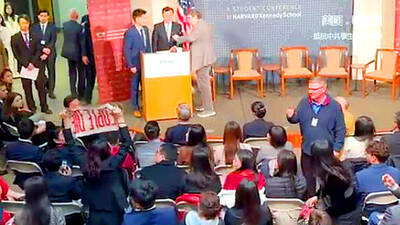
A group of Taiwanese-American and Tibetan-American students at Harvard University on Saturday disrupted Chinese Ambassador to the US Xie Feng’s (謝鋒) speech at the school, accusing him of being responsible for numerous human rights violations. Four students — two Taiwanese Americans and two from Tibet — held up banners inside a conference hall where Xie was delivering a speech at the opening ceremony of the Harvard Kennedy School China Conference 2024. In a video clip provided by the Coalition of Students Resisting the CCP (Chinese Communist Party), Taiwanese-American Cosette Wu (吳亭樺) and Tibetan-American Tsering Yangchen are seen holding banners that together read:

UNAWARE: Many people sit for long hours every day and eat unhealthy foods, putting them at greater risk of developing one of the ‘three highs,’ an expert said More than 30 percent of adults aged 40 or older who underwent a government-funded health exam were unaware they had at least one of the “three highs” — high blood pressure, high blood lipids or high blood sugar, the Health Promotion Administration (HPA) said yesterday. Among adults aged 40 or older who said they did not have any of the “three highs” before taking the health exam, more than 30 percent were found to have at least one of them, Adult Preventive Health Examination Service data from 2022 showed. People with long-term medical conditions such as hypertension or diabetes usually do not
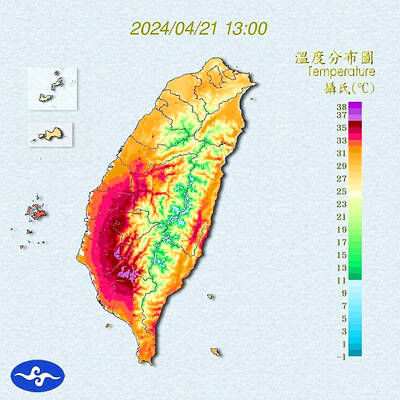
Heat advisories were in effect for nine administrative regions yesterday afternoon as warm southwesterly winds pushed temperatures above 38°C in parts of southern Taiwan, the Central Weather Administration (CWA) said. As of 3:30pm yesterday, Tainan’s Yujing District (玉井) had recorded the day’s highest temperature of 39.7°C, though the measurement will not be included in Taiwan’s official heat records since Yujing is an automatic rather than manually operated weather station, the CWA said. Highs recorded in other areas were 38.7°C in Kaohsiung’s Neimen District (內門), 38.2°C in Chiayi City and 38.1°C in Pingtung’s Sandimen Township (三地門), CWA data showed. The spell of scorching
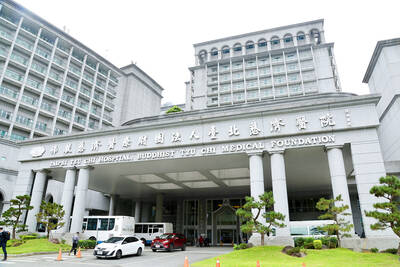
POLICE INVESTIGATING: A man said he quit his job as a nurse at Taipei Tzu Chi Hospital as he had been ‘disgusted’ by the behavior of his colleagues A man yesterday morning wrote online that he had witnessed nurses taking photographs and touching anesthetized patients inappropriately in Taipei Tzu Chi Hospital’s operating theaters. The man surnamed Huang (黃) wrote on the Professional Technology Temple bulletin board that during his six-month stint as a nurse at the hospital, he had seen nurses taking pictures of patients, including of their private parts, after they were anesthetized. Some nurses had also touched patients inappropriately and children were among those photographed, he said. Huang said this “disgusted” him “so much” that “he felt the need to reveal these unethical acts in the operating theater


 RSS
RSS