


US President George W. Bush's latest comments about Taiwan and President Chen Shui-bian's (
One of the attendees of the conference, titled "The rise of China revisited: perception and reality," was Ross Munro, director of Asian Studies at the Center for Security Studies in Washington, co-author of The Coming Conflict with China, who said he was furious about the latest development in the US-Taiwan relationship.
"This is serious. I do not completely agree with what President [George W.] Bush did. I do not like the language he used, but I understand why he did this," Munro told the Taipei Times.
He said he doesn't think that people in Taiwan understood how serious the situation is. The Bush administration was the most pro-Taiwan administration in American history, he said, and Chen had soured that relationship.
Munro made reference to Taiwan's ungratefulness by describing a US official's anger toward Chen as "the anger of an old friend who feels their friendship has been abused."
Munro believed Chen has made a mistake.
In contrast to Munro's condemnation, June Teufel Dreyer of the University of Miami's political science department, and commissioner of the US China Security Review Commission, felt that the latest development couldn't be blamed on Chen.
"I think [Chinese premier] Wen Jiabao (
She noted that China has been giving US headaches over its huge trade deficit and violations of its WTO agreements and has been unhelpful to the US in the war on terror or solving the North Korea nuclear proliferation problem.
Just as Munro was dismayed with Chen, Dreyer expressed her rage with Wen's trying to make an analogy of US president Abraham Lincoln fighting to keep the US together with China's wanting to absorb Taiwan.
"The South wanted to be part of the United States until the slavery issue came up, but obviously Taiwan has not been part of China. It was a colony of Japan for over 50 years. It was only a province for China for barely 10 years and that was more than 100 years ago," she said.
"I think this was a very poor analogy and I think Bush should have corrected him [Wen] instead of allowing it to stand," she said.
Dreyer supports Taiwan's right, as a sovereign state, to hold referendums and amend or rewrite its Constitution when it is clearly inapplicable.
"I am hoping that the Bush administration will revise its stance," she said.
While Dreyer does not blame Chen for the uproar in US-Taiwan relations, she said her position is not totally different from that of Munro.
"Because what a country has the right to do is not always what is wise to do, or prudent to do," she said.
Dreyer suggests that prior communication between the US and Taiwan on the issue of referendum was perhaps inadequate.
"Ultimately, the US is Taiwan's only reliable protector," she said, alluding to Taiwan's need to take US government's position into consideration.
Dreyer said she thinks Chen should go on with his plans for a referendum on election day, "otherwise he will look like a failure to his own supporters."
She suggested diluting the level of what is described as "provocative" by China, by having the wording of the referendum carefully thought out, or combining the referendum on China's missile with referendums on less provocative topics.
"So that Taiwan's people could not just vote for one issue but for five or six," she said.
"I think it is very important to the future of Taiwan's democracy that the people of Taiwan should be able to make their own decisions without having the PRC making decisions for them," she said, referring to the issue of referendums and rewriting the Constitution.
She warned of the danger of allowing the PRC to make decisions for Taiwan.
"China can not be allowed to take [for] themselves the right to decide what is independence `under the guise of democracy.' Otherwise, Taiwan will be slowly strangled by the PRC," she said.
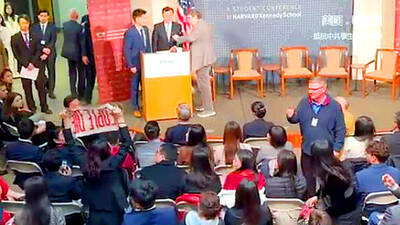
A group of Taiwanese-American and Tibetan-American students at Harvard University on Saturday disrupted Chinese Ambassador to the US Xie Feng’s (謝鋒) speech at the school, accusing him of being responsible for numerous human rights violations. Four students — two Taiwanese Americans and two from Tibet — held up banners inside a conference hall where Xie was delivering a speech at the opening ceremony of the Harvard Kennedy School China Conference 2024. In a video clip provided by the Coalition of Students Resisting the CCP (Chinese Communist Party), Taiwanese-American Cosette Wu (吳亭樺) and Tibetan-American Tsering Yangchen are seen holding banners that together read:

UNAWARE: Many people sit for long hours every day and eat unhealthy foods, putting them at greater risk of developing one of the ‘three highs,’ an expert said More than 30 percent of adults aged 40 or older who underwent a government-funded health exam were unaware they had at least one of the “three highs” — high blood pressure, high blood lipids or high blood sugar, the Health Promotion Administration (HPA) said yesterday. Among adults aged 40 or older who said they did not have any of the “three highs” before taking the health exam, more than 30 percent were found to have at least one of them, Adult Preventive Health Examination Service data from 2022 showed. People with long-term medical conditions such as hypertension or diabetes usually do not
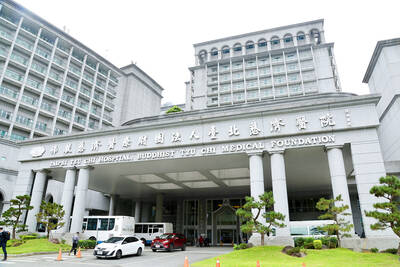
POLICE INVESTIGATING: A man said he quit his job as a nurse at Taipei Tzu Chi Hospital as he had been ‘disgusted’ by the behavior of his colleagues A man yesterday morning wrote online that he had witnessed nurses taking photographs and touching anesthetized patients inappropriately in Taipei Tzu Chi Hospital’s operating theaters. The man surnamed Huang (黃) wrote on the Professional Technology Temple bulletin board that during his six-month stint as a nurse at the hospital, he had seen nurses taking pictures of patients, including of their private parts, after they were anesthetized. Some nurses had also touched patients inappropriately and children were among those photographed, he said. Huang said this “disgusted” him “so much” that “he felt the need to reveal these unethical acts in the operating theater
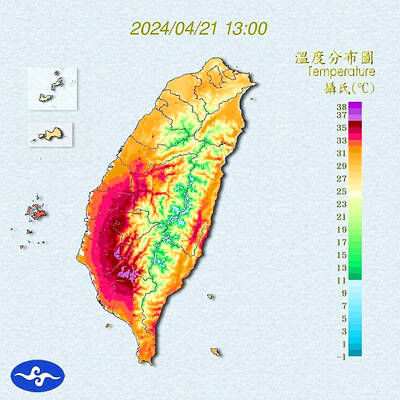
Heat advisories were in effect for nine administrative regions yesterday afternoon as warm southwesterly winds pushed temperatures above 38°C in parts of southern Taiwan, the Central Weather Administration (CWA) said. As of 3:30pm yesterday, Tainan’s Yujing District (玉井) had recorded the day’s highest temperature of 39.7°C, though the measurement will not be included in Taiwan’s official heat records since Yujing is an automatic rather than manually operated weather station, the CWA said. Highs recorded in other areas were 38.7°C in Kaohsiung’s Neimen District (內門), 38.2°C in Chiayi City and 38.1°C in Pingtung’s Sandimen Township (三地門), CWA data showed. The spell of scorching


 RSS
RSS