


Voice-activated computers and equipment that can scan text and then read it out to deaf people are just some of the applications technology is making available to disabled people, a group of computer professionals said yesterday.
However, the limited market for such tools means government support is necessary to bring bright ideas for helping disabled people to fruition.
"Only with synergy between the government and computer professionals can hindrance-free computer programs be fully developed, as the development of such projects is time-consuming and costly," said Ray Chao (晁旭光), managing director of IQ China Technology Inc (網際智慧股份有限公司).
The seminar was directed by the Council of Labor Affairs, the Cabinet's Development and Evaluation Commission and the Department of Social Affairs at the Ministry of the Interior to discuss the problems faced by the disabled and come up with solutions.
IQ China Technology Inc was one of the private sector organizations there to discuss the development of computer technology for the disabled.
According to Chao, IQ China has already developed hands-free systems that allow physically disabled people to operate the computer with voice commands instead of using hardware peripherals.
"Voice command has long been available. However, an effective noise filter has yet to be developed," Chao said.
"This voice command program will not be as user-friendly if the computer cannot separate voice commands from background noises," he said.
According to Chao, this system will be available next year.
As well as voice-controlled computers, the company is also developing tools that speak to the user.
"A program that is still under development can scan a newspaper story and convert the words into voice. Basically, the computer can scan and then read out a newspaper article for those who are visually impaired," Chao said.
Chao said he had been working with many schools for the blind and other specialized educational institutions to come up with better products for the disabled.
Educational software programs are also available for children with learning disabilities.
"Very soon, learning software will hit the market to help children with brain damage, autism and learning disabilities to learn to talk. This software is designed to be topical and practical," Wu Whang-rong (吳煌榮), an advisor at the National Rehabilitation Engineering Research Center, said.
According to Wu, this software provides several scenarios where children up to the age of six can learn to say simple expressions.
"For instance, one scenario in this program is set in a ... restaurant. Children can learn to order from the menu and tell others what they need by learning to say expressions like `I want' and `I need.' These are expressions used in daily life," Wu said.
Besides the efforts of the private sector, the government is also passing regulations to better serve the disabled population.
"On July 11, 2003, the Executive Yuan's Development and Evaluation Commission passed a Regulation for Hindrance-free Web sites (無障礙網頁開發規範) to enforce Web site development that aims to serve the disabled," said Chou Er-ming (周二銘), director of the Mobility Aid Technology Development Association.
Chou said that starting with the Web sites of government administrations, special devices such as audio and voice operation will be available to the disabled.

THE HAWAII FACTOR: While a 1965 opinion said an attack on Hawaii would not trigger Article 5, the text of the treaty suggests the state is covered, the report says NATO could be drawn into a conflict in the Taiwan Strait if Chinese forces attacked the US mainland or Hawaii, a NATO Defense College report published on Monday says. The report, written by James Lee, an assistant research fellow at Academia Sinica’s Institute of European and American Studies, states that under certain conditions a Taiwan contingency could trigger Article 5 of NATO, under which an attack against any member of the alliance is considered an attack against all members, necessitating a response. Article 6 of the North Atlantic Treaty specifies that an armed attack in the territory of any member in Europe,
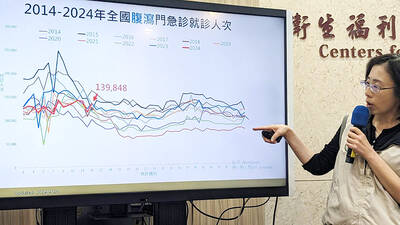
FLU SEASON: Twenty-six severe cases were reported from Tuesday last week to Monday, including a seven-year-old girl diagnosed with influenza-associated encephalopathy Nearly 140,000 people sought medical assistance for diarrhea last week, the Centers for Disease Control (CDC) said on Tuesday. From April 7 to Saturday last week, 139,848 people sought medical help for diarrhea-related illness, a 15.7 percent increase from last week’s 120,868 reports, CDC Epidemic Intelligence Center Deputy Director Lee Chia-lin (李佳琳) said. The number of people who reported diarrhea-related illness last week was the fourth highest in the same time period over the past decade, Lee said. Over the past four weeks, 203 mass illness cases had been reported, nearly four times higher than the 54 cases documented in the same period
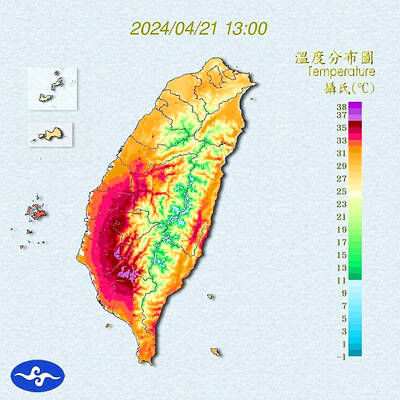
Heat advisories were in effect for nine administrative regions yesterday afternoon as warm southwesterly winds pushed temperatures above 38°C in parts of southern Taiwan, the Central Weather Administration (CWA) said. As of 3:30pm yesterday, Tainan’s Yujing District (玉井) had recorded the day’s highest temperature of 39.7°C, though the measurement will not be included in Taiwan’s official heat records since Yujing is an automatic rather than manually operated weather station, the CWA said. Highs recorded in other areas were 38.7°C in Kaohsiung’s Neimen District (內門), 38.2°C in Chiayi City and 38.1°C in Pingtung’s Sandimen Township (三地門), CWA data showed. The spell of scorching

HOSPITALITY HIT: Hotels in Hualien have an occupancy rate of 10 percent, down from 30 percent before the earthquake, a Tourism Administration official said The Executive Yuan yesterday unveiled a stimulus package of vouchers and subsidies to revive tourism in Hualien County following a quake measuring 7.2 on the Richter scale. The tremor on April 3, which killed at least 17 people and left two others missing, caused the county an estimated NT$3 billion (US$92.7 million) in damages. The Ministry of Economic Affairs is to issue vouchers worth NT$200 at the price of NT$100 for purchases at the Dongdamen Night Market (東大門夜市) in Hualien City to boost spending, a ministry official told a news conference after a Cabinet meeting in Taipei. The ministry plans to issue 18,400


 RSS
RSS