


It is legitimate for President Chen Shui-bian (陳水扁) to initiate a "defensive referendum" on sovereignty on March 20 as Beijing has never stopped its intimidation of Taiwan, Cabinet Spokesman Lin Chia-lung (
"It is Beijing that wants to change the status quo across the Taiwan Strait not us," Lin said. "While we're already an independent sovereign state, the `defensive referendum' doesn't have anything to do with our independence or unification but with safeguarding national security and sovereignty.
"Most of the people are so used to having Beijing set the deadline and call the shots, why it is not the other way around?" Lin asked.
"Such a negotiation model puts us in a bad position and I don't think it's fair to call it provocative if we change things around," Lin told reporters in response to US comments on the referendum.
Until the defensive referendum is held, Lin said, the Cabinet welcomes any suggestion regarding potential topics of the referendum.
"We're open to all kinds of questions such as the `one China, two system' policy or China's military buildup," he said. "We're confident that the US government understands and respects the Democratic Progressive Party (DPP)-led government's efforts to deepen democracy and let its people decide their own future via a popular vote."
Premier Yu Shyi-kun later told reporters that Chen personally told him on Monday that the defensive referendum can consider such a topic as China's military buildup.
"An appropriate topic for next year's `defensive referendum' should take into account the political and social situation when the referendum is held," Yu said.
Accenting that a "defensive referendum" has many functions, Yu said that the government will honor Chen's "five noes" while holding one.
"While China's political and military threats remain obvious, we'll honor Chen's `five noes' pledge and continue to offer goodwill gestures to China," Lin said.
The "five noes" refer to: no to declaring independence; no to changing Taiwan's formal name from the Republic of China; no to enshrining "state-to-state" in the Constitution; no to endorsing a referendum on formal independence; and no to abolishing either the National Reunification Council or the National Reunification Guidelines.
The "five noes," however, are on condition that China has no intention of using military force against Taiwan.
Under its "one China" policy, Beijing is suppressing Taiwan in three major areas: politics, defense and the economy, Lin said.
"On the political front, it continues to deny our sovereignty and belittle our status, including pressuring us to change our name in the World Trade Organization (WTO), blocking our bid to enter the World Health Organization (WHO) and preventing us from signing the Government Procurement Agreement (GPA)," Lin said, adding that Taiwan is a member of 19 out of the world's some 6,000 international organizations.
It has also intimidated our diplomatic allies to switch ties, causing the number of the nation's diplomatic allies to drop from 32 in 1971 when the nation withdrew from the UN to 27.
On the military front, the Chinese regime has continued to increase its military buildup against Taiwan at a speed of 50 to 70 missiles every year.
To isolate the nation economically, Lin said China has warned countries suchh as the US, Japan and Singapore against signing free-trade agreements with the nation.
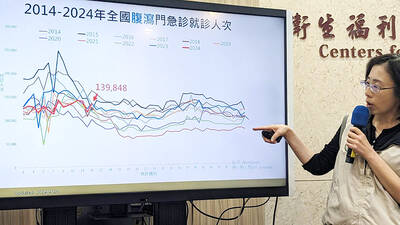
FLU SEASON: Twenty-six severe cases were reported from Tuesday last week to Monday, including a seven-year-old girl diagnosed with influenza-associated encephalopathy Nearly 140,000 people sought medical assistance for diarrhea last week, the Centers for Disease Control (CDC) said on Tuesday. From April 7 to Saturday last week, 139,848 people sought medical help for diarrhea-related illness, a 15.7 percent increase from last week’s 120,868 reports, CDC Epidemic Intelligence Center Deputy Director Lee Chia-lin (李佳琳) said. The number of people who reported diarrhea-related illness last week was the fourth highest in the same time period over the past decade, Lee said. Over the past four weeks, 203 mass illness cases had been reported, nearly four times higher than the 54 cases documented in the same period
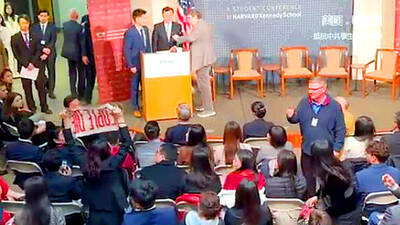
A group of Taiwanese-American and Tibetan-American students at Harvard University on Saturday disrupted Chinese Ambassador to the US Xie Feng’s (謝鋒) speech at the school, accusing him of being responsible for numerous human rights violations. Four students — two Taiwanese Americans and two from Tibet — held up banners inside a conference hall where Xie was delivering a speech at the opening ceremony of the Harvard Kennedy School China Conference 2024. In a video clip provided by the Coalition of Students Resisting the CCP (Chinese Communist Party), Taiwanese-American Cosette Wu (吳亭樺) and Tibetan-American Tsering Yangchen are seen holding banners that together read:

UNAWARE: Many people sit for long hours every day and eat unhealthy foods, putting them at greater risk of developing one of the ‘three highs,’ an expert said More than 30 percent of adults aged 40 or older who underwent a government-funded health exam were unaware they had at least one of the “three highs” — high blood pressure, high blood lipids or high blood sugar, the Health Promotion Administration (HPA) said yesterday. Among adults aged 40 or older who said they did not have any of the “three highs” before taking the health exam, more than 30 percent were found to have at least one of them, Adult Preventive Health Examination Service data from 2022 showed. People with long-term medical conditions such as hypertension or diabetes usually do not
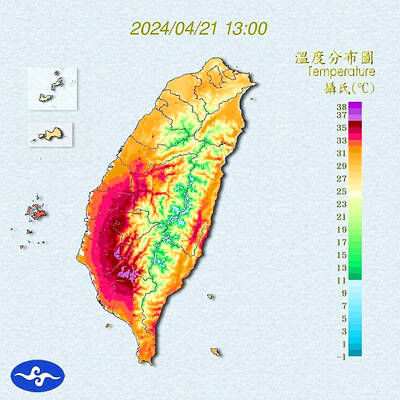
Heat advisories were in effect for nine administrative regions yesterday afternoon as warm southwesterly winds pushed temperatures above 38°C in parts of southern Taiwan, the Central Weather Administration (CWA) said. As of 3:30pm yesterday, Tainan’s Yujing District (玉井) had recorded the day’s highest temperature of 39.7°C, though the measurement will not be included in Taiwan’s official heat records since Yujing is an automatic rather than manually operated weather station, the CWA said. Highs recorded in other areas were 38.7°C in Kaohsiung’s Neimen District (內門), 38.2°C in Chiayi City and 38.1°C in Pingtung’s Sandimen Township (三地門), CWA data showed. The spell of scorching


 RSS
RSS