


In addition to the recent dysentery outbreak brought about by tourists returning from Bali, a new influenza strain and an infant dying from hand, foot and mouth disease have kept the Center for Disease Control (CDC) busy for more than a week.
According to Su Ih-jen (
The new variant differs from the Panama strain by 13 amino acids, and from the Fujian strain by only 3 amino acids, Su said.
Yen Tse-chieh (
The CDC yesterday also confirmed that an infant had died of hand, foot and mouth disease on Nov. 27. The infant, along with 12 other children who had been in the same nursery, was transferred to the Taipei Mackay Memorial Hospital for further observation.
Hand, foot and mouth disease is not the same as the more well known foot-and-mouth disease, which occurs in cattle, sheep and swine. Although the names are similar, the two diseases are not related and are caused by different viruses.
Shih confirmed that the infant had contracted echovirus 11 and said that health officials were investigating the possibility that it had been caused by hospital infection or mother-to-child transmission.
In an effort to prevent an outbreak of the disease, the CDC has had specimens from over 100 healthcare workers and patients analyzed. The results will be available next week.
Su said that influenza vaccines currently being used in Taiwan are effective against the Panama, New Caledonia and Hong Kong virus strains.
Because the effectiveness of a vaccine depends on how closely it matches the circulating viruses, the Department of Health Director General Chen Chien-jen (陳建仁) said that the vaccines currently being used provided some cross-protective immunity against the Fujian virus strain.
Shih Wen-yi (
Su said that because the Fujian influenza strain has mostly affected young children in the US, Canada and Europe, the CDC was considering policies that would provide vaccine injections for kindergarteners and preschoolers in the event of fever outbreaks.
The consequences of influenza were most serious among the elderly, often leading to pneumonia and even death, Su said.
Yen said influenza and pneumonia caused about 3, 000 deaths last year, about 90 percent of which were among the elderly.
Meanwhile, Shih said that as of last night 99 cases of dysentery had been reported.
"The 99 cases were found in travelers who returned to Taiwan before Nov. 24. It's possible that members of the same tour group passed dysentery to others in the group, and the newly infected travelers could be exhibiting symptoms by now," Shih said, stressing that the situation was under control.

THE HAWAII FACTOR: While a 1965 opinion said an attack on Hawaii would not trigger Article 5, the text of the treaty suggests the state is covered, the report says NATO could be drawn into a conflict in the Taiwan Strait if Chinese forces attacked the US mainland or Hawaii, a NATO Defense College report published on Monday says. The report, written by James Lee, an assistant research fellow at Academia Sinica’s Institute of European and American Studies, states that under certain conditions a Taiwan contingency could trigger Article 5 of NATO, under which an attack against any member of the alliance is considered an attack against all members, necessitating a response. Article 6 of the North Atlantic Treaty specifies that an armed attack in the territory of any member in Europe,
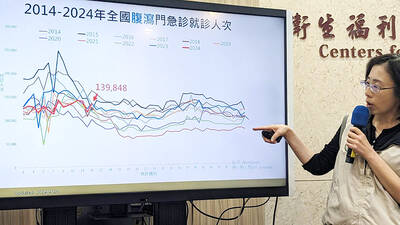
FLU SEASON: Twenty-six severe cases were reported from Tuesday last week to Monday, including a seven-year-old girl diagnosed with influenza-associated encephalopathy Nearly 140,000 people sought medical assistance for diarrhea last week, the Centers for Disease Control (CDC) said on Tuesday. From April 7 to Saturday last week, 139,848 people sought medical help for diarrhea-related illness, a 15.7 percent increase from last week’s 120,868 reports, CDC Epidemic Intelligence Center Deputy Director Lee Chia-lin (李佳琳) said. The number of people who reported diarrhea-related illness last week was the fourth highest in the same time period over the past decade, Lee said. Over the past four weeks, 203 mass illness cases had been reported, nearly four times higher than the 54 cases documented in the same period
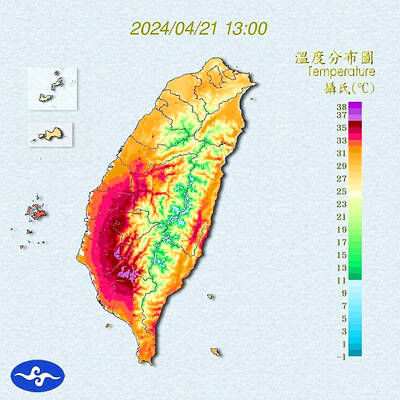
Heat advisories were in effect for nine administrative regions yesterday afternoon as warm southwesterly winds pushed temperatures above 38°C in parts of southern Taiwan, the Central Weather Administration (CWA) said. As of 3:30pm yesterday, Tainan’s Yujing District (玉井) had recorded the day’s highest temperature of 39.7°C, though the measurement will not be included in Taiwan’s official heat records since Yujing is an automatic rather than manually operated weather station, the CWA said. Highs recorded in other areas were 38.7°C in Kaohsiung’s Neimen District (內門), 38.2°C in Chiayi City and 38.1°C in Pingtung’s Sandimen Township (三地門), CWA data showed. The spell of scorching

A group of Taiwanese-American and Tibetan-American students at Harvard University on Saturday disrupted Chinese Ambassador to the US Xie Feng’s (謝鋒) speech at the school, accusing him of being responsible for numerous human rights violations. Four students — two Taiwanese Americans and two from Tibet — held up banners inside a conference hall where Xie was delivering a speech at the opening ceremony of the Harvard Kennedy School China Conference 2024. In a video clip provided by the Coalition of Students Resisting the CCP (Chinese Communist Party), Taiwanese-American Cosette Wu (吳亭樺) and Tibetan-American Tsering Yangchen are seen holding banners that together read:


 RSS
RSS