


Premier Yu Shyi-kun yesterday called on civil servants to maintain administrative neutrality ahead of next year's presidential election, in accordance with the guidelines set down for them.
"Administrative neutrality means that civil servants should bear in mind the interests of the nation and the people and exert themselves to help push the government's policies in a fair, neutral and objective manner," Cabinet Spokesman Lin Chia-lung (林佳龍) quoted Yu as saying yesterday morning.
Yu made the remarks during the weekly closed-door Cabinet meeting after listening to a briefing presented by Lee Yi-yang (
Lee said regular civil servants, who entered the civil sector after passing the national civil-servant examinations, would be banned from supporting or opposing a political party, according to the draft law governing administrative neutrality of civil servants (公務人員行政中立法) that the Cabinet has passed and sent to the legislature for approval.
The draft law also states that civil servants should not engage in activities organized by a particular political party or group; print, distribute or post campaign documents, pictures or flyers; or take a job with any political party, political group or their campaign office.
They would also be prohibited from wearing outfits bearing the insignia or flags of any candidate or party or displaying such insignia.
Hosting campaign rallies, initiating a march or signature drive, running campaign ads or commercials in the media would also be forbidden.
The draft law also applies to public school superintendents, teachers, employees; professionals employed by social educational institutions; research fellows at academic institutions; military personnel and managers and employees of state-run businesses.
Political appointees, on the other hand, would have more leeway because they enjoy a different level of rights and responsibilities, Lee said.
According to the draft bill of the administrative officers law (政務人員法), political appointees would be allowed to take up a job with a political party, group or campaign office.
This bill would apply to mem-bers of the Examination Yuan, Control Yuan, Council of Grand Justices, the Fair Trade Commission and the Central Election Commission and the commission's local chapters.
Political appointees could also host campaign rallies; initiate a march or signature drive and run campaign ads or commercials.
They would, however, be banned from engaging in campaign activities during office hours.
Nor would they be allowed to take advantage of their authority to ask other civil servants to engage in activities prohibited by law.
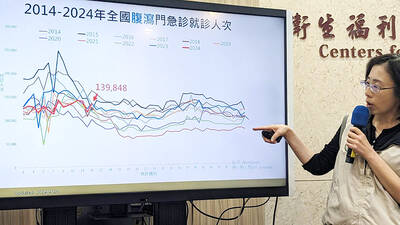
FLU SEASON: Twenty-six severe cases were reported from Tuesday last week to Monday, including a seven-year-old girl diagnosed with influenza-associated encephalopathy Nearly 140,000 people sought medical assistance for diarrhea last week, the Centers for Disease Control (CDC) said on Tuesday. From April 7 to Saturday last week, 139,848 people sought medical help for diarrhea-related illness, a 15.7 percent increase from last week’s 120,868 reports, CDC Epidemic Intelligence Center Deputy Director Lee Chia-lin (李佳琳) said. The number of people who reported diarrhea-related illness last week was the fourth highest in the same time period over the past decade, Lee said. Over the past four weeks, 203 mass illness cases had been reported, nearly four times higher than the 54 cases documented in the same period
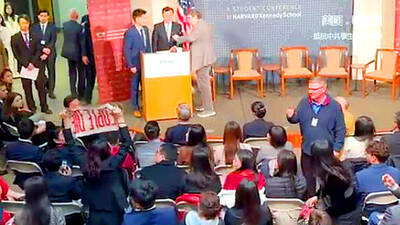
A group of Taiwanese-American and Tibetan-American students at Harvard University on Saturday disrupted Chinese Ambassador to the US Xie Feng’s (謝鋒) speech at the school, accusing him of being responsible for numerous human rights violations. Four students — two Taiwanese Americans and two from Tibet — held up banners inside a conference hall where Xie was delivering a speech at the opening ceremony of the Harvard Kennedy School China Conference 2024. In a video clip provided by the Coalition of Students Resisting the CCP (Chinese Communist Party), Taiwanese-American Cosette Wu (吳亭樺) and Tibetan-American Tsering Yangchen are seen holding banners that together read:
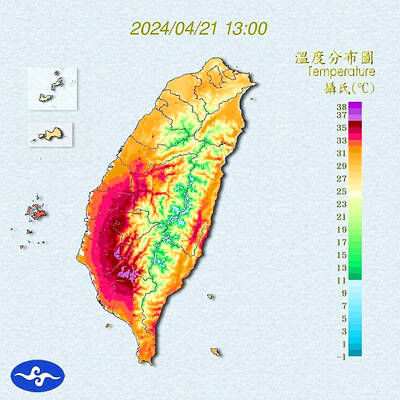
Heat advisories were in effect for nine administrative regions yesterday afternoon as warm southwesterly winds pushed temperatures above 38°C in parts of southern Taiwan, the Central Weather Administration (CWA) said. As of 3:30pm yesterday, Tainan’s Yujing District (玉井) had recorded the day’s highest temperature of 39.7°C, though the measurement will not be included in Taiwan’s official heat records since Yujing is an automatic rather than manually operated weather station, the CWA said. Highs recorded in other areas were 38.7°C in Kaohsiung’s Neimen District (內門), 38.2°C in Chiayi City and 38.1°C in Pingtung’s Sandimen Township (三地門), CWA data showed. The spell of scorching

UNAWARE: Many people sit for long hours every day and eat unhealthy foods, putting them at greater risk of developing one of the ‘three highs,’ an expert said More than 30 percent of adults aged 40 or older who underwent a government-funded health exam were unaware they had at least one of the “three highs” — high blood pressure, high blood lipids or high blood sugar, the Health Promotion Administration (HPA) said yesterday. Among adults aged 40 or older who said they did not have any of the “three highs” before taking the health exam, more than 30 percent were found to have at least one of them, Adult Preventive Health Examination Service data from 2022 showed. People with long-term medical conditions such as hypertension or diabetes usually do not


 RSS
RSS