


Many mainstream foreign media groups have withdrawn from Taiwan and relocated to China and other Asian countries, diminishing the nation's international profile, Democratic Progressive Party Legislator Hsiao Bi-khim (
"While the government vows to build the nation into an information hub in the Asia-Pacific region, such internationally acclaimed foreign media as Far Eastern Economic Review, Newsweek and Time magazine have left Taiwan for Beijing, Hong Kong and Singapore," Hsiao said.
Hsiao made the remark yesterday morning during the question and answer session of the legislature's diplomacy and overseas affairs committee.
According to Michael Chen (
"Since Dow Jones purchased the Asian Wall Street Journal, it made its correspondent of the Far Eastern Economic Review double up as the correspondent of that journal to save costs," Chen said. "Time magazine used to have a bureau office and a correspondent here, but the office was later closed down and that person became a freelancer."
Regarding Newsweek, Chen said that it belongs to the Washington Post group, which has never set up a bureau office here but instead dispatches reporters from Hong Kong to cover important events in Taiwan.
Fewer bureaus
A study conducted by the GIO indicated that, as of last month, 12 European and American mainstream foreign media have bureau offices here, while 61 have bureau offices in Beijing, 35 in Tokyo, 31 in Bangkok and 19 in Hong Kong.
In a bid to lure back foreign media, Hsiao proposed setting up an international press center offering preferential rental fees.
Pledging to study the suggestion, Lee Cher-jean (
"Newsworthiness matters more, I reckon," she said. "The government's policies may sound important to local media but they may not be much of a big deal for international media."
While it was rather difficult to invite foreign media, especially those from the US, to visit and report on Taiwan-related issues, Lee said the GIO is looking at alternatives.
"We're thinking of beefing up efforts to invite renowned European academics and European media groups' correspondents based in Asia to visit Taiwan," Lee said.
"In addition, we're working on exploiting newsworthy issues, collecting related information and informing headquarters of international media and their overseas bureaus," she said.
Press freedom
In related news, Taiwan's world ranking in press freedom slipped from last year's 35th to 61st this year, according to the France-based Reporters Without Borders' worldwide press freedom index.
According to the report, Taiwan's decline had much to do with the government's seizure of Next magazine for disclosing an alleged secret account of former president Lee Teng-hui (
The six bottom-ranked countries were North Korea, Cuba, Burma, Laos, Eritrea and China. The top three ranking countries were Finland, Iceland and the Netherlands. The UK was placed 27th, while the US was 31st.
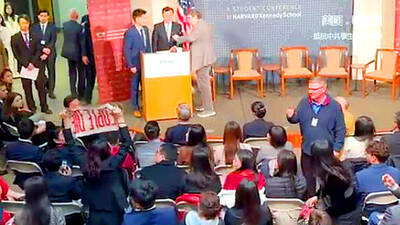
A group of Taiwanese-American and Tibetan-American students at Harvard University on Saturday disrupted Chinese Ambassador to the US Xie Feng’s (謝鋒) speech at the school, accusing him of being responsible for numerous human rights violations. Four students — two Taiwanese Americans and two from Tibet — held up banners inside a conference hall where Xie was delivering a speech at the opening ceremony of the Harvard Kennedy School China Conference 2024. In a video clip provided by the Coalition of Students Resisting the CCP (Chinese Communist Party), Taiwanese-American Cosette Wu (吳亭樺) and Tibetan-American Tsering Yangchen are seen holding banners that together read:

UNAWARE: Many people sit for long hours every day and eat unhealthy foods, putting them at greater risk of developing one of the ‘three highs,’ an expert said More than 30 percent of adults aged 40 or older who underwent a government-funded health exam were unaware they had at least one of the “three highs” — high blood pressure, high blood lipids or high blood sugar, the Health Promotion Administration (HPA) said yesterday. Among adults aged 40 or older who said they did not have any of the “three highs” before taking the health exam, more than 30 percent were found to have at least one of them, Adult Preventive Health Examination Service data from 2022 showed. People with long-term medical conditions such as hypertension or diabetes usually do not
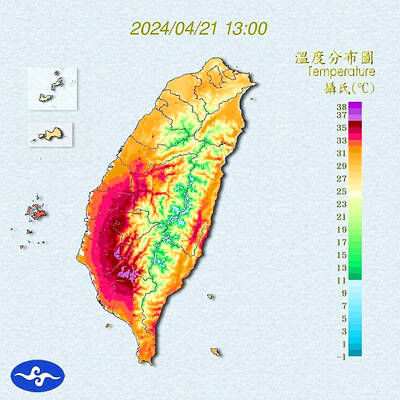
Heat advisories were in effect for nine administrative regions yesterday afternoon as warm southwesterly winds pushed temperatures above 38°C in parts of southern Taiwan, the Central Weather Administration (CWA) said. As of 3:30pm yesterday, Tainan’s Yujing District (玉井) had recorded the day’s highest temperature of 39.7°C, though the measurement will not be included in Taiwan’s official heat records since Yujing is an automatic rather than manually operated weather station, the CWA said. Highs recorded in other areas were 38.7°C in Kaohsiung’s Neimen District (內門), 38.2°C in Chiayi City and 38.1°C in Pingtung’s Sandimen Township (三地門), CWA data showed. The spell of scorching
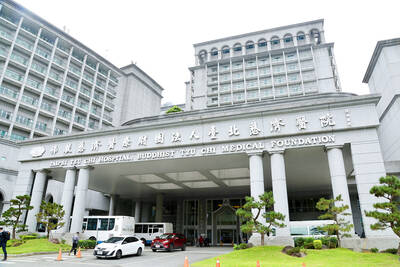
POLICE INVESTIGATING: A man said he quit his job as a nurse at Taipei Tzu Chi Hospital as he had been ‘disgusted’ by the behavior of his colleagues A man yesterday morning wrote online that he had witnessed nurses taking photographs and touching anesthetized patients inappropriately in Taipei Tzu Chi Hospital’s operating theaters. The man surnamed Huang (黃) wrote on the Professional Technology Temple bulletin board that during his six-month stint as a nurse at the hospital, he had seen nurses taking pictures of patients, including of their private parts, after they were anesthetized. Some nurses had also touched patients inappropriately and children were among those photographed, he said. Huang said this “disgusted” him “so much” that “he felt the need to reveal these unethical acts in the operating theater


 RSS
RSS