


Cross-strait exchanges may lead to Taiwan's demise if the country does not stop China from achieving its ambition of unification with Taiwan, experts warned yesterday.
Grave warnings against China's unification strategies interspersed experts'speeches in an international conference session titled "The Strategy and Campaign -- How China Uses Cross-Strait Exchanges to Influence Taiwan" in Taipei.
"This summer alone, China's Association for Relations Across the Taiwan Straits (ARATS) held six summer camps for Taiwanese children," said Deputy Secretary-General of Taiwan's Straits Exchange Foundation Yen Wan-ching (

PHOTO: SEAN CHAO, TAIPEI TIMES
ARATS, China's semi-official body handling cross-strait affairs, also recruited more than 1,500 Taiwanese university students to China this summer for sightseeing trips to ancient Chinese emperors' tombs and cultural sites such as Confucius temples, Yen said.
The design of such trips' itineraries was intended to evoke Taiwanese students' admiration for China, Yen said.
The association's enthusiasm for inviting Taiwanese students to visit China, Yen added, reveals Beijing is now expanding its campaign to unify with Taiwan by wooing the nation's younger generation.
Moreover, the Beijing authorities have been recently relocating Chinese officials based in the coastal provinces inland in order to bring Taiwanese businessmen's investment into the more backwater areas, Yen said.
As these Chinese officials have established good relationships with Taiwanese businessmen operating in the coastal provinces, Yen said, it is easy for them to persuade the businessmen to invest their money in China's less developed provinces.
"China may not swallow Taiwan in a mouthful, but we have to be very wary to prevent it from eating Taiwan bit by bit," Yen cautioned.
"We cannot have the illusion that if we stop developing our ties with other countries, China will be in cordial terms with us," Yen said.
Advisor to the Taiwan Research Institute Ruan Ming (
According to their analysis, Wang Daohan (
In 1996, China launched missile tests off Taiwan's waters before the country's first direct presidential election in an effort to persuade voters not to choose former president Lee Teng-hui (李登輝), who Beijing viewed as a separatist. Lee won a landslide victory.
Three days before the 2000 presidential election, former Chinese premier Zhu Rongji (朱鎔基) held a press conference to threaten the Taiwanese people to vote for either Lien Chan (連戰) or James Soong (宋楚瑜), now leaders of the major opposition parties, rather than the pro-independence Chen Shui-bian.
Zhu's intimidation was believed to have boosted Chen Shui-bian's popularity and helped him end the Chinese Nationalist Party's (KMT) half-century regime in Taiwan.
In Wang's review of China's blunders in attempting to influence Taiwan's 1996 and 2000 presidential elections, he said because of the missile tests and Zhu's threat, China had made itself look like "a diner devouring with ugly gestures."
Wang decided China should not display the "ugly eating gestures" anymore. Instead, if Beijing wanted to unify with Taiwan, it should release a bait to lure Taiwan into the trap, Ruan's report quoted Wang as saying.
Wang said: "We have to observe [Taiwan's situation] calmly ... Taiwan is changing. We have to study the developments of its political parties. We will use politicians and the media to split Taiwan."
Ruan's report said the KMT, after losing its regime, took China's bait.
"Lien has so far been unable to give a clear definition of Taiwan's national identity," Ruan said.
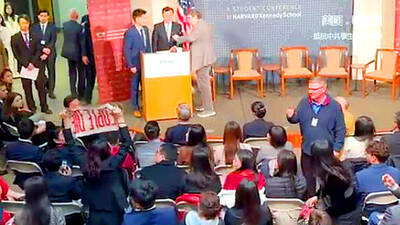
A group of Taiwanese-American and Tibetan-American students at Harvard University on Saturday disrupted Chinese Ambassador to the US Xie Feng’s (謝鋒) speech at the school, accusing him of being responsible for numerous human rights violations. Four students — two Taiwanese Americans and two from Tibet — held up banners inside a conference hall where Xie was delivering a speech at the opening ceremony of the Harvard Kennedy School China Conference 2024. In a video clip provided by the Coalition of Students Resisting the CCP (Chinese Communist Party), Taiwanese-American Cosette Wu (吳亭樺) and Tibetan-American Tsering Yangchen are seen holding banners that together read:

UNAWARE: Many people sit for long hours every day and eat unhealthy foods, putting them at greater risk of developing one of the ‘three highs,’ an expert said More than 30 percent of adults aged 40 or older who underwent a government-funded health exam were unaware they had at least one of the “three highs” — high blood pressure, high blood lipids or high blood sugar, the Health Promotion Administration (HPA) said yesterday. Among adults aged 40 or older who said they did not have any of the “three highs” before taking the health exam, more than 30 percent were found to have at least one of them, Adult Preventive Health Examination Service data from 2022 showed. People with long-term medical conditions such as hypertension or diabetes usually do not
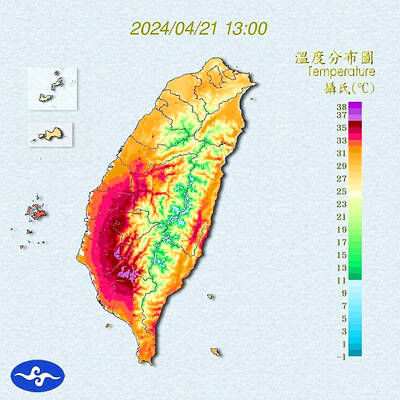
Heat advisories were in effect for nine administrative regions yesterday afternoon as warm southwesterly winds pushed temperatures above 38°C in parts of southern Taiwan, the Central Weather Administration (CWA) said. As of 3:30pm yesterday, Tainan’s Yujing District (玉井) had recorded the day’s highest temperature of 39.7°C, though the measurement will not be included in Taiwan’s official heat records since Yujing is an automatic rather than manually operated weather station, the CWA said. Highs recorded in other areas were 38.7°C in Kaohsiung’s Neimen District (內門), 38.2°C in Chiayi City and 38.1°C in Pingtung’s Sandimen Township (三地門), CWA data showed. The spell of scorching
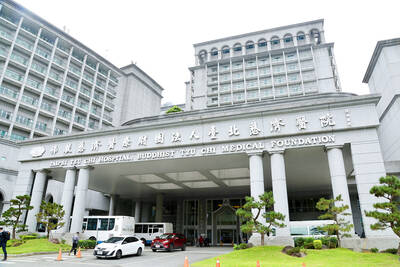
POLICE INVESTIGATING: A man said he quit his job as a nurse at Taipei Tzu Chi Hospital as he had been ‘disgusted’ by the behavior of his colleagues A man yesterday morning wrote online that he had witnessed nurses taking photographs and touching anesthetized patients inappropriately in Taipei Tzu Chi Hospital’s operating theaters. The man surnamed Huang (黃) wrote on the Professional Technology Temple bulletin board that during his six-month stint as a nurse at the hospital, he had seen nurses taking pictures of patients, including of their private parts, after they were anesthetized. Some nurses had also touched patients inappropriately and children were among those photographed, he said. Huang said this “disgusted” him “so much” that “he felt the need to reveal these unethical acts in the operating theater


 RSS
RSS