


Chung Lung-hsing (
In 2000, however, the Culture Bureau of the Tainan City Government started a program which trained tour guides for archaeological sites. Chung, who was interested in learning about Tainan culture and history, decided to sign up as a volunteer tour guide.

PHOTO: CODY YIU, TAIPEI TIMES
Last year, the National Taiwan Museum also started a community tour guide program, which allowed residents from local communities around the country to better understand the culture and history of their communities. Chung, an avid history activist, also participates in this program as a volunteer.
"With this program, we provide tours on weekends in the Anping area for the people of Tainan. When events are held focusing on special cultural or artistic themes in the Tainan area, we also serve as volunteer tour guides for those activities," said Chung.
On June 10 this year, as part of a Council of Labor Affairs (CLA) multiskilling employment program, Chung was able to receive an income for the first time in his capacity as tour guide. According to the program's guidelines, each employee is able to work up to a maximum of 22 days per month and receive NT$95 per hour.
Currently, there are 14 tour guides and 10 janitors employed under the program.
"As tour guides, we are trained to express ourselves clearly and must learn a significant amount about Tainan's history, culture and geography," said Chung.
"The culture bureau provided a special training program for us in order that we could become professional tour guides, and the trainees are expected to receive their tour guide licenses this month," he said.
According to Chung, many tour guides in the program were formerly managers of tourist agencies or individuals involved in the tourism industry. Due to the economic slump and SARS, they were stripped of their previous jobs, but this CLA program provides them with a source of income.
"The pay is not great, but some of us are very interested in promoting Tainan's rich culture and history. So to us, money is not the only motivation for doing this job," said Chung.
Anping Castle was first established by Dutch traders and the East India Company in 1624. In 1627, the castle was renamed "Zeelandia" and a 200m-square township built surrounding the castle. The Chinese residents there named it "Tayouan." Some argue that Tayouan, which was the first urban district in Taiwan, was the place name which eventually evolved into the present name of Taiwan.
In 1662, after Cheng Cheng-kung (鄭成功), the famed general of the dying Ming Dynasty, evicted the Dutch from Taiwan, he renamed "Tayouan" as "Anping," which means "peace" in Chinese.
"In the Anping area, there are two first-class, six third-class and six fourth-class archaeological sites," Chung said.
According to regulations passed by the Ministry of the Interior in 1982, the classification system for archaeological sites is determined by the local government whose jurisdiction covers the site.
"How an archaeological site is classified depends not only on its historical value today, but also upon its significance and what it represented in earlier periods of time," said Lee Tsung-nan (
"A complete tour includes a visit of the Anping Castle as well as the surrounding old city, which altogether takes about two hours to complete," said Chung. He also pointed out that not all visitors wanted to take the complete tour.
"We usually ask visitors what they are interested in seeing once they get here. For instance, there is the famous Matzu Temple (天后宮), as well as several old wells and 300-year-old houses that have tremendous historical value," said Chung.
According to Chung, the tour guides use a passive method in that they do not approach visitors and offer their service straight away, but rather stand by and wait for visitors to approach them.
"So far, most of the visitors have been student groups and families who are on outings," said Chung. He added that these two groups of visitors are usually more interested in the history of Anping.
"This is in contrast to those groups on pilgrimages, who are usually only interested in visiting the Matzu Temple and other temples in the area," he said.
"The culture bureau also trains specialist tour guides who are fluent in Japanese and English. With notice, we will make arrangements with the bureau to provide these guides to foreign visitors," said Lee.
Chung, who learned Japanese in school, also guides visitors from Japan through the archaeological sites of the Anping area.
In addition to many other historical attractions, the Anping Cultural Foundation last year set up a Taiwanese-language library that offers books and magazines of nursery rhymes, idioms and teaching materials in the local language.
The CLA's job program guidelines state that employees are only allowed to stay in the same job for nine months, after which a new group will take over.
The current allotment of tour guides and janitors stationed in Anping will therefore be paid only until March next year.
"With or without a pay packet, this tour guide job is always interesting, because I love to introduce Tainan's rich culture to tourists," said Chung.

Former president Ma Ying-jeou’s (馬英九) mention of Taiwan’s official name during a meeting with Chinese President Xi Jinping (習近平) on Wednesday was likely a deliberate political play, academics said. “As I see it, it was intentional,” National Chengchi University Graduate Institute of East Asian Studies professor Wang Hsin-hsien (王信賢) said of Ma’s initial use of the “Republic of China” (ROC) to refer to the wider concept of “the Chinese nation.” Ma quickly corrected himself, and his office later described his use of the two similar-sounding yet politically distinct terms as “purely a gaffe.” Given Ma was reading from a script, the supposed slipup
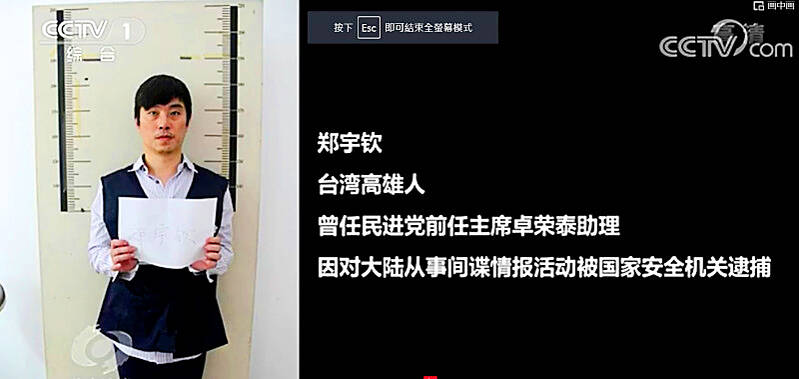
Former Czech Republic-based Taiwanese researcher Cheng Yu-chin (鄭宇欽) has been sentenced to seven years in prison on espionage-related charges, China’s Ministry of State Security announced yesterday. China said Cheng was a spy for Taiwan who “masqueraded as a professor” and that he was previously an assistant to former Cabinet secretary-general Cho Jung-tai (卓榮泰). President-elect William Lai (賴清德) on Wednesday last week announced Cho would be his premier when Lai is inaugurated next month. Today is China’s “National Security Education Day.” The Chinese ministry yesterday released a video online showing arrests over the past 10 years of people alleged to be
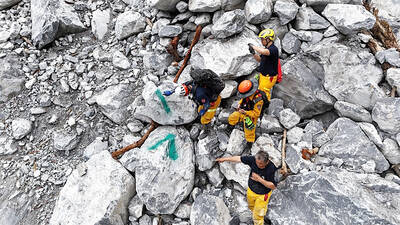
The bodies of two individuals were recovered and three additional bodies were discovered on the Shakadang Trail (砂卡礑) in Taroko National Park, eight days after the devastating earthquake in Hualien County, search-and-rescue personnel said. The rescuers reported that they retrieved the bodies of a man and a girl, suspected to be the father and daughter from the Yu (游) family, 500m from the entrance of the trail on Wednesday. The rescue team added that despite the discovery of the two bodies on Friday last week, they had been unable to retrieve them until Wednesday due to the heavy equipment needed to lift
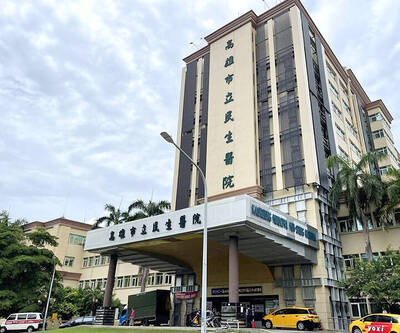
MIX-UP: Kaohsiung Municipal Min-Sheng Hospital director Yen Chia-chi was suspended from his duties after surgeons operated on the wrong patient last week The Kaohsiung Department of Health yesterday fined Kaohsiung Municipal Min-Sheng Hospital NT$500,0000 for misidentifying two patients and consequently causing one of them to undergo the wrong surgery last week. The hospital’s director Yen Chia-chi (顏家祺) was suspended from his duties. The surgeon who was scheduled to operate on the patient was given a major demerit and is subject to subsequent disciplinary actions. Demerits were given to the anesthesiologist, the nurse in the operation room, the nurse in the ward and the worker who helped transfer the patient from the ward to the operation room for having failed to verify the patient’s identity. Meanwhile, the


 RSS
RSS