


Chen Hsiu-hsia (陳秀暇) has been a housewife for a large portion of her life. She is 50 years old and has five grandchildren. Chen's husband has been plagued by illness for a long time and is unable to work.
In order to pay for living expenses, Chen babysits. Chen, along with other individuals from low-income families, also turned to her village chief for financial help.
Fortunately for Chen, earlier this year, Tainan City's Vocational Training Center was hiring individuals to work on a wetland project and told her she would be paid by the Council of Labor Affairs' job development program.

PHOTO: CODY YIU, TAIPEI TIMES
This program aims to help the unemployed and the underprivileged. The wetland project is a green community development program in Chen's hometown, Er-Hsin village in Tainan.
Chen's job was to take care of plants on a wetland, where the waste water discharged from 80 households in Er-Hsin village was purified using a specialized ecological recycling system. The water is then utilized to water the plants.
Starting April 1, Chen and her co-workers work eight hours a day and 22 days a month, for NT$95 an hour.
"By working here, not only do I receive a steady income, but also get exercise while I work," Chen said.
The wetland project was begun in 1990, led by Jing Shu-ren (荊樹人) of the department of environmental engineering and health at Chia Nan University of Pharmacy and Science.
The university is located in Ren-te village, where the tributaries of the Er-ren Stream were heavily polluted due to waste discharged from nearby pig farms. The stream also flowed through deserted farms, which caused more pollution to the water.
Jing came up with the wetland project to recycle the polluted water. The purification system consists of two stages: the first is using the earth's surface filtering system to remove to break up the waste; the second stage is utilizing water plants which feed on organic waste material to carry out the purification.
The wetland in Er-hsin village was established in October 2001 on a piece deserted farm land. The cooperation between Jing's team and residents of the village enabled the community to turn the wasteland into an arboretum.
Soong Ching-shu (
Of course, taking care of the 1800m2 green land is no easy job.
"Every morning, I will assign tasks to Chen and her co-workers so that they know what to do," said Soong.
Examples of tasks include pruning trees and burying outgrown plants. Chen and her co-workers did not have any prior gardening experience, and Soong invited members of the Green Thumb Club to train them.
Thanks to the effort of the trio, the 1800m2 wetland was turned into a more beautiful mini-forest.
The wetland is a popular destination for school children and college students who major in environment-related subjects.
Furthermore, ecology and environmental professionals from numerous offices of the Bureau of Environmental Protection also frequent the wetland, as they want to learn the operation and technicality of the wetland to run a similar project in their own areas.
This project is classified as a societal project under the CLA's job training program.
A societal project is one that focuses on community building instead of making a profit. The community is not yet planning to switch over to an economical project.
"Our goal is to hire only Er-hsin village residents and to build a beautiful community that we are proud of, as well as to promote environmental awareness around the country," Soong said.
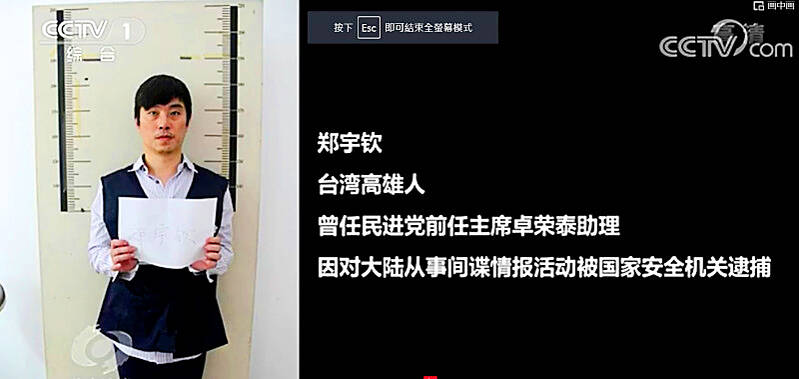
Former Czech Republic-based Taiwanese researcher Cheng Yu-chin (鄭宇欽) has been sentenced to seven years in prison on espionage-related charges, China’s Ministry of State Security announced yesterday. China said Cheng was a spy for Taiwan who “masqueraded as a professor” and that he was previously an assistant to former Cabinet secretary-general Cho Jung-tai (卓榮泰). President-elect William Lai (賴清德) on Wednesday last week announced Cho would be his premier when Lai is inaugurated next month. Today is China’s “National Security Education Day.” The Chinese ministry yesterday released a video online showing arrests over the past 10 years of people alleged to be

THE HAWAII FACTOR: While a 1965 opinion said an attack on Hawaii would not trigger Article 5, the text of the treaty suggests the state is covered, the report says NATO could be drawn into a conflict in the Taiwan Strait if Chinese forces attacked the US mainland or Hawaii, a NATO Defense College report published on Monday says. The report, written by James Lee, an assistant research fellow at Academia Sinica’s Institute of European and American Studies, states that under certain conditions a Taiwan contingency could trigger Article 5 of NATO, under which an attack against any member of the alliance is considered an attack against all members, necessitating a response. Article 6 of the North Atlantic Treaty specifies that an armed attack in the territory of any member in Europe,

LIKE FAMILY: People now treat dogs and cats as family members. They receive the same medical treatments and tests as humans do, a veterinary association official said The number of pet dogs and cats in Taiwan has officially outnumbered the number of human newborns last year, data from the Ministry of Agriculture’s pet registration information system showed. As of last year, Taiwan had 94,544 registered pet dogs and 137,652 pet cats, the data showed. By contrast, 135,571 babies were born last year. Demand for medical care for pet animals has also risen. As of Feb. 29, there were 5,773 veterinarians in Taiwan, 3,993 of whom were for pet animals, statistics from the Animal and Plant Health Inspection Agency showed. In 2022, the nation had 3,077 pediatricians. As of last

XINJIANG: Officials are conducting a report into amending an existing law or to enact a special law to prohibit goods using forced labor Taiwan is mulling an amendment prohibiting the importation of goods using forced labor, similar to the Uyghur Forced Labor Prevention Act (UFLPA) passed by the US Congress in 2021 that imposed limits on goods produced using forced labor in China’s Xinjiang region. A government official who wished to remain anonymous said yesterday that as the US customs law explicitly prohibits the importation of goods made using forced labor, in 2021 it passed the specialized UFLPA to limit the importation of cotton and other goods from China’s Xinjiang Uyghur region. Taiwan does not have the legal basis to prohibit the importation of goods


 RSS
RSS