


After over two years of study, the Ministry of National Defense has decided on a joint-operation mechanism for the years to come, the ministry said in a recent written response to inquiries from a lawmaker
The joint-operation mechanism is to be established according to lessons learned from the Hankuang No. 18 last year and Hankuang No. 19 exercises this year's, the ministry says.
"Thanks to the two exercises, the joint-operation mechanism for the future has been determined. It is to be divided into two parts: joint-operation command and operation support," the ministry said.
"As a compliment to the new joint-operation mechanism, the current division of the country into separate war zones will be abolished. Instead, the whole country will be taken as one war zone, with all armed forces to be deployed and dispatched in joint modes," it said.
The ministry released the statement in response to a recent article by ex-navy commander in chief and People First Party (PFP) Legislator Nelson Ku (顧崇廉).
Ku's article ideas that might become the centerpiece of a defense white paper to be adopted by the PFP and Chinese Nationalist Party (KMT) in the campaign for next year's presidential elections.
With the statement it would appear that the ministry is committed to have a joint-operation mechanism.
The joint-operations system is comprised of two main pillars: a joint-operation command based on the office of the chief of the general staff and an operation support that is to cut through service barriers.
In the Hankuang exercises, the joint-operation command structure was put to test. The new structure features a direct command of combat troops by the office of the chief of the general staff, bypassing the commanders-in-chief of the three armed services.
For the new command structure to be enforced, the general headquarters of the three armed services would first have to be downgraded or eliminated, a direction already prescribed in the National Defense Law (國防法).
The commanders in chief of the three services would also drop in rank from three-star to two-star generals and become staff or advisers to the defense minister.
Ku's idea is to transform the office of the chief of the general staff into a structure similar to the joint chiefs of staff of the US military.
The ministry does not object to Ku's suggestion, saying the ministry's National Defense Law and the Organizational Law (國防部組織法) have to be amended first.
A defense official, who spoke in private, said as the ministry maps out the vision for the future, it might forget to inform the public that the road ahead is still full of obstacles.
The joint-operation mechanism, for instance, is to become operable only after the construction of a cross-service command, control, communication, computer, intelligence, surveillance and reconnaissance (C4ISR) system, the official said.
"The US military has pointed out that much of the failure of the Hankuang No. 19 exercise was due to the absence of information sharing between services. Information sharing is one of the functions of the C4ISR system," he said.
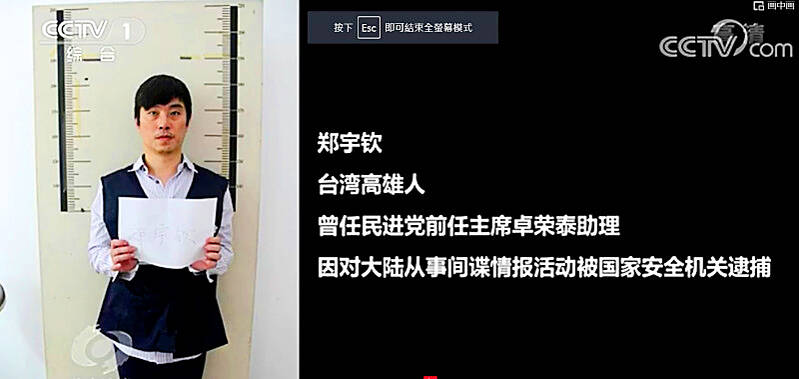
Former Czech Republic-based Taiwanese researcher Cheng Yu-chin (鄭宇欽) has been sentenced to seven years in prison on espionage-related charges, China’s Ministry of State Security announced yesterday. China said Cheng was a spy for Taiwan who “masqueraded as a professor” and that he was previously an assistant to former Cabinet secretary-general Cho Jung-tai (卓榮泰). President-elect William Lai (賴清德) on Wednesday last week announced Cho would be his premier when Lai is inaugurated next month. Today is China’s “National Security Education Day.” The Chinese ministry yesterday released a video online showing arrests over the past 10 years of people alleged to be
THE HAWAII FACTOR: While a 1965 opinion said an attack on Hawaii would not trigger Article 5, the text of the treaty suggests the state is covered, the report says NATO could be drawn into a conflict in the Taiwan Strait if Chinese forces attacked the US mainland or Hawaii, a NATO Defense College report published on Monday says. The report, written by James Lee, an assistant research fellow at Academia Sinica’s Institute of European and American Studies, states that under certain conditions a Taiwan contingency could trigger Article 5 of NATO, under which an attack against any member of the alliance is considered an attack against all members, necessitating a response. Article 6 of the North Atlantic Treaty specifies that an armed attack in the territory of any member in Europe,

LIKE FAMILY: People now treat dogs and cats as family members. They receive the same medical treatments and tests as humans do, a veterinary association official said The number of pet dogs and cats in Taiwan has officially outnumbered the number of human newborns last year, data from the Ministry of Agriculture’s pet registration information system showed. As of last year, Taiwan had 94,544 registered pet dogs and 137,652 pet cats, the data showed. By contrast, 135,571 babies were born last year. Demand for medical care for pet animals has also risen. As of Feb. 29, there were 5,773 veterinarians in Taiwan, 3,993 of whom were for pet animals, statistics from the Animal and Plant Health Inspection Agency showed. In 2022, the nation had 3,077 pediatricians. As of last
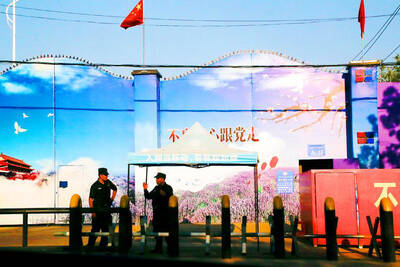
XINJIANG: Officials are conducting a report into amending an existing law or to enact a special law to prohibit goods using forced labor Taiwan is mulling an amendment prohibiting the importation of goods using forced labor, similar to the Uyghur Forced Labor Prevention Act (UFLPA) passed by the US Congress in 2021 that imposed limits on goods produced using forced labor in China’s Xinjiang region. A government official who wished to remain anonymous said yesterday that as the US customs law explicitly prohibits the importation of goods made using forced labor, in 2021 it passed the specialized UFLPA to limit the importation of cotton and other goods from China’s Xinjiang Uyghur region. Taiwan does not have the legal basis to prohibit the importation of goods


 RSS
RSS