


Premier Yu Shyi-kun said yesterday that a delay in passage of new laws and amendments would hinder reforms in various fields and eventually undermine the nation's overall competitiveness.
Yu noted in an interview that the Cabinet has sent to the Legislative Yuan a basket of reform bills for deliberation, including three statutes concerning government restructuring and six "sunshine bills" aimed at establishing clean politics.
"The enactment of these bills is necessary for launching sweeping domestic reforms, upgrading national competitiveness and attracting foreign investment," Yu said.
If these bills fail to clear legislature, he said, the government will not be able to carry out many badly needed reform programs, and multinational business groups will become more hesitant about launching investment projects in Taiwan.
Noting that national competition is different from corporate competition, Yu said national competition involves competition on many fronts, including university education, government efficiency and manpower quality.
"And there is still ample room for Taiwan to upgrade its national strength and competitiveness," he said.
Citing government restructuring as an example, Yu said the US government has only 13 departments, Japan has cut the number of its central government departments from 20 to 12, while the Chinese government has also reduced the number of its ministries from 35 to 20.
In contrast, Yu pointed out, this country still has 36 ministries and commissions.
Cutting red tape
He said a bloated bureaucracy often hinders interministerial coordination and can even blunt administrative efficiency.
"The Cabinet has drafted three bills that will downsize the hierarchy and cut red tape," he said.
"I'm hopeful that these bills can be passed into law during the current legislative session to let the restructuring work kick off smoothly," he said.
Yu also stressed the importance of financial reform.
"If banking reforms cannot succeed, many local banks will continue being gripped by huge bad loans. Should that be the case, foreign companies will be reluctant to invest in Taiwan, " he said.
"So long as we can succeed in banking reform, we'll be able to create many new business opportunities and further expand our niches in the world financial market," he said.
Yu said the Cabinet has drafted a five-year, NT$500 billion stimulus plan aimed at speeding up infrastructure construction, boosting balanced regional development and upgrading the quality of life.
"A special bill on this ambitious plan will be referred to the Legislative Yuan for deliberation before the end of this month," Yu said, adding that he hopes the legislature can approve the special bill as soon as possible.
As for the proposal to allow Taiwanese-financed companies in China to list their stocks on the local bourse, Yu said the government must work out a comprehensive package of complementary measures before such an idea can be put into force.
"As the proposal involves some critical problems, we must exercise prudence in tackling it," Yu said, citing the difficulty monitoring such companies' finances as a reason.
Capital flow
Another problem would be how to get these companies to remit their China-generated profits back to Taiwan, Yu said, adding that a cross-strait capital flow mechanism must be forged before such a proposal can be implemented.
He said the Cabinet will continue to push for more convenient cross-strait cargo transportation, including the opening of indirect cargo charter flights.
Despite Beijing's reluctance to resume dialogue with Taipei, Yu said the government will not be daunted and will make continued efforts to maintain cross-strait peace and boost civilian exchanges.
Also See Stories:
Taiwan to ease investment rules
Yu urges lawmakers to pass financial-reform bills
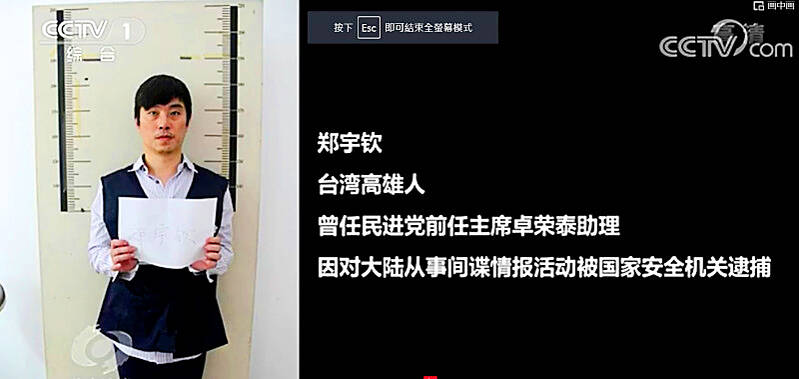
Former Czech Republic-based Taiwanese researcher Cheng Yu-chin (鄭宇欽) has been sentenced to seven years in prison on espionage-related charges, China’s Ministry of State Security announced yesterday. China said Cheng was a spy for Taiwan who “masqueraded as a professor” and that he was previously an assistant to former Cabinet secretary-general Cho Jung-tai (卓榮泰). President-elect William Lai (賴清德) on Wednesday last week announced Cho would be his premier when Lai is inaugurated next month. Today is China’s “National Security Education Day.” The Chinese ministry yesterday released a video online showing arrests over the past 10 years of people alleged to be
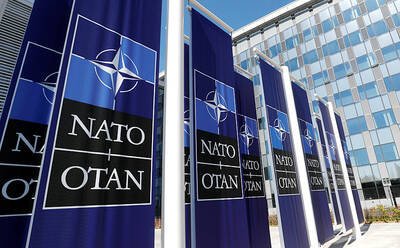
THE HAWAII FACTOR: While a 1965 opinion said an attack on Hawaii would not trigger Article 5, the text of the treaty suggests the state is covered, the report says NATO could be drawn into a conflict in the Taiwan Strait if Chinese forces attacked the US mainland or Hawaii, a NATO Defense College report published on Monday says. The report, written by James Lee, an assistant research fellow at Academia Sinica’s Institute of European and American Studies, states that under certain conditions a Taiwan contingency could trigger Article 5 of NATO, under which an attack against any member of the alliance is considered an attack against all members, necessitating a response. Article 6 of the North Atlantic Treaty specifies that an armed attack in the territory of any member in Europe,

LIKE FAMILY: People now treat dogs and cats as family members. They receive the same medical treatments and tests as humans do, a veterinary association official said The number of pet dogs and cats in Taiwan has officially outnumbered the number of human newborns last year, data from the Ministry of Agriculture’s pet registration information system showed. As of last year, Taiwan had 94,544 registered pet dogs and 137,652 pet cats, the data showed. By contrast, 135,571 babies were born last year. Demand for medical care for pet animals has also risen. As of Feb. 29, there were 5,773 veterinarians in Taiwan, 3,993 of whom were for pet animals, statistics from the Animal and Plant Health Inspection Agency showed. In 2022, the nation had 3,077 pediatricians. As of last

XINJIANG: Officials are conducting a report into amending an existing law or to enact a special law to prohibit goods using forced labor Taiwan is mulling an amendment prohibiting the importation of goods using forced labor, similar to the Uyghur Forced Labor Prevention Act (UFLPA) passed by the US Congress in 2021 that imposed limits on goods produced using forced labor in China’s Xinjiang region. A government official who wished to remain anonymous said yesterday that as the US customs law explicitly prohibits the importation of goods made using forced labor, in 2021 it passed the specialized UFLPA to limit the importation of cotton and other goods from China’s Xinjiang Uyghur region. Taiwan does not have the legal basis to prohibit the importation of goods


 RSS
RSS