


Taipei Times: Before you set off for Hong Kong last year, you mentioned that there are misunderstandings between Hong Kong and Taiwan. What are these misunderstandings?
Ping Lu: (
The people of Hong Kong say Taiwan's democracy is a source of many chaotic scenes. Taiwan does not have many high-rise buildings and is not a sufficiently modernized place. Taiwan is messy and mundane, they say.

TAIPEI TIMES FILE PHOTO
But if they look deeper into Taiwan, they will discover more layers to its society. Taiwan is a civil society. Traces of this civil society can be perceived in coffee shops, a community schools or parks.
Hong Kong has yet to conceive concepts of communities and a civil society.
The Taiwanese also hold mis-understandings toward the people of Hong Kong. They say their only goal is to make money and that they don't have any culture.
But Taiwanese do not quite understand the professionalism of the people of Hong Kong and its law-binding society. Hong Kongers trust the bar more than their government.
It's really a shame that Taiwan and Hong Kong, being so close to each other, have so little understanding of each other.
TT: What have you done to boost Taiwan and Hong Kong's mutual understanding since you took office?
Ping: Building the two sides' mutual understanding is an accumulative process. I have introduced to Hong Kong Taiwan's culture, particularly its democratic experience.
The Kwang Hwa Information and Culture Center has held a number of forums that Taiwanese academics have joined in with. We have discussed the differences in the Hakka culture and the Apple Daily newspaper in Taiwan and Hong Kong.
TT: Do you agree with the observation that the people of Hong Kong don't care about politics as long as they make money?
Ping: There is nobody that does not care about politics. Politics is related to everybody's life. Taiwan has a good democratic process but Hong Kong doesn't. The people of Hong Kong have few opportunities to get involved in politics and they don't have the right institutions and processes to express their interest in politics.
TT: Do you think the people of Hong Kong have changed their opinions on politics and democracy since the 1997 handover and the July 1 demonstration [when 500,000 people took to the streets to protest an anti-subversion bill]?
Ping: The July 1 demonstration was very significant. The people of Hong Kong felt empowered because of the demonstration. [Hong Kong] Chief Executive Tung Chee-hwa (
The public took action and it got results. The July 1 demonstration was quite different from the 1989 protests against the Tiananmen Square massacre. Nothing happened after the protests in 1989.
However, in the aftermath of the July 1 demonstration, what's more important is how to channel the energy accumulated during the event to the right institution to produce democratic results.
In Taiwan, all demonstrations -- be they of a political nature or aimed at bringing about social changes -- are able to channel their energies into the right institutions to maximize their efforts.
But Hong Kong doesn't have such a mechanism.
TT: Do you think the gruesome and even bloody effects of the push for democratic change in Taiwan during the 1950s and the 1960s are likely to happen in Hong Kong as its people strive for democracy?
Ping: Democratic movements exist in different forms. Each individual society has its own process of democratization.
Taiwan has gone from a government patronized by one party to a rotation of ruling parties. Now, Hong Kong's democratic aim is that the Chief Executive and all members of the Legislative Council be elected by universal suffrage.
Hopefully Hong Kong can achieve that. Taiwan and Hong Kong have taken different paths, but the paths lead to the same destination.
The foundation stone of democracy is a civil society. The power of democratic change can spread to various corners and propel social reforms. Such power is still invisible in Hong Kong.
TT: Some observers say Taiwan's younger generation grows more like Hong Kong's because they only care about making money and are apathetic toward politics. Do you agree with this observation?
Ping: I don't thing the people of Hong Kong are apathetic toward politics, they just don't have the opportunities to get involved in it. I don't think Taiwan's younger generation is apathetic toward politics, either.
Taiwan is heading toward a more delicate democracy, where more legality in the democratic processes will be demanded.
Perhaps Taiwan's younger generation is not as passionate as their predecessors. But I have seen young lawyers and activists who care very much about what's happening in society's corners.
TT: During a recent international conference discussing Hong Kong under Beijing's "one country, two systems" formula, Hong Kong delegates said they believed democracy is still possible in the region under the formula. According to your observation of the political atmosphere in Hong Kong, do you agree with what they said?
Ping: Hong Kong could be the place to which China directs the mainlands political tensions. China can learn about democracy from Hong Kong. Hong Kong will play a very important role in China's democratization process.
TT: Can the degree of democracy China allows to happen in Hong Kong be an indicator of the levels of democratization China might achieve in the future?
Ping: No. But hopefully the democracy in Hong Kong can hasten mainland democratization. I believe it is inevitable that China will become a democracy.
If Hong Kong accelerates China's democratization, it will have contributed a lot to Asia's stability.
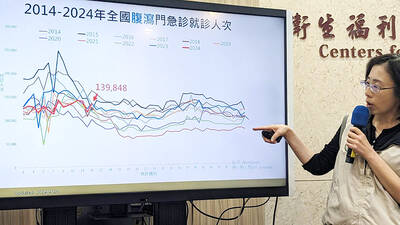
FLU SEASON: Twenty-six severe cases were reported from Tuesday last week to Monday, including a seven-year-old girl diagnosed with influenza-associated encephalopathy Nearly 140,000 people sought medical assistance for diarrhea last week, the Centers for Disease Control (CDC) said on Tuesday. From April 7 to Saturday last week, 139,848 people sought medical help for diarrhea-related illness, a 15.7 percent increase from last week’s 120,868 reports, CDC Epidemic Intelligence Center Deputy Director Lee Chia-lin (李佳琳) said. The number of people who reported diarrhea-related illness last week was the fourth highest in the same time period over the past decade, Lee said. Over the past four weeks, 203 mass illness cases had been reported, nearly four times higher than the 54 cases documented in the same period
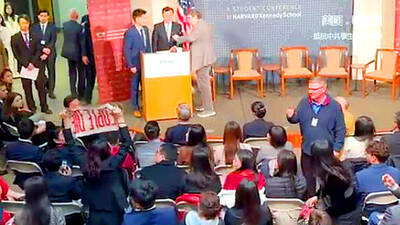
A group of Taiwanese-American and Tibetan-American students at Harvard University on Saturday disrupted Chinese Ambassador to the US Xie Feng’s (謝鋒) speech at the school, accusing him of being responsible for numerous human rights violations. Four students — two Taiwanese Americans and two from Tibet — held up banners inside a conference hall where Xie was delivering a speech at the opening ceremony of the Harvard Kennedy School China Conference 2024. In a video clip provided by the Coalition of Students Resisting the CCP (Chinese Communist Party), Taiwanese-American Cosette Wu (吳亭樺) and Tibetan-American Tsering Yangchen are seen holding banners that together read:
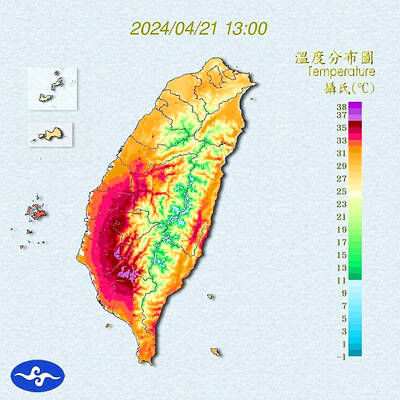
Heat advisories were in effect for nine administrative regions yesterday afternoon as warm southwesterly winds pushed temperatures above 38°C in parts of southern Taiwan, the Central Weather Administration (CWA) said. As of 3:30pm yesterday, Tainan’s Yujing District (玉井) had recorded the day’s highest temperature of 39.7°C, though the measurement will not be included in Taiwan’s official heat records since Yujing is an automatic rather than manually operated weather station, the CWA said. Highs recorded in other areas were 38.7°C in Kaohsiung’s Neimen District (內門), 38.2°C in Chiayi City and 38.1°C in Pingtung’s Sandimen Township (三地門), CWA data showed. The spell of scorching

UNAWARE: Many people sit for long hours every day and eat unhealthy foods, putting them at greater risk of developing one of the ‘three highs,’ an expert said More than 30 percent of adults aged 40 or older who underwent a government-funded health exam were unaware they had at least one of the “three highs” — high blood pressure, high blood lipids or high blood sugar, the Health Promotion Administration (HPA) said yesterday. Among adults aged 40 or older who said they did not have any of the “three highs” before taking the health exam, more than 30 percent were found to have at least one of them, Adult Preventive Health Examination Service data from 2022 showed. People with long-term medical conditions such as hypertension or diabetes usually do not


 RSS
RSS