


The introduction of integrated circuit (IC) national health insurance cards will seriously damage privacy and human rights because the government cannot prove the system is safe, human-rights groups said yesterday.
"Employers, drug manufacturers, insurance companies, government departments, even intelligence agencies, would be able to easily access personal and private information if the policy is put into place," said the Personal Information Protection Alliance (PIPA), an association founded by 56 groups.
The government began validating IC national health insurance cards on July 1 and plans to completely phase out paper ones by Jan. 1.
"The biggest problem with this policy is that the public was not able to participate in the decision-making process or have a say in this," said Ivory Lin (
People should have the right to decide what kind of personal data will be put on the chip, Lin said.
"But they don't. I really cannot see where the government's concerns for human rights are," Lin said. "I think I have the right not to let others, except the doctor, know when my last period was when I visit an obstetrics clinic."
Technical problems will also hamper the introduction of the new system, PIPA said.
"Errors may happen when millions of pieces of personal information are inscribed on the chips," warned Chuang Tyng-ruey (
"Many patients' medical records have leaked out from hospitals in the past," Chuang said. "It's hard to imagine what will happen next year when the control mechanism is so loosely constructed."
Computer networks linking hospitals would face attacks by computer viruses and hackers would try to break into the system despite the protection of firewalls, PIPA said.
"We have met with government agencies to discuss this several times. We even sent letters to President Chen [Shui-bian] (陳水扁), Vice President [Annette] Lu (呂秀蓮) and Premier Yu Shyi-kun, but there has been no positive response from them," said Serena Chuang (莊紀婷), international affairs director of the Taiwan Association for Human Rights.
PIPA urged the government to postpone the IC card plan while doubts linger over the security of the system.

Former president Ma Ying-jeou’s (馬英九) mention of Taiwan’s official name during a meeting with Chinese President Xi Jinping (習近平) on Wednesday was likely a deliberate political play, academics said. “As I see it, it was intentional,” National Chengchi University Graduate Institute of East Asian Studies professor Wang Hsin-hsien (王信賢) said of Ma’s initial use of the “Republic of China” (ROC) to refer to the wider concept of “the Chinese nation.” Ma quickly corrected himself, and his office later described his use of the two similar-sounding yet politically distinct terms as “purely a gaffe.” Given Ma was reading from a script, the supposed slipup
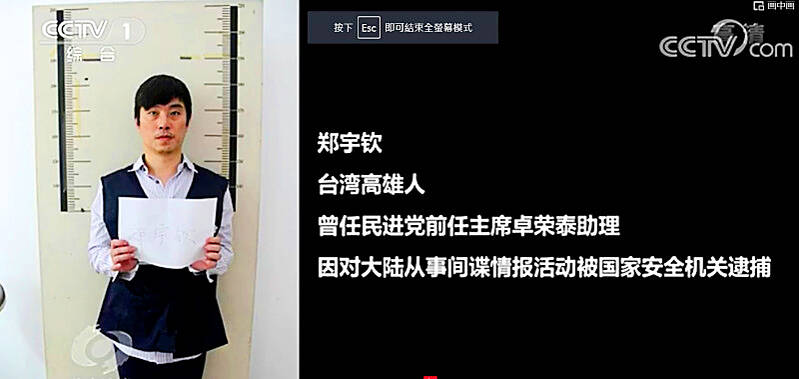
Former Czech Republic-based Taiwanese researcher Cheng Yu-chin (鄭宇欽) has been sentenced to seven years in prison on espionage-related charges, China’s Ministry of State Security announced yesterday. China said Cheng was a spy for Taiwan who “masqueraded as a professor” and that he was previously an assistant to former Cabinet secretary-general Cho Jung-tai (卓榮泰). President-elect William Lai (賴清德) on Wednesday last week announced Cho would be his premier when Lai is inaugurated next month. Today is China’s “National Security Education Day.” The Chinese ministry yesterday released a video online showing arrests over the past 10 years of people alleged to be
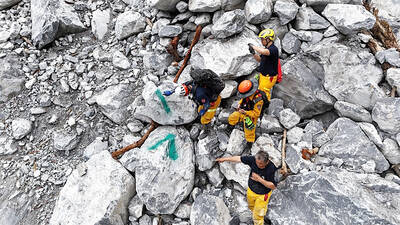
The bodies of two individuals were recovered and three additional bodies were discovered on the Shakadang Trail (砂卡礑) in Taroko National Park, eight days after the devastating earthquake in Hualien County, search-and-rescue personnel said. The rescuers reported that they retrieved the bodies of a man and a girl, suspected to be the father and daughter from the Yu (游) family, 500m from the entrance of the trail on Wednesday. The rescue team added that despite the discovery of the two bodies on Friday last week, they had been unable to retrieve them until Wednesday due to the heavy equipment needed to lift
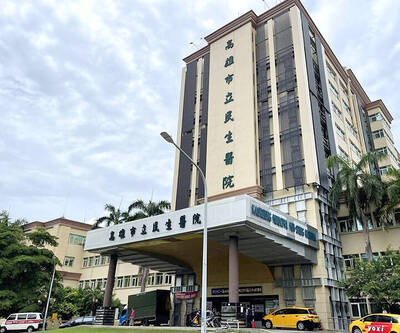
MIX-UP: Kaohsiung Municipal Min-Sheng Hospital director Yen Chia-chi was suspended from his duties after surgeons operated on the wrong patient last week The Kaohsiung Department of Health yesterday fined Kaohsiung Municipal Min-Sheng Hospital NT$500,0000 for misidentifying two patients and consequently causing one of them to undergo the wrong surgery last week. The hospital’s director Yen Chia-chi (顏家祺) was suspended from his duties. The surgeon who was scheduled to operate on the patient was given a major demerit and is subject to subsequent disciplinary actions. Demerits were given to the anesthesiologist, the nurse in the operation room, the nurse in the ward and the worker who helped transfer the patient from the ward to the operation room for having failed to verify the patient’s identity. Meanwhile, the


 RSS
RSS