


A high-level delegation headed by Presidential Office Secretary-General Chiou I-jen (
The Chen Shui-bian (
The delegation kept a low profile and scrupulously avoided the press during the visit. Both sides had wanted to keep the trip secret but it was leaked to the press earlier this week.
While neither side would give any details, Randall Schriver, the deputy assistant secretary of state for East Asian and Pacific Affairs, indicated that the referendum issue was one of the topics discussed.
"It's something we know is a very sensitive topic, and it's something that we are watching. And we're willing to hear from the Taiwan side why they think it's important," Schriver told Taiwanese reporters who approached him after he made a public appearance Thursday morning.
Shriver said the referendum decision "is a decision that Taiwan is going to have to make for itself. But I think in terms of the way it's been debated in public in Taiwan, we haven't seen a real compelling need" to conduct the referendums that Chen is currently considering.
"It's been domestic politics, maybe that's what's driving it. If so, it's not necessarily something that we have to proactively support," Schriver said.
However, Schriver declined to discuss any of the other issues that might have come up during the talks with the Chiou delegation.
Washington's reaction to the referendum issue is linked in the eyes of some observers to the arms purchases and Taiwan's overall security posture.
As some US officials see it, Taiwan should not proceed with referendums, which are potentially provocative to China, without assuring its own defensive capability to deal with Beijing's reaction to such provocations, sources said.
The intellectual property rights issue has been a long-standing source of irritation in Washington, which has suspended high-level trade visits between the two capitals in view of the lack of progress by Taipei in halting the illegal copying and distribution of videos, music and other intellectual property.
The delegation was scheduled to meet with Deputy Secretary of State Richard Armitage, Assistant Secretary of State James Kelly and Deputy Secretary of Defense Paul Wolfowitz.
It was also believed that Stephen Hadley, National Security Advisor Condoleezza Rice's deputy, was on the list. But it was not known which US trade officials the Taiwanese met.
The group also met with members of the Brookings Institution, Heritage Foundation, Carnegie Endowment for International Peace and other think tanks.
Yesterday, two of the delegation members, Vice Minister of Foreign Affairs Michael Kau and National Security Council Deputy Secretary-General Ko Cheng-heng (
Officials from the Pentagon, State Department, National Security Council and American Institute in Taiwan will also take part. Other members of the Taiwanese delegation are DPP foreign affairs chief and legislator Hsiao Bi-khim (
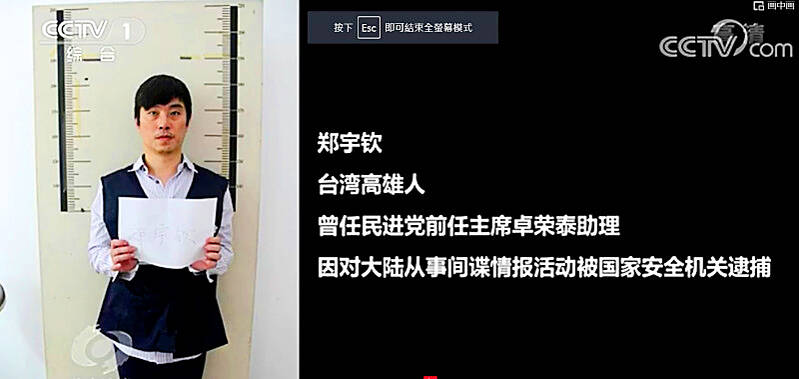
Former Czech Republic-based Taiwanese researcher Cheng Yu-chin (鄭宇欽) has been sentenced to seven years in prison on espionage-related charges, China’s Ministry of State Security announced yesterday. China said Cheng was a spy for Taiwan who “masqueraded as a professor” and that he was previously an assistant to former Cabinet secretary-general Cho Jung-tai (卓榮泰). President-elect William Lai (賴清德) on Wednesday last week announced Cho would be his premier when Lai is inaugurated next month. Today is China’s “National Security Education Day.” The Chinese ministry yesterday released a video online showing arrests over the past 10 years of people alleged to be
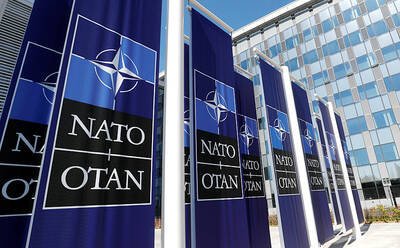
THE HAWAII FACTOR: While a 1965 opinion said an attack on Hawaii would not trigger Article 5, the text of the treaty suggests the state is covered, the report says NATO could be drawn into a conflict in the Taiwan Strait if Chinese forces attacked the US mainland or Hawaii, a NATO Defense College report published on Monday says. The report, written by James Lee, an assistant research fellow at Academia Sinica’s Institute of European and American Studies, states that under certain conditions a Taiwan contingency could trigger Article 5 of NATO, under which an attack against any member of the alliance is considered an attack against all members, necessitating a response. Article 6 of the North Atlantic Treaty specifies that an armed attack in the territory of any member in Europe,
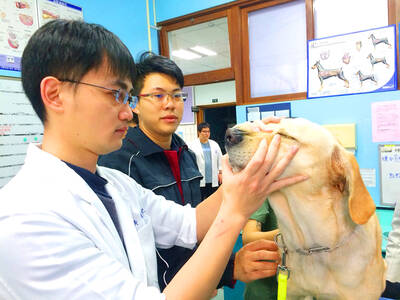
LIKE FAMILY: People now treat dogs and cats as family members. They receive the same medical treatments and tests as humans do, a veterinary association official said The number of pet dogs and cats in Taiwan has officially outnumbered the number of human newborns last year, data from the Ministry of Agriculture’s pet registration information system showed. As of last year, Taiwan had 94,544 registered pet dogs and 137,652 pet cats, the data showed. By contrast, 135,571 babies were born last year. Demand for medical care for pet animals has also risen. As of Feb. 29, there were 5,773 veterinarians in Taiwan, 3,993 of whom were for pet animals, statistics from the Animal and Plant Health Inspection Agency showed. In 2022, the nation had 3,077 pediatricians. As of last
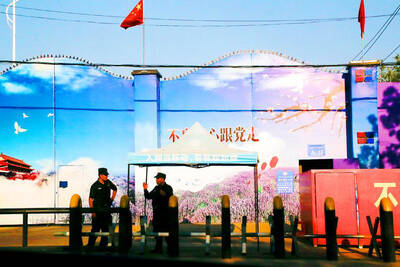
XINJIANG: Officials are conducting a report into amending an existing law or to enact a special law to prohibit goods using forced labor Taiwan is mulling an amendment prohibiting the importation of goods using forced labor, similar to the Uyghur Forced Labor Prevention Act (UFLPA) passed by the US Congress in 2021 that imposed limits on goods produced using forced labor in China’s Xinjiang region. A government official who wished to remain anonymous said yesterday that as the US customs law explicitly prohibits the importation of goods made using forced labor, in 2021 it passed the specialized UFLPA to limit the importation of cotton and other goods from China’s Xinjiang Uyghur region. Taiwan does not have the legal basis to prohibit the importation of goods


 RSS
RSS