


A referendum on legislative reform could prod lawmakers into reviving a government pledge made in 2001 that all parties support, a political analyst said.
Two DPP lawmakers last week suggested adding the referendum to two others -- on the the Fourth Nuclear Power Plant and membership of the World Health Organization -- which the government is planning to hold on presidential election day next March.
A vote in favor of legislative reform would create enormous pressure on lawmakers who have been lazy in honoring their commitments, said Hsu Yung-ming (徐永明), assistant research fellow at the Academia Sinica.
Hsu said it was unlikely that lawmakers would speed up reform of the Legislative Yuan in the next few months without an catalyst such as the referendum since the task required amending the Constitution.
"Because the number of legislature seats is stipulated in the ROC Constitution, the country cannot realize the goal of legislative reform until the revisions are confirmed by a special session of the National Assembly," Hsu explained.
He said a referendum, especially if it is conducted according to a yet-to-be-passed referendum law, would help kickstart the stalled reforms.
A consensus to reform the legislature was reached by the major parties when they decided to abolish the National Assembly in 2000 and was endorsed by a majority of legislators in the 2001 legislative election.
A campaign initiated by the Action Alliance for the Reform of the Legislature (改造國會行動聯盟) attracted the signatures of 179 lawmakers who pledged that they would press for the reforms in the Legislative Yuan.
The alliance, comprising scholarly groups and societies, advocates reducing the number of seats in the legislature, changing the way legislators are elected and extending legislative terms to four years.
By the time lawmakers started their summer recess in June, the legislature had made little progress in setting up a special committee to decide on the details of the reform plan.
"The stalled program proves that it is impossible for legislators to do something that would deprive them of their power and interests even though so many of them pledged to carry out the reforms in 2001," said DPP Legislator Yeh Yi-jin (葉宜津).
The measures have been held up by disputes over how many lawmakers the legislature should have and on how the special legislative committee should be set up.
The DPP, which Hsu described as the driving force behind the reforms, wants to reduce the minimum number of lawmakers needed to vote to convene the special committee to less than half.
The DPP and its pan-green ally TSU suggested that the committee should convene upon request of one-fifth, or 45, of the lawmakers.
The ruling party advocates downsizing the legislature to 150 seats and using a "single-member district, two vote" election system.
A poll conducted by a group of pro-independence academics demonstrated public support for DPP plan to hold a referendum on legislative reform.
The results of the poll, conducted by the Taiwan Professors Association (台灣教授協會) and released on July 6, showed that 67 percent of respondents agreed on the need for the referendum, while 74 percent supported halving the number of lawmakers.
Sixty percent of the 1,080 people interviewed agreed with the ruling party's plans for legislative reform.
The KMT, although it differs from the DPP regarding the special legislative committee, said it endorses the reform plans.
"The KMT supports legislative reform," said KMT legislative whip Tseng Yung-chuan (曾永權).
Tseng said the party agreed with halving the number of legislative seats and that the KMT might initiate a legislative petition to get the reform program started.
But Hsu said the pan-blue camp might merely be trying to avoid future criticism from the pan-green camp.
"The remarks, at most, could be interpreted as a pan-blue tactic for the upcoming presidential election," Hsu said.
"A brutal battle between members of the KMT-PFP alliance to be nominated to run for a 225-seat legislature next year is already foreseeable. It goes without saying that the competition would become even more intense once the legislature becomes a 113-seat body," Hsu said.
But he remained optimistic about the effect a referendum could have on the reform movement.
"The price of ignoring the conclusions of a referendum would be extremely high. Neither a ruling nor opposition party would recklessly disregard the public consensus," he said.

Former president Ma Ying-jeou’s (馬英九) mention of Taiwan’s official name during a meeting with Chinese President Xi Jinping (習近平) on Wednesday was likely a deliberate political play, academics said. “As I see it, it was intentional,” National Chengchi University Graduate Institute of East Asian Studies professor Wang Hsin-hsien (王信賢) said of Ma’s initial use of the “Republic of China” (ROC) to refer to the wider concept of “the Chinese nation.” Ma quickly corrected himself, and his office later described his use of the two similar-sounding yet politically distinct terms as “purely a gaffe.” Given Ma was reading from a script, the supposed slipup
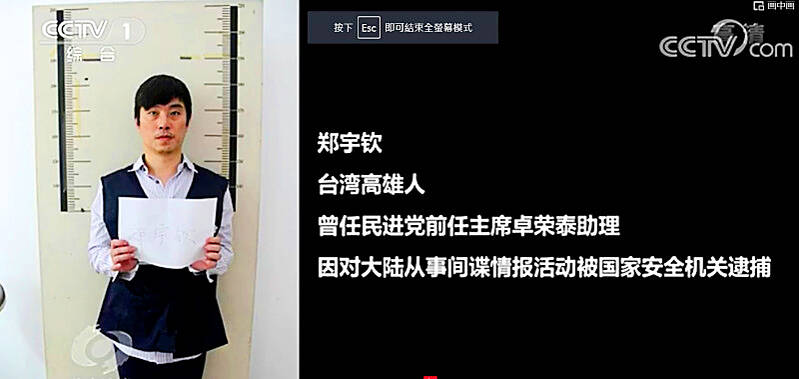
Former Czech Republic-based Taiwanese researcher Cheng Yu-chin (鄭宇欽) has been sentenced to seven years in prison on espionage-related charges, China’s Ministry of State Security announced yesterday. China said Cheng was a spy for Taiwan who “masqueraded as a professor” and that he was previously an assistant to former Cabinet secretary-general Cho Jung-tai (卓榮泰). President-elect William Lai (賴清德) on Wednesday last week announced Cho would be his premier when Lai is inaugurated next month. Today is China’s “National Security Education Day.” The Chinese ministry yesterday released a video online showing arrests over the past 10 years of people alleged to be

THE HAWAII FACTOR: While a 1965 opinion said an attack on Hawaii would not trigger Article 5, the text of the treaty suggests the state is covered, the report says NATO could be drawn into a conflict in the Taiwan Strait if Chinese forces attacked the US mainland or Hawaii, a NATO Defense College report published on Monday says. The report, written by James Lee, an assistant research fellow at Academia Sinica’s Institute of European and American Studies, states that under certain conditions a Taiwan contingency could trigger Article 5 of NATO, under which an attack against any member of the alliance is considered an attack against all members, necessitating a response. Article 6 of the North Atlantic Treaty specifies that an armed attack in the territory of any member in Europe,
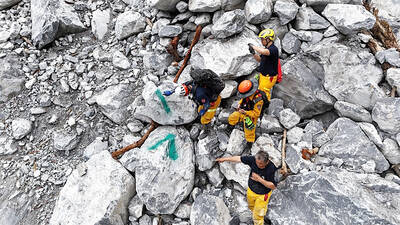
The bodies of two individuals were recovered and three additional bodies were discovered on the Shakadang Trail (砂卡礑) in Taroko National Park, eight days after the devastating earthquake in Hualien County, search-and-rescue personnel said. The rescuers reported that they retrieved the bodies of a man and a girl, suspected to be the father and daughter from the Yu (游) family, 500m from the entrance of the trail on Wednesday. The rescue team added that despite the discovery of the two bodies on Friday last week, they had been unable to retrieve them until Wednesday due to the heavy equipment needed to lift


 RSS
RSS