


President Chen Shui-bian's (陳水扁) pledge to hold a national referendum could be seen as a move to advance the kind of direct democracy that had been obstructed by former KMT administrations, political analysts say. But, they add, the result of a referendum on the Fourth Nuclear Power Plant issue may not benefit Chen in the upcoming presidential campaign.
"The DPP says that, according to its public opinion surveys, nearly 60 percent of the people in this country support a referendum on the nuclear power plant issue as a means of solving the controversy that has lasted two decades," said Hu Wen-huei (胡文輝), a political columnist and senior journalist. "The question is whether the DPP's stance of abandoning the plant's construction can get enough support from the people."
"If over half of the people vote to continue the construction of the plant, it means that the DPP has followed the wrong policy. That would give the opposition parties more opportunities to attack the DPP government's incompetence," Hu said.
If the DPP wins the referendum, then it has to face a series of follow-up controversies that includes proposing a new energy project to replace the nuclear plant, finding a way to ensure the working rights of the power plant's employees and figuring out how to reorganize the government's annual budget, Hu said.
Hu stressed that the DPP's strategy to conduct a referendum on the issue seems to have successfully moved to the forefront of the political agenda and even forced the opposition parties to stand on Chen's side and support the idea of a plebiscite -- for the time being. But, Hu warned, Chen will have to face possible negative aftereffects if the government goes ahead and holds a plebiscite.
Ku Chung-hua (顧忠華), president of the Taipei Society and political professor at the National Chengchi University, said that the public is concerned about whether the controversial referendum issue will again harm the economic recovery.
"The nuclear power plant issue has bothered the country's development and caused controversy almost every year in the past two decades," said Ku. "So the referendum, which now all political parties express support for, can be regarded as a proper way to solve the problem once and for all."
Ku said that since the DPP has vowed to accept the responsibilities and risks of holding a referendum, the public can see it as a positive sign that Taiwan is finally enjoying direct democracy.
A close aide to the president has admitted that Chen made his referendum pledge due to pressure from former DPP chairman Lin Ying-hsiung (林義雄), who has spent a lifetime advocating the abolition of nuclear power. So, the aide said, and no matter how the referendum turns out, the point is that the president must demonstrate his resolution to facilitate Lin's wish.
"To realize his promise to Lin to solve the issue of the Fourth Nuclear Power Plant, President Chen has for a long time seriously considered holding a national referendum. The World Health Organization issue, in which China again demonstrated its rudeness by obstructing Taiwan's participation in the international community, gave the president an opportunity," the aide said.
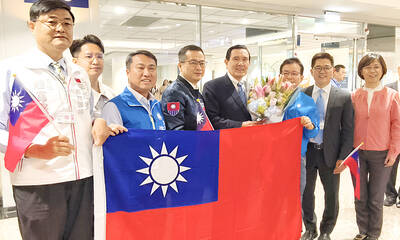
Former president Ma Ying-jeou’s (馬英九) mention of Taiwan’s official name during a meeting with Chinese President Xi Jinping (習近平) on Wednesday was likely a deliberate political play, academics said. “As I see it, it was intentional,” National Chengchi University Graduate Institute of East Asian Studies professor Wang Hsin-hsien (王信賢) said of Ma’s initial use of the “Republic of China” (ROC) to refer to the wider concept of “the Chinese nation.” Ma quickly corrected himself, and his office later described his use of the two similar-sounding yet politically distinct terms as “purely a gaffe.” Given Ma was reading from a script, the supposed slipup
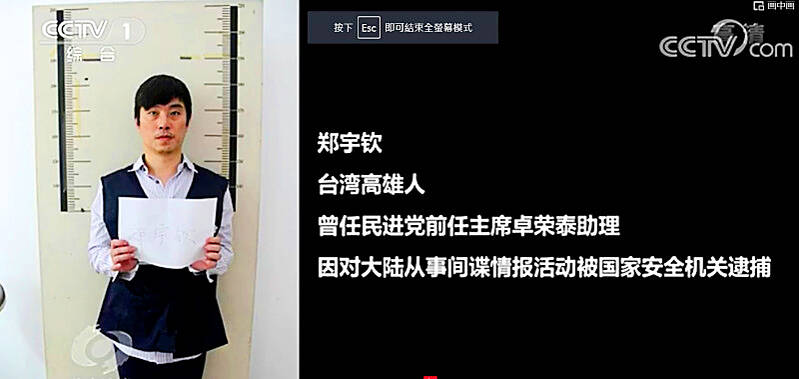
Former Czech Republic-based Taiwanese researcher Cheng Yu-chin (鄭宇欽) has been sentenced to seven years in prison on espionage-related charges, China’s Ministry of State Security announced yesterday. China said Cheng was a spy for Taiwan who “masqueraded as a professor” and that he was previously an assistant to former Cabinet secretary-general Cho Jung-tai (卓榮泰). President-elect William Lai (賴清德) on Wednesday last week announced Cho would be his premier when Lai is inaugurated next month. Today is China’s “National Security Education Day.” The Chinese ministry yesterday released a video online showing arrests over the past 10 years of people alleged to be
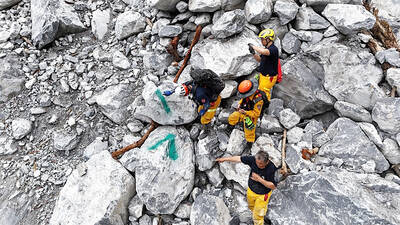
The bodies of two individuals were recovered and three additional bodies were discovered on the Shakadang Trail (砂卡礑) in Taroko National Park, eight days after the devastating earthquake in Hualien County, search-and-rescue personnel said. The rescuers reported that they retrieved the bodies of a man and a girl, suspected to be the father and daughter from the Yu (游) family, 500m from the entrance of the trail on Wednesday. The rescue team added that despite the discovery of the two bodies on Friday last week, they had been unable to retrieve them until Wednesday due to the heavy equipment needed to lift
THE HAWAII FACTOR: While a 1965 opinion said an attack on Hawaii would not trigger Article 5, the text of the treaty suggests the state is covered, the report says NATO could be drawn into a conflict in the Taiwan Strait if Chinese forces attacked the US mainland or Hawaii, a NATO Defense College report published on Monday says. The report, written by James Lee, an assistant research fellow at Academia Sinica’s Institute of European and American Studies, states that under certain conditions a Taiwan contingency could trigger Article 5 of NATO, under which an attack against any member of the alliance is considered an attack against all members, necessitating a response. Article 6 of the North Atlantic Treaty specifies that an armed attack in the territory of any member in Europe,


 RSS
RSS