


An air force flight instructor who wanted to punish his student caused the jet fighter they were flying to crash, defense sources said yesterday.
The flight instructor on the locally made, twin-seat Indigenous Defense Fighter (IDF), Major Wang Chu-hsiang (
The maneuvers rendered Sung unable to take over the controls again, forcing the plane to spin out of control.
Wang and Sung ejected to safety before the plane crashed.
Wang wept at a press conference after the crash, but claimed that the plane suddenly went out of control and that they had no choice but to abandon it.
According to the sources, Wang was telling only half the truth and should be held responsible for causing the accident. Wang's unnecessary harshness was a result of problems with his mental state, the sources said.
Wang has been suspended from all flight activities and could be barred from flying again.
Some air force officials, who argue that the instructor's willful action has caused the air force to lose a fighter plane worth more than NT$1 billion, consider the punishment to be too light.
But others fear that a harsher punishment might cause flight instructors to be scared of being tough on trainees in the future.
An analyst said that the air force has many such pilots who have great confidence in their flying skills and are never willing to admit to their mistakes.
Several years ago, a civil passenger plane, which crashed when trying to land at the CKS airport in Taoyuan, was flown by a retired air force pilot who was overconfident in his abilities, said the analyst, who wished to remain anonymous.
The crash could have been avoided if the pilot had followed instructions from the control tower of the airport to come around for a second landing attempt, he said.
"The pilot insisted on landing the plane under unfavorable conditions. He seemed to be too confident of himself. But the consequence of such overconfidence was the loss of the lives of hundreds of passengers," he said.
"The pilot came from the air force, where he learned good flying skills but poor flight safety concepts," he said.
The crash of the IDF tarnished the safety record of the domestically-built fighter. Before the incident, the IDF fleet had lost only one plane through crashes.
Even so, the IDF still has a better safety record that the air force's US-made F-16 A/B and French-made Mirage 2000-5.
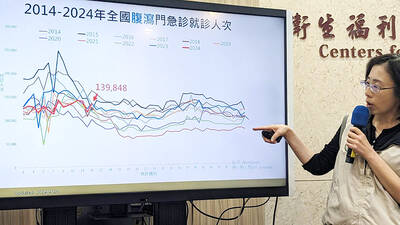
FLU SEASON: Twenty-six severe cases were reported from Tuesday last week to Monday, including a seven-year-old girl diagnosed with influenza-associated encephalopathy Nearly 140,000 people sought medical assistance for diarrhea last week, the Centers for Disease Control (CDC) said on Tuesday. From April 7 to Saturday last week, 139,848 people sought medical help for diarrhea-related illness, a 15.7 percent increase from last week’s 120,868 reports, CDC Epidemic Intelligence Center Deputy Director Lee Chia-lin (李佳琳) said. The number of people who reported diarrhea-related illness last week was the fourth highest in the same time period over the past decade, Lee said. Over the past four weeks, 203 mass illness cases had been reported, nearly four times higher than the 54 cases documented in the same period

A group of Taiwanese-American and Tibetan-American students at Harvard University on Saturday disrupted Chinese Ambassador to the US Xie Feng’s (謝鋒) speech at the school, accusing him of being responsible for numerous human rights violations. Four students — two Taiwanese Americans and two from Tibet — held up banners inside a conference hall where Xie was delivering a speech at the opening ceremony of the Harvard Kennedy School China Conference 2024. In a video clip provided by the Coalition of Students Resisting the CCP (Chinese Communist Party), Taiwanese-American Cosette Wu (吳亭樺) and Tibetan-American Tsering Yangchen are seen holding banners that together read:
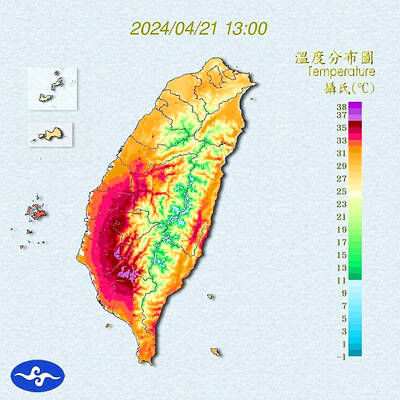
Heat advisories were in effect for nine administrative regions yesterday afternoon as warm southwesterly winds pushed temperatures above 38°C in parts of southern Taiwan, the Central Weather Administration (CWA) said. As of 3:30pm yesterday, Tainan’s Yujing District (玉井) had recorded the day’s highest temperature of 39.7°C, though the measurement will not be included in Taiwan’s official heat records since Yujing is an automatic rather than manually operated weather station, the CWA said. Highs recorded in other areas were 38.7°C in Kaohsiung’s Neimen District (內門), 38.2°C in Chiayi City and 38.1°C in Pingtung’s Sandimen Township (三地門), CWA data showed. The spell of scorching

UNAWARE: Many people sit for long hours every day and eat unhealthy foods, putting them at greater risk of developing one of the ‘three highs,’ an expert said More than 30 percent of adults aged 40 or older who underwent a government-funded health exam were unaware they had at least one of the “three highs” — high blood pressure, high blood lipids or high blood sugar, the Health Promotion Administration (HPA) said yesterday. Among adults aged 40 or older who said they did not have any of the “three highs” before taking the health exam, more than 30 percent were found to have at least one of them, Adult Preventive Health Examination Service data from 2022 showed. People with long-term medical conditions such as hypertension or diabetes usually do not


 RSS
RSS