


In view of the recent outcry over PFP Legislator Kao Ming-chien's (高明見) attendance at a WHO-organized SARS conference in Kuala Lumpur last week on the recommendation of China, political observers said that Beijing's latest attempt to belittle Taiwan have once again proved counterproductive.
Rather than affirming its claim to the Taiwanese public that Taiwan is a part of China, Beijing ended up stoking Taiwan's resentment toward Beijing and fanning independence sentiment.
"On the outside, Beijing appeared to score points as it showed to the international community that -- by adding a Taiwanese representative onto its own recommendation list -- Taiwan is part of China," said Shane Lee (李憲榮), a professor of law and politics at Chang-jung University.
"Yet on the inside, Beijing appeared to drop points as its aroused public indignation and awoke the Taiwanese public's awareness on sovereignty and identification with Taiwan," Lee said.
Indeed, Beijing has touched a sensitive nerve regarding the debate between independence and unification.
In Taipei, a group of TSU supporters showed up in front of the PFP headquarters protesting against Kao's acceptance of China's recommendation.
And in Kaohsiung, over 500 pro-green supporters staged a protest outside the city's PFP offices charging Kao and PFP Chairman James Soong (宋楚瑜) with treason.
Echoing Lee's comments, Hung Mao-hsiung (洪茂雄), an international relations graduate research fellow at National Chengchi University, said that Beijing made the recommendation in a bid to belittle Taiwan on the international stage.
The incident also highlighted the Chinese Communist Party's true essence, "which is inflexible and harbors an an arrogance that reeks of its determination to take action regardless of consequence and how other people think and feel," Hung said.
Hung said it is China's communist mentality that prompts China to often act in ways that more often than not draw a negative response in Taiwan.
"Despite previous lessons that its oppression of Taiwan is likely to result in a strong backlash, Beijing finds it hard to refrain itself from doing so because of its communist nature," Hung said.
"Given its communist nature, Beijing, regardless of the fact that there have been increasing interacting and exchange between people on both sides of the strait, still chooses to resort to methods that hurt the feelings of people in Taiwan," Hung said. "Beijing really ought to learn to respect Taiwan's democracy."
Chang Ya-chung (
One hypothesis is that China might have the kind of bureaucracy that forces it to make these kinds of decisions, Chang said.
Chan also commented on Taiwan's peculiar political state.
"Where else in the world would you find a legislator's loyalty to the nation being questioned or presidential candidates that always have to emphasize and defend their loyalty to their nation?" Chang said.
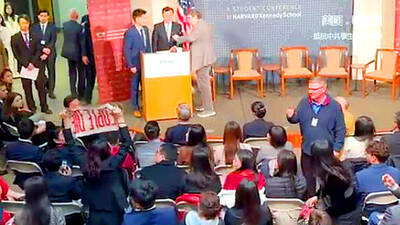
A group of Taiwanese-American and Tibetan-American students at Harvard University on Saturday disrupted Chinese Ambassador to the US Xie Feng’s (謝鋒) speech at the school, accusing him of being responsible for numerous human rights violations. Four students — two Taiwanese Americans and two from Tibet — held up banners inside a conference hall where Xie was delivering a speech at the opening ceremony of the Harvard Kennedy School China Conference 2024. In a video clip provided by the Coalition of Students Resisting the CCP (Chinese Communist Party), Taiwanese-American Cosette Wu (吳亭樺) and Tibetan-American Tsering Yangchen are seen holding banners that together read:

UNAWARE: Many people sit for long hours every day and eat unhealthy foods, putting them at greater risk of developing one of the ‘three highs,’ an expert said More than 30 percent of adults aged 40 or older who underwent a government-funded health exam were unaware they had at least one of the “three highs” — high blood pressure, high blood lipids or high blood sugar, the Health Promotion Administration (HPA) said yesterday. Among adults aged 40 or older who said they did not have any of the “three highs” before taking the health exam, more than 30 percent were found to have at least one of them, Adult Preventive Health Examination Service data from 2022 showed. People with long-term medical conditions such as hypertension or diabetes usually do not
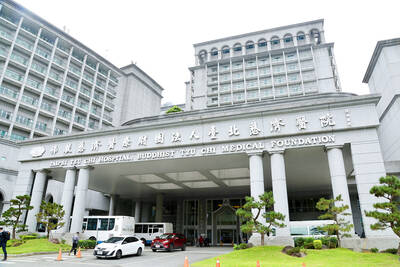
POLICE INVESTIGATING: A man said he quit his job as a nurse at Taipei Tzu Chi Hospital as he had been ‘disgusted’ by the behavior of his colleagues A man yesterday morning wrote online that he had witnessed nurses taking photographs and touching anesthetized patients inappropriately in Taipei Tzu Chi Hospital’s operating theaters. The man surnamed Huang (黃) wrote on the Professional Technology Temple bulletin board that during his six-month stint as a nurse at the hospital, he had seen nurses taking pictures of patients, including of their private parts, after they were anesthetized. Some nurses had also touched patients inappropriately and children were among those photographed, he said. Huang said this “disgusted” him “so much” that “he felt the need to reveal these unethical acts in the operating theater
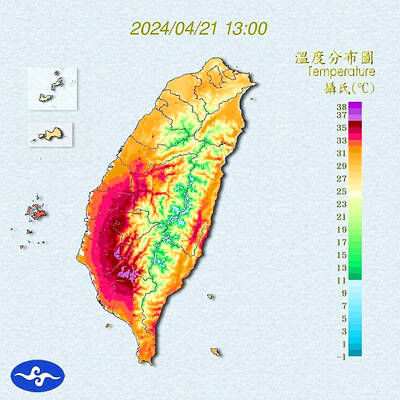
Heat advisories were in effect for nine administrative regions yesterday afternoon as warm southwesterly winds pushed temperatures above 38°C in parts of southern Taiwan, the Central Weather Administration (CWA) said. As of 3:30pm yesterday, Tainan’s Yujing District (玉井) had recorded the day’s highest temperature of 39.7°C, though the measurement will not be included in Taiwan’s official heat records since Yujing is an automatic rather than manually operated weather station, the CWA said. Highs recorded in other areas were 38.7°C in Kaohsiung’s Neimen District (內門), 38.2°C in Chiayi City and 38.1°C in Pingtung’s Sandimen Township (三地門), CWA data showed. The spell of scorching


 RSS
RSS