


The navy plans to develop a submarine-launched missile because the US refuses to sell Taiwan a similar weapon, defense sources said yesterday.
The new missile is to be developed from the Hsiung Feng-II anti-ship missile built by the military's Chun Shan Institute of Science and Technology (CSIST).
It is set to have a range of 50km. The Hsiung Feng-II has a longer range and recorded great accuracy in tests.
A naval source, who wished to remain anonymous, said the navy might be using the new missile development plan as a bargaining chip to try to convince the US to sell the same kind of weapon to the country.
"Far too many precedents have been set in similar circumstances. The military loves to ask the institute to develop weapon systems that the US refuses to sell to them. After these weapon systems have been successfully developed, the US usually agrees to sell the same stuff to us," the source said.
"Such tactics have been used again and again. Now the navy plans to use it one more time. Everyone knows that the CSIST does not have the ability to turn the Hsiung Feng-II into a submarine-launched missile," he said.
"The only way that the institute can get the job done is by buying technology from foreign countries, including the US."
To convert the Hsiung Feng-II into a submarine-launched weapon, the institute has to overcome many technical problems.
One of the first problems to be tackled is whether the missile can fit into the launch tubes of the two modern submarines that the navy bought from The Netherlands.
The Hsiung Feng-II, especially after being fitted with a booster, might be too large for the tubes.
Another big problem is how the missile will be guided after launch. It will be flying blind since the navy does not have a mid-course guidance system.
Usually, a helicopter is needed to provide such mid-course guidance for a missile of this kind, but it is logistically impossible to always have a helicopter at the ready close to wherever a submarine is deployed.
These two technical problems are enough for the institute to solve, not counting many others that have not yet been brought up for open discussion among naval personnel.
A defense official said the navy is acting correctly to plan for developing the missile since it is going to buy eight new submarines from the US.
"With new submarines, the navy is sure to demand better and more lethal underwater weapons. To effectively deter threats from China's warships, the navy needs anti-ship missiles that could be fired stealthily from underneath the surface of the sea," the official said.
"It does not matter whether the US agrees to sell the submarine-launched missile to us. If it does not sell the missile now, it will do so later," he said.
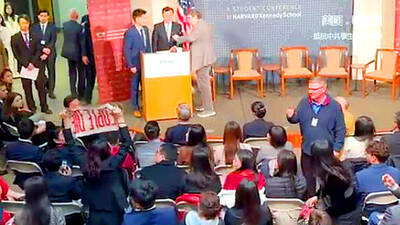
A group of Taiwanese-American and Tibetan-American students at Harvard University on Saturday disrupted Chinese Ambassador to the US Xie Feng’s (謝鋒) speech at the school, accusing him of being responsible for numerous human rights violations. Four students — two Taiwanese Americans and two from Tibet — held up banners inside a conference hall where Xie was delivering a speech at the opening ceremony of the Harvard Kennedy School China Conference 2024. In a video clip provided by the Coalition of Students Resisting the CCP (Chinese Communist Party), Taiwanese-American Cosette Wu (吳亭樺) and Tibetan-American Tsering Yangchen are seen holding banners that together read:

UNAWARE: Many people sit for long hours every day and eat unhealthy foods, putting them at greater risk of developing one of the ‘three highs,’ an expert said More than 30 percent of adults aged 40 or older who underwent a government-funded health exam were unaware they had at least one of the “three highs” — high blood pressure, high blood lipids or high blood sugar, the Health Promotion Administration (HPA) said yesterday. Among adults aged 40 or older who said they did not have any of the “three highs” before taking the health exam, more than 30 percent were found to have at least one of them, Adult Preventive Health Examination Service data from 2022 showed. People with long-term medical conditions such as hypertension or diabetes usually do not
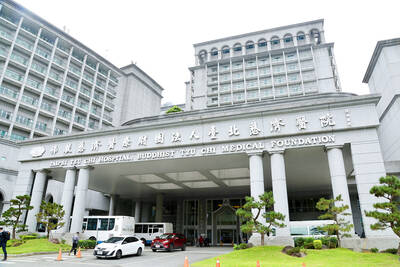
POLICE INVESTIGATING: A man said he quit his job as a nurse at Taipei Tzu Chi Hospital as he had been ‘disgusted’ by the behavior of his colleagues A man yesterday morning wrote online that he had witnessed nurses taking photographs and touching anesthetized patients inappropriately in Taipei Tzu Chi Hospital’s operating theaters. The man surnamed Huang (黃) wrote on the Professional Technology Temple bulletin board that during his six-month stint as a nurse at the hospital, he had seen nurses taking pictures of patients, including of their private parts, after they were anesthetized. Some nurses had also touched patients inappropriately and children were among those photographed, he said. Huang said this “disgusted” him “so much” that “he felt the need to reveal these unethical acts in the operating theater
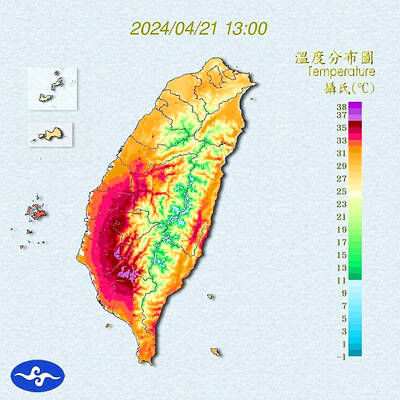
Heat advisories were in effect for nine administrative regions yesterday afternoon as warm southwesterly winds pushed temperatures above 38°C in parts of southern Taiwan, the Central Weather Administration (CWA) said. As of 3:30pm yesterday, Tainan’s Yujing District (玉井) had recorded the day’s highest temperature of 39.7°C, though the measurement will not be included in Taiwan’s official heat records since Yujing is an automatic rather than manually operated weather station, the CWA said. Highs recorded in other areas were 38.7°C in Kaohsiung’s Neimen District (內門), 38.2°C in Chiayi City and 38.1°C in Pingtung’s Sandimen Township (三地門), CWA data showed. The spell of scorching


 RSS
RSS