


Taipei Times: The Cabinet's recent decision to continue construction of a wharf being built for the Fourth Nuclear Power Plant in Kungliao township, Taipei County -- which led to the severe erosion of nearby Fulung Beach (福隆沙灘) -- shows its reluctance to review existing mistakes caused by an unsound environmental impact assessment for the project; what is the EPA's view?
Hau Lung-bin (郝龍斌): The Environmental Impact Assessment (EIA) for the project has long been completed. The EPA now only monitors environmental impacts pertaining to the construction of the plant based on conclusions listed on the EIA report. If any condition changes, the EPA will demand a "difference analysis" (差異分析) report, by which the EPA can evaluate the possible environmental impact sustained.
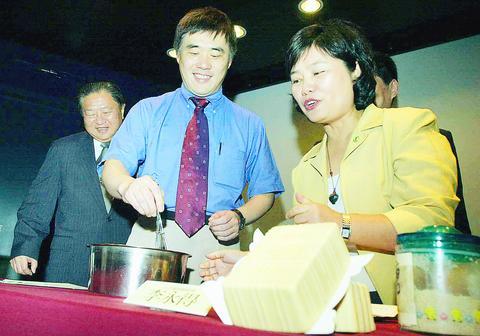
PHOTO: CHIANG YING-YING, TAIPEI TIMES
The EIA [for the Fourth Nuclear Power Plant] was done by the Atomic Energy Council (AEC) in 1991, long before the Environmental Impact Assessment Act came into effect in 1994. I believe that at that time the environmental impact on Fulung Beach of the wharf construction was not seriously considered. So now the Cabinet has a committee formed by several agencies, including the EPA, the AEC, the Ministry of Economic Affairs (MOEA), and others, to keep a close eye on the project.
I have to stress that the EPA plays the role of supervisor, which would not risk the credibility of the government when facing challenges relating to environmental protection policy.
TT: Do you have any specific strategy to enhance the EPA's credibility?
Hau: If the EPA isn't trusted, what's the point of having it? For a long time, the EPA has aimed to implement environmental laws thoroughly. For example, since I assumed office [in March, 2001], we've been clamping down on all kinds of polluters by randomly inspecting illegal factories.
TT: Don't you think reviewing the controversial results of questionable EIAs can also help to build the EPA's credibility?
Hau: The EPA does not actively conduct Strategic Environmental Assessments (SEA, 政策環評). I think the responsible agencies, which carry out controversial policies, should work closely with us to carry out related SEAs. Example, the EPA has to carefully review regulations regarding the establishment of golf courses island-wide in order to limit the overall environmental impact of these development projects.
TT: Has the EPA ever actively intervened to block any controversial policy for the sake of environmental protection?
Hau: Here's an example. In 2001, the MOEA agreed to suspend a project to reduce a water sources protection area in the Tsengwen River (曾文溪) basin in southern Taiwan, after conducting discussions with us. Development in basins, which are listed as drinking water source protection areas, can lead to problems at national levels. So we gave the MOEA a period of time to bring up a proposal pertaining to all similar development projects. So the Tsengwen River project remains suspended. That's an example demonstrating that the EPA will not give a green light to inappropriate plans which would eventually damage our environment. In addition, we usually urge the relevant agencies to reconsider how necessary their development projects are. If the MOEA brings up the proposal again in the near future, the EPA will conduct the SEA carefully.
TT: Controversies surrounding a newly implemented policy that limits the use of plastic shopping bags and disposable utensils continue. How do you answer challenges from academics who argue that, in terms of life cycle assessment [LCA, a tool used by the industry to assess and improve the eco-efficiency or sustainability of products], paper products are not more environmentally friendly than plastic materials?
Hau: What professors say is based on too many theories. What the EPA faces is the reality. We need to figure out practical strategies to tackle problems about the abuse of plastic products.
The percentage of plastic materials in our household waste, 20 percent, is almost twice of that in other advanced countries. However, we don't abuse paper products. We consume about 4.12 million tonnes of paper products annually, and 60.4 percent of them are recycled. In other words, we don't have problems in dealing with paper waste.
In terms of paper dining tableware, in the past we consumed about 16,000 tonnes. We estimate that the amount would increase to 48,000 tonnes after the implementation of the policy limiting the use of plastic materials in certain places. Even so, the amount accounts for only 1 percent of all paper products we consume.
If you are interested in approaching the use of paper from an LCA angle, I have to stress that all the paper we consume in Taiwan comes from forests in Switzerland, Canada, and other countries grown specifically for the purpose. All those trees are supposed to be transformed into paper products.
Actually the EPA does not encourage the use of disposable materials at all, in order to treasure the limited natural resources in the world.
TT: Do you still believe the implementation of the policy has been successful?
Hau: Yes, I do. The EPA has successfully solved diverse problems, ranging from unemployment to punishment for violating related regulations. The most important part of the policy is to educate the public. Early this month, I was deeply moved by Taiwanese people who celebrated the birthday of Matsu (媽祖), goddess of the sea in Taoist beliefs, in very simple and economic ways. When visiting a temple in Chiayi County I observed an unusual phenomenon that nobody used disposable tableware. It means that most people are willing to bear the inconvenience caused by the implementation of the policy. According to our recent survey, more than 75 percent of residents support the policy.
TT: Environmentalists, legislators and some residents have criticized the EPA for its incineration-oriented waste management policies for a long time. Currently, the EPA has yet to solve problems regarding the insufficiency of household waste [to justify incinerator construction], unsound regulations which were drawn up to ensure the safe disposal of toxic fly ash and bottom ash collected from incinerators, the lack of mutual trust between the government and civil society and the low recycling rate. Do you see an urgency to adjust existing policies?
Hau: I believe that the EPA has no choice but to have at least one incinerator in each jurisdiction because regional agreement has not been formed. The EPA has slightly adjusted waste management policies because six projects had been cancelled since last year due to the insufficiency of household waste. Meanwhile, the EPA has focused on the promotion of waste reduction, recycling and letting all raw solid wastes be treated in incinerators rather than landfills.
Actually, I don't think those who criticize the EPA have correct information about waste management; unfortunately a lot of false information has been given to the public. Although the EPA has been focusing on educating the public on environment-related issues, it has to focus on incinerator-related issues soon in order to eliminate public misunderstanding. Since we can't avoid dealing with the waste people produce, we must have strategies to handle it. I think incineration-oriented waste management policies are practical for Taiwan, a densely populated island country.
TT: What's your vision of bringing a better environment to Taiwanese people?
Hau: I believe that people's attitude is a key factor in transforming Taiwan into a better environment to live in. In Switzerland, Germany and other advanced countries, residents with environmental concerns play the role of guardians of the environment. Promoting environmental protection needs little theory but rather a strong resolution to show and practice concern for the environment in day-to-day life.
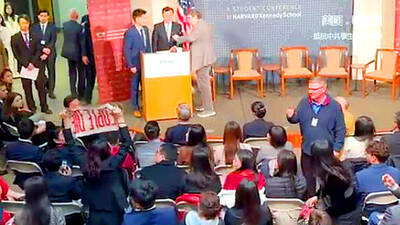
A group of Taiwanese-American and Tibetan-American students at Harvard University on Saturday disrupted Chinese Ambassador to the US Xie Feng’s (謝鋒) speech at the school, accusing him of being responsible for numerous human rights violations. Four students — two Taiwanese Americans and two from Tibet — held up banners inside a conference hall where Xie was delivering a speech at the opening ceremony of the Harvard Kennedy School China Conference 2024. In a video clip provided by the Coalition of Students Resisting the CCP (Chinese Communist Party), Taiwanese-American Cosette Wu (吳亭樺) and Tibetan-American Tsering Yangchen are seen holding banners that together read:

UNAWARE: Many people sit for long hours every day and eat unhealthy foods, putting them at greater risk of developing one of the ‘three highs,’ an expert said More than 30 percent of adults aged 40 or older who underwent a government-funded health exam were unaware they had at least one of the “three highs” — high blood pressure, high blood lipids or high blood sugar, the Health Promotion Administration (HPA) said yesterday. Among adults aged 40 or older who said they did not have any of the “three highs” before taking the health exam, more than 30 percent were found to have at least one of them, Adult Preventive Health Examination Service data from 2022 showed. People with long-term medical conditions such as hypertension or diabetes usually do not
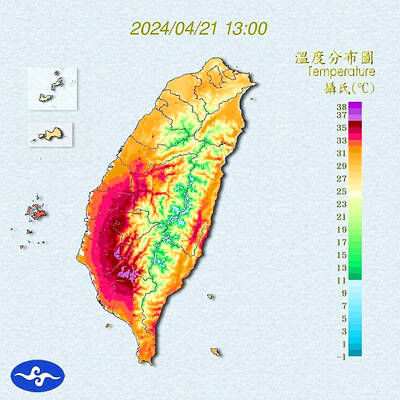
Heat advisories were in effect for nine administrative regions yesterday afternoon as warm southwesterly winds pushed temperatures above 38°C in parts of southern Taiwan, the Central Weather Administration (CWA) said. As of 3:30pm yesterday, Tainan’s Yujing District (玉井) had recorded the day’s highest temperature of 39.7°C, though the measurement will not be included in Taiwan’s official heat records since Yujing is an automatic rather than manually operated weather station, the CWA said. Highs recorded in other areas were 38.7°C in Kaohsiung’s Neimen District (內門), 38.2°C in Chiayi City and 38.1°C in Pingtung’s Sandimen Township (三地門), CWA data showed. The spell of scorching
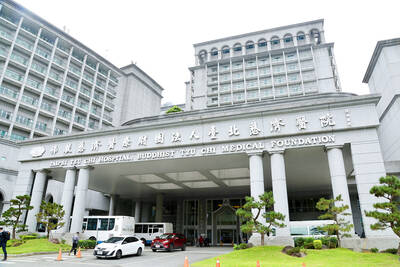
POLICE INVESTIGATING: A man said he quit his job as a nurse at Taipei Tzu Chi Hospital as he had been ‘disgusted’ by the behavior of his colleagues A man yesterday morning wrote online that he had witnessed nurses taking photographs and touching anesthetized patients inappropriately in Taipei Tzu Chi Hospital’s operating theaters. The man surnamed Huang (黃) wrote on the Professional Technology Temple bulletin board that during his six-month stint as a nurse at the hospital, he had seen nurses taking pictures of patients, including of their private parts, after they were anesthetized. Some nurses had also touched patients inappropriately and children were among those photographed, he said. Huang said this “disgusted” him “so much” that “he felt the need to reveal these unethical acts in the operating theater


 RSS
RSS