


Academics yesterday debated the possibility of setting up a nuclear-weapons-free zone in the Taiwan Strait with many concerned that such a proposal would be unrealistic in the face of pressure from Beijing.
Hsieh Shu-yuan (
While Beijing has yet to renounce the use of force against Taiwan, Hsieh said that Taipei should seek to engage in various security arrangements, such as joining its neighbors in a Theater Missile Defense system and establishing a nuclear-weapons-free zone in the Taiwan Strait.
Regional states, which use the Strait as a major trade route, should embrace the establishment of a zone in area, Hsieh said.
The mechanism, once established, could prevent a future arms race in the region and even pressure China into abandoning its threat of force, especially with nuclear weapons, she argued.
Hsieh said China remained the major stumbling block to the realization of such an initiative, while arguing that Taiwan could go for a unilateral declaration of the Strait as a nuclear-weapons-free zone following the Mongolian pattern of 11 years ago.
The then Mongolian president, Punsalmaagiin Ochirbatin, in his address to the UN Security Council in 1992 declared his nation to be a nuclear-weapons-free zone, adding his government would endeavor to have its status internationally guaranteed, according to Hsieh.
But other participants had different concerns.
"If we reduce nuclear weapons, does it make conventional weapons more likely to be acquired, to be threatened with, to be used?" said Robert Henderson, senior strategic analyst and editor of R+E+A Group, an Ottawa-based think tank, during a break from Hsieh's presentation.
Calling Hsieh's proposal a "good idea," Henderson said that Taiwan is threatened by increasing numbers of high-tech weapons and not so much by nuclear weapons.
David Carlton, senior lecturer in international studies from the University of Warwick, outlined his concerns in general terms over the feasibility of any zone initiatives.
"There are always complications as to who you include and who you don't, and whether it's worthwhile to have a regional arrangement from which a key actor is excluded because they won't participate," Carlton said outside of the conference venue.
"Another [question] is whether it is necessary for more than one state to take part in the agreement," Carlton said.
"In theory, you could have a state, like Mongolia, on its own declaring itself a nuclear-weapon-free zone. How meaningful is this?" he asked.
"Is there any difference from a non-nuclear-use declaration?" Carlton asked.
"If it is going to be very narrowly based -- ?in other words, a unilateral decision by a particular government -- ?is that a proper use of the term, or is it simply a unilateral declaration of policy by a given government?" he added.
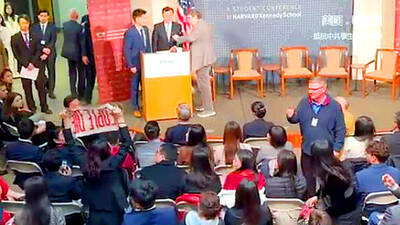
A group of Taiwanese-American and Tibetan-American students at Harvard University on Saturday disrupted Chinese Ambassador to the US Xie Feng’s (謝鋒) speech at the school, accusing him of being responsible for numerous human rights violations. Four students — two Taiwanese Americans and two from Tibet — held up banners inside a conference hall where Xie was delivering a speech at the opening ceremony of the Harvard Kennedy School China Conference 2024. In a video clip provided by the Coalition of Students Resisting the CCP (Chinese Communist Party), Taiwanese-American Cosette Wu (吳亭樺) and Tibetan-American Tsering Yangchen are seen holding banners that together read:

UNAWARE: Many people sit for long hours every day and eat unhealthy foods, putting them at greater risk of developing one of the ‘three highs,’ an expert said More than 30 percent of adults aged 40 or older who underwent a government-funded health exam were unaware they had at least one of the “three highs” — high blood pressure, high blood lipids or high blood sugar, the Health Promotion Administration (HPA) said yesterday. Among adults aged 40 or older who said they did not have any of the “three highs” before taking the health exam, more than 30 percent were found to have at least one of them, Adult Preventive Health Examination Service data from 2022 showed. People with long-term medical conditions such as hypertension or diabetes usually do not
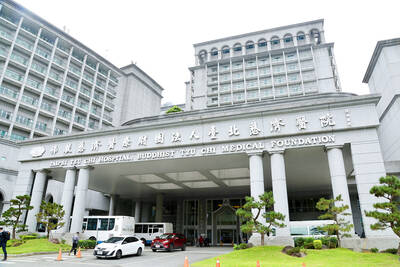
POLICE INVESTIGATING: A man said he quit his job as a nurse at Taipei Tzu Chi Hospital as he had been ‘disgusted’ by the behavior of his colleagues A man yesterday morning wrote online that he had witnessed nurses taking photographs and touching anesthetized patients inappropriately in Taipei Tzu Chi Hospital’s operating theaters. The man surnamed Huang (黃) wrote on the Professional Technology Temple bulletin board that during his six-month stint as a nurse at the hospital, he had seen nurses taking pictures of patients, including of their private parts, after they were anesthetized. Some nurses had also touched patients inappropriately and children were among those photographed, he said. Huang said this “disgusted” him “so much” that “he felt the need to reveal these unethical acts in the operating theater
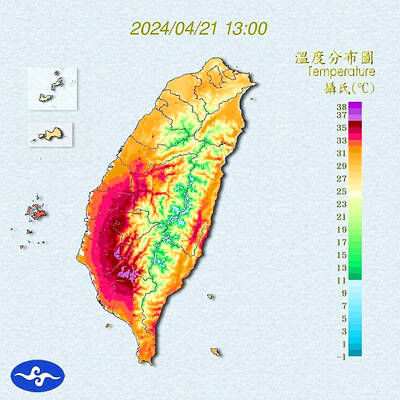
Heat advisories were in effect for nine administrative regions yesterday afternoon as warm southwesterly winds pushed temperatures above 38°C in parts of southern Taiwan, the Central Weather Administration (CWA) said. As of 3:30pm yesterday, Tainan’s Yujing District (玉井) had recorded the day’s highest temperature of 39.7°C, though the measurement will not be included in Taiwan’s official heat records since Yujing is an automatic rather than manually operated weather station, the CWA said. Highs recorded in other areas were 38.7°C in Kaohsiung’s Neimen District (內門), 38.2°C in Chiayi City and 38.1°C in Pingtung’s Sandimen Township (三地門), CWA data showed. The spell of scorching


 RSS
RSS