


Practicing the philosophy of Mahatma Gandhi, former DPP chairman Lin I-hsiung (
A week ago, Lin led members of the Association for Promoting Public Voting on the Fourth Nuclear Power Plant (核四公投促進會) for a sit-down demonstration in front of the Executive Yuan to demand that the government determine the future of the controversial plant through a plebiscite.
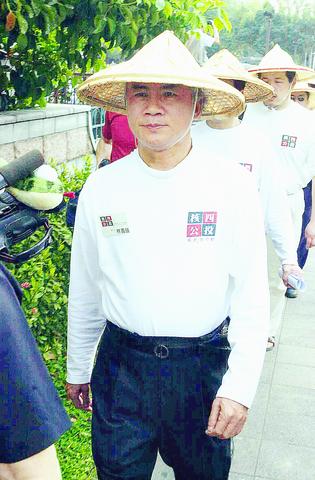
PHOTO: SEAN CHAO, TAIPEI TIMES
Lin remained silent throughout the half-day activities as he joined the group on an hourly walk around the building, and he meditated when he was sitting down. He took no heed of any politicians that came to show their concern or sought to communicate with them.
The more Lin remains quiet, the more pressure the DPP feels because it was him who led the party to power, but now the former party chairman appears to be a major critical force as the party prepares for the presidential election next year.
Lin has been advocating non-violent resistance since the early 1990s. In 1994, he put the idea into practice by leading the first wave of nationwide anti-nuclear protests in September that year, which was preceded with a hunger strike.
The drive is on its third round. Since Sept. 21 last year, Lin has led activists on a 1,000km march across the country to rally support for a national referendum on the future of the Fourth Nuclear Power Plant. He and his followers plan to march 20km every weekend for at least 50 weeks.
By launching the hunger strike and marching drive, Lin said he meant to "highlight the resolve of anti-nuclear activists and at the same time train the bodies and souls of the movement's campaigners."
An anti-nuclear stance is part of the DPP's party charter. Among the numerous anti-nuclear politicians, Lin wins the most respect because he is not trying to solicit votes. He regards opposing nuclear power as a political conviction and it is his life-long goal to abolish nuclear power in Taiwan, a goal which he tries to attain through physical suffering, like what is endured by an ascetic monk.
The DPP has paid a huge price on the anti-nuclear issue. In October 2000, the party made the announcement to scrap the project, in part due to Lin's insistence. But the decision quickly turned into a debacle for the DPP, which had only been in power for a few months and had a minority in the legislature. It was compelled to reverse its decision and give in to the opposition parties the following January. The same dilemma is coming back to vex the party two years later.
Lin is persistent, uncompromising and full of a sense of justice. But these qualities intensified after Lin's 6-year-old twin daughters were brutally murdered along with their grandmother on Feb. 28, 1980.
Lin's eldest daughter, Huan-chun (
The murder took place at midday in their home when Lin, then a provincial assemblyman, was arrested for participating in a human-rights rally in Kaohsiung on Dec. 10 the previous year, whereas his wife Fang Su-min (
The murderer has never been apprehended. However, Lin and many Taiwanese believe that the killings were politically motivated.
The girls and their grandmother were not buried until Lin was released from jail in 1984. Fang and the surviving daughter moved to the US to start a new life soon after the mishap. In 1985, Lin joined his family in California, setting out on a four-year voyage of learning in the US, Europe and Japan.
The time abroad was an opportunity for him to heal his sorrow and to hone his talents to serve Taiwan in the future.
But he also developed different interests, for the family tragedy had provoked him to pursue eternal values as he grew disenchanted with the transience of politics.
Since he returned to Taiwan in 1989, Lin has devoted himself to social and political reforms.
In March 1991, he founded the Chilin Foundation (慈林文教基金會), seeking to end political corruption through spiritual reform. The foundation focuses on cultivating young talents and disseminating Lin's beliefs in mercy and love.
At the time when the DPP's resolution on reform has sometimes given way to political considerations, Lin represents a moral force in the party that can not be challenged.
Lin treats issues such as the anti-nuclear movement or the need for a public referendum like a social-awakening movement. They are tools for him to carry out his conception of true democracy, which is, "the people are the master in a civil society; the strength of the people outweighs that of the government."
It will be a long way to go before he reaches his goals under Taiwan's fledgling democracy.
As he cited Robert Frost's poem The Road Not Taken the day he resigned his DPP chairmanship in May 2000, Lin said that he would always choose "the road less traveled by, and that has made all the difference."
The difference Lin insists, however, will put the DPP in a quandary.

Former president Ma Ying-jeou’s (馬英九) mention of Taiwan’s official name during a meeting with Chinese President Xi Jinping (習近平) on Wednesday was likely a deliberate political play, academics said. “As I see it, it was intentional,” National Chengchi University Graduate Institute of East Asian Studies professor Wang Hsin-hsien (王信賢) said of Ma’s initial use of the “Republic of China” (ROC) to refer to the wider concept of “the Chinese nation.” Ma quickly corrected himself, and his office later described his use of the two similar-sounding yet politically distinct terms as “purely a gaffe.” Given Ma was reading from a script, the supposed slipup
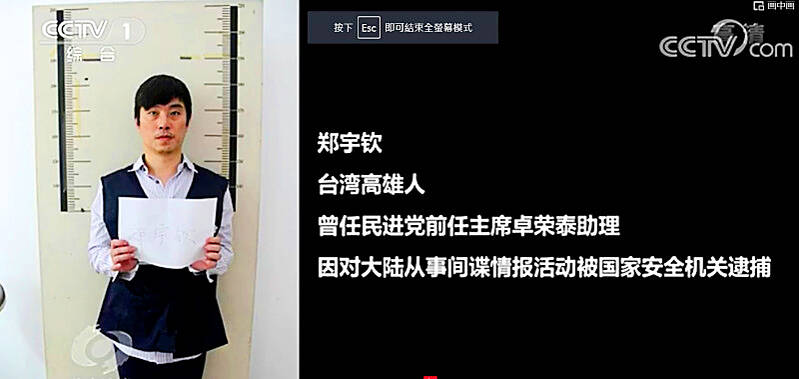
Former Czech Republic-based Taiwanese researcher Cheng Yu-chin (鄭宇欽) has been sentenced to seven years in prison on espionage-related charges, China’s Ministry of State Security announced yesterday. China said Cheng was a spy for Taiwan who “masqueraded as a professor” and that he was previously an assistant to former Cabinet secretary-general Cho Jung-tai (卓榮泰). President-elect William Lai (賴清德) on Wednesday last week announced Cho would be his premier when Lai is inaugurated next month. Today is China’s “National Security Education Day.” The Chinese ministry yesterday released a video online showing arrests over the past 10 years of people alleged to be
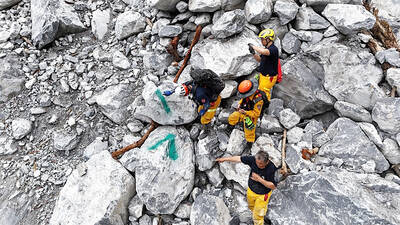
The bodies of two individuals were recovered and three additional bodies were discovered on the Shakadang Trail (砂卡礑) in Taroko National Park, eight days after the devastating earthquake in Hualien County, search-and-rescue personnel said. The rescuers reported that they retrieved the bodies of a man and a girl, suspected to be the father and daughter from the Yu (游) family, 500m from the entrance of the trail on Wednesday. The rescue team added that despite the discovery of the two bodies on Friday last week, they had been unable to retrieve them until Wednesday due to the heavy equipment needed to lift

THE HAWAII FACTOR: While a 1965 opinion said an attack on Hawaii would not trigger Article 5, the text of the treaty suggests the state is covered, the report says NATO could be drawn into a conflict in the Taiwan Strait if Chinese forces attacked the US mainland or Hawaii, a NATO Defense College report published on Monday says. The report, written by James Lee, an assistant research fellow at Academia Sinica’s Institute of European and American Studies, states that under certain conditions a Taiwan contingency could trigger Article 5 of NATO, under which an attack against any member of the alliance is considered an attack against all members, necessitating a response. Article 6 of the North Atlantic Treaty specifies that an armed attack in the territory of any member in Europe,


 RSS
RSS