


Water conservation should be better promoted in Taiwan in order to manage the country's limited water resources more wisely, according to water resources officials, experts and legislators.
A report on Taiwan's Water Poverty Index (WPI) ranking released yesterday by the Taipei-based Environmental Quality Protection Foundation (EQPF) suggests that Taiwan consumes water unwisely.
Designed by UK scientists in 2002 to express the link between water availability and household welfare, WPI also indicates the degree to which water scarcity impacts on human populations.

PHOTO: GEORGE TSORNG, TAIPEI TIMES
To show where the best and worst water situations exist, the measure grades 147 countries according to five different measures, including resources, access, capacity, use and environmental impact.
After collecting related raw data, Yeh Shin-cheng (
Yeh's conclusion, that Taiwan ranked the 40th out of the 148 nations, has been confirmed by Jeremy Meigh, one of the key designers of the WPI.
"The result might not be too bad, but it hints that we consume water unwisely," Yeh said.
According to Yeh, the water use component of the WPI measures how efficiently a country uses water for domestic, agricultural and industrial purpose. The lowest ranking country is the US, while Taiwan is the 8th lowest.
Statistically, each Taipei City resident consumes 356 liters of water daily, while each person in the rest of Taiwan, 239 liters. Both figures are relatively higher than Britain's 108 liters, The Netherlands' 126 liters, Denmark's 190 liters, and Spain's 126 liters.
Yeh said a high water-loss rate -- the amount of water lost between the reservoir and the tap -- is partly responsible for Taiwan's heavy consumption of fresh water. The national water-loss rate is about 30 percent.
Kuo Jan-tai (郭振泰), a professor of Water Resources Engineering at National Taiwan University, attributed the high water usage to poor promotion of sustainable development and conservation.
Kuo stressed the importance of recycling and reusing waste water discharged from both the industrial and residential sectors.
"Singapore vows to get 20 percent of its water supply from recycled waste water, in order to reduce its reliance on neighboring Malaysia," Kuo said.
Kuo said Singapore is also using high water prices -- about two to three times those of Taiwan -- to promote water conservation.
DPP Legislator Eugene Jao (
But according to local media, the government has no plans to raise water prices before the 2004 presidential election. Jao said that is a mistake.
"The government should not manage the water resources politically," Jao said.
He believes a mechanism for setting water prices -- involving community groups, water experts, academics, and the government -- should be established.
Chen Shen-hsien (陳伸賢), deputy director of the Water Resources Agency, said it is inevitable that water prices will be adjusted.
Chen said that by the end of 2004, old leaky facilities at governmental organizations and public schools would be replaced by new ones that use less water.
"By revising related laws, we might be able to further promote water conservation in the private sector," Chen said.
EQPF Secretary-General Eric Liou (劉銘龍) said that by looking at how Taiwan rates on the WPI, the government could find efficient ways to manage water resources.
Related water issues pertaining to the WPI will be discussed at the Third World Water Forum that starts today in Japan.
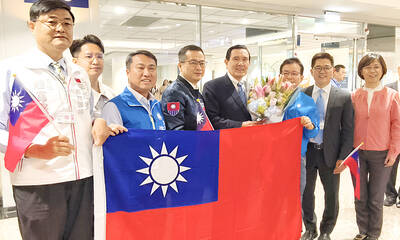
Former president Ma Ying-jeou’s (馬英九) mention of Taiwan’s official name during a meeting with Chinese President Xi Jinping (習近平) on Wednesday was likely a deliberate political play, academics said. “As I see it, it was intentional,” National Chengchi University Graduate Institute of East Asian Studies professor Wang Hsin-hsien (王信賢) said of Ma’s initial use of the “Republic of China” (ROC) to refer to the wider concept of “the Chinese nation.” Ma quickly corrected himself, and his office later described his use of the two similar-sounding yet politically distinct terms as “purely a gaffe.” Given Ma was reading from a script, the supposed slipup
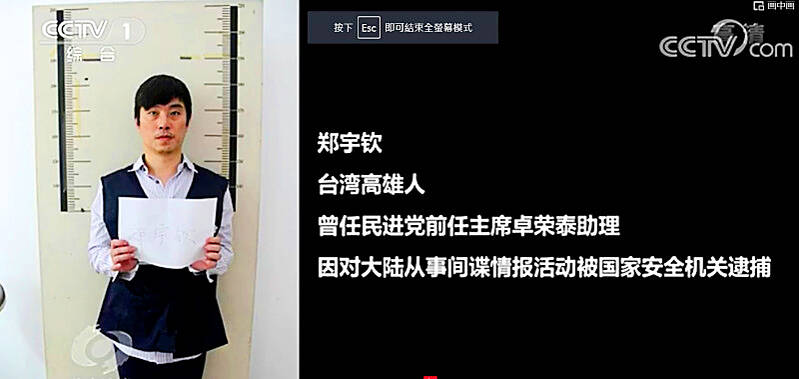
Former Czech Republic-based Taiwanese researcher Cheng Yu-chin (鄭宇欽) has been sentenced to seven years in prison on espionage-related charges, China’s Ministry of State Security announced yesterday. China said Cheng was a spy for Taiwan who “masqueraded as a professor” and that he was previously an assistant to former Cabinet secretary-general Cho Jung-tai (卓榮泰). President-elect William Lai (賴清德) on Wednesday last week announced Cho would be his premier when Lai is inaugurated next month. Today is China’s “National Security Education Day.” The Chinese ministry yesterday released a video online showing arrests over the past 10 years of people alleged to be
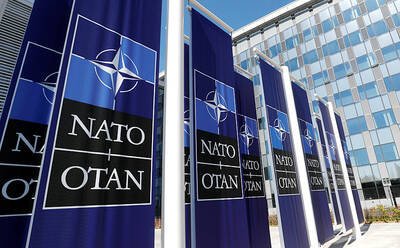
THE HAWAII FACTOR: While a 1965 opinion said an attack on Hawaii would not trigger Article 5, the text of the treaty suggests the state is covered, the report says NATO could be drawn into a conflict in the Taiwan Strait if Chinese forces attacked the US mainland or Hawaii, a NATO Defense College report published on Monday says. The report, written by James Lee, an assistant research fellow at Academia Sinica’s Institute of European and American Studies, states that under certain conditions a Taiwan contingency could trigger Article 5 of NATO, under which an attack against any member of the alliance is considered an attack against all members, necessitating a response. Article 6 of the North Atlantic Treaty specifies that an armed attack in the territory of any member in Europe,
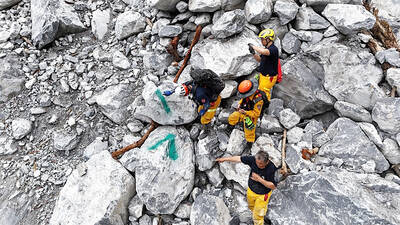
The bodies of two individuals were recovered and three additional bodies were discovered on the Shakadang Trail (砂卡礑) in Taroko National Park, eight days after the devastating earthquake in Hualien County, search-and-rescue personnel said. The rescuers reported that they retrieved the bodies of a man and a girl, suspected to be the father and daughter from the Yu (游) family, 500m from the entrance of the trail on Wednesday. The rescue team added that despite the discovery of the two bodies on Friday last week, they had been unable to retrieve them until Wednesday due to the heavy equipment needed to lift


 RSS
RSS