


The discovery of deadly toxins in carcasses of various birds, ranging from the common egret to the endangered black-faced spoonbill, demonstrates that the coastal region near the estuary of the Tsengwen River (曾文溪) in southern Taiwan poses an environmental danger, researchers for the Tainan County government said yesterday.
Between Dec. 9 and Jan. 5, 88 black-faced spoonbills in Chiku Lagoon -- on the north side of the Tsengwen River -- were infected by C. botulinum toxin. Seventy-one of those birds died.
Then, on Feb. 4, two recently deceased spoonbills were discovered by bird conservationists from the Bird Society of Taiwan. One bird carcass was found in the Chiku wetlands, the other in the Sitsao (
What shocked bird conservationists was that symptoms of the two spoonbills were different from those infected by the C. botulinum toxin.
"The real cause of the death of the two remains unconfirmed. But their deaths were not related to the deaths ending in early January," said veterinarian William Chyi (
Scientifically speaking, the last die-off technically ended on Jan. 5 because no new deaths were reported in the two weeks following that date.
This time, it's not just spoonbills that are dying. In the area around the Sitsao wetlands -- located on the south side of Tsengwen River -- bird conservationists also found bodies of various other birds, including egrets and snipes, Chyi said.
When examining the carcass of a great egret picked up in Sitsao, Chyi discovered C. botulinum toxins and D. botulinum toxins.
Chyi said that researchers and local activists were still looking for sources of toxins to prevent the spread of any infections.
Chyi said that researchers had focused on a spot near a fish farm, where dead fish, dead egrets, and decomposing mice bodies eaten by maggots were discovered.
On shoals near the fish farm, footprints of the black-faced spoonbills were discovered -- suggesting that spoonbills had fed there.
"We believe that all kinds of birds near the estuary now are in danger. Undiscovered bodies of birds and other animals could exacerbate the spread of various infections because they function like toxin factories," Chyi said.
Chyi added that searching for bodies could be the only workable strategy the local government could adopt to prevent any more bird infections in coastal areas.
Yang Jiao-yen (楊嬌豔), assistant to DPP Legislator Eugene Jao (趙永清), said that Japanese experts who visited Chihku Lagoon last month had pointed out that the coastal area was contaminated by spores of many types of botulinum.
"Some legislators believe that the situation is far more serious than we can imagine and will soon suggest that the Cabinet have the military search for bodies and clean up the environment in coastal areas in Tainan County," Yang said.
In an effort to seek international assistance with the problem, the local government will hold the International Symposium on Black-faced Spoonbill Conservation in late March.
It is expected that Malcolm Coulter of the International Union for the Conservation of Nature and Natural Resources, and representatives from Spoonbill Action Voluntary Echo International, among others, will attend.
Meanwhile, local government officials said they would pay all expenses -- except travel expenses -- for any international conservation organization which could set up in Tainan for a long-term, on-site investigation into the deaths of the birds.

A group of Taiwanese-American and Tibetan-American students at Harvard University on Saturday disrupted Chinese Ambassador to the US Xie Feng’s (謝鋒) speech at the school, accusing him of being responsible for numerous human rights violations. Four students — two Taiwanese Americans and two from Tibet — held up banners inside a conference hall where Xie was delivering a speech at the opening ceremony of the Harvard Kennedy School China Conference 2024. In a video clip provided by the Coalition of Students Resisting the CCP (Chinese Communist Party), Taiwanese-American Cosette Wu (吳亭樺) and Tibetan-American Tsering Yangchen are seen holding banners that together read:

UNAWARE: Many people sit for long hours every day and eat unhealthy foods, putting them at greater risk of developing one of the ‘three highs,’ an expert said More than 30 percent of adults aged 40 or older who underwent a government-funded health exam were unaware they had at least one of the “three highs” — high blood pressure, high blood lipids or high blood sugar, the Health Promotion Administration (HPA) said yesterday. Among adults aged 40 or older who said they did not have any of the “three highs” before taking the health exam, more than 30 percent were found to have at least one of them, Adult Preventive Health Examination Service data from 2022 showed. People with long-term medical conditions such as hypertension or diabetes usually do not
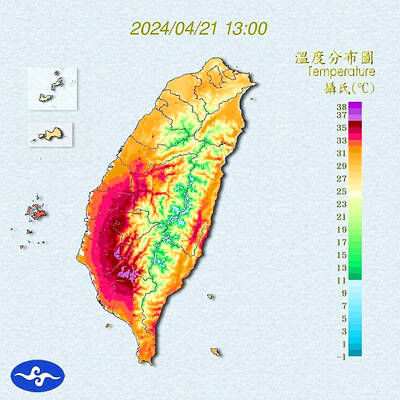
Heat advisories were in effect for nine administrative regions yesterday afternoon as warm southwesterly winds pushed temperatures above 38°C in parts of southern Taiwan, the Central Weather Administration (CWA) said. As of 3:30pm yesterday, Tainan’s Yujing District (玉井) had recorded the day’s highest temperature of 39.7°C, though the measurement will not be included in Taiwan’s official heat records since Yujing is an automatic rather than manually operated weather station, the CWA said. Highs recorded in other areas were 38.7°C in Kaohsiung’s Neimen District (內門), 38.2°C in Chiayi City and 38.1°C in Pingtung’s Sandimen Township (三地門), CWA data showed. The spell of scorching

POLICE INVESTIGATING: A man said he quit his job as a nurse at Taipei Tzu Chi Hospital as he had been ‘disgusted’ by the behavior of his colleagues A man yesterday morning wrote online that he had witnessed nurses taking photographs and touching anesthetized patients inappropriately in Taipei Tzu Chi Hospital’s operating theaters. The man surnamed Huang (黃) wrote on the Professional Technology Temple bulletin board that during his six-month stint as a nurse at the hospital, he had seen nurses taking pictures of patients, including of their private parts, after they were anesthetized. Some nurses had also touched patients inappropriately and children were among those photographed, he said. Huang said this “disgusted” him “so much” that “he felt the need to reveal these unethical acts in the operating theater


 RSS
RSS