


On Chinese New Year's Eve this year, people living near Sun Moon Lake (日月潭), in central Nantou County, rang copper bells at five temples 108 times simultaneously to prevent disasters, pray for good fortune, and seek peace.
In Buddhist philosophy, there are 108 mental defilements. It is believed that by ringing the bell 108 times on New Year's Eve, one can erase past mental impurities and start the year anew.
Whether pollution disasters resulting from the discharge of household waste water from residential areas and hotels around the renowned scenic spot can be eliminated by the ringing of the bells this year remains uncertain.

PHOTO: LIN KUO-CHANG
Water pollution in the artificial lake has shocked Wu Sheng (吳晟), 59, known to many as the as "poet of the soil." When he visited the scenic spot in June last year, the water level of the lake was very low due to the drought. The low levels exposed aqueducts connected to residential areas and hotels.
"Discharging household waste water into the lake through hidden aqueducts" is a shocking phenomenon Wu said.
"There are no sanitary sewers at all," Wu said.
Wu said that the lower water level revealed the existence of waste hidden in the lake for a long time.
Walking along the drained slope surrounding the lake, he saw struggling egrets searching for food in swamps inundated with dark sewage, large industrial batteries, abandoned nylon fishing nets and broken boats.
"It's outrageous that the government did not seize the post-921 reconstruction period as an opportunity to solve this long-term pollution problem," Wu said.
In September, 1999, the scenic spot was severely destroyed by the devastating temblor that claimed 2,400 lives.
"We don't see the government managing the place with any concept of sustainable development," Wu said.
Wu is especially upset with the establishment of a luxurious hotel, the Lalu (
In a newly released book, A Note on the Choshui River (
Wu's accusation was not unprecedented. As early as March last year, one month after the completion of the hotel, residents complained to the local government about the smell of effluents coming from the hotel.
The Environmental Protection Bureau of Nantou County Government carried out field investigation several times, confirming that effluents discharged from the hotel did not meet regulations.
"Later, the hotel was forced to enhance it's sewage treatment systems. Now the water quality of the lake meets official standards," said Lin Lung-ju (
Lin said that the water quality is monitored monthly because confirmed pollutants include residential sewage and residue of insecticides spread in farmland upstream but flushed downstream by rainwater.
After he was invited as a visiting writer to Nantou County, Wu spent a lot of time around Choshui River last year. There he wrote 23 articles about the country's longest river.
In the book, Wu also describes how the environment was damaged by the construction of Chi-Chi Common Diversion Project. After the construction was completed in 2001, the government has been criticized for relying on cement to build Chi-Chi Weir (
"The government carried out the project to ensure water demand for the Sixth Naphtha Cracker (
Activists told Wu that a fish ladder built to improve fish spawning and migration along the weir was entirely a construction to quiet voices from conservation circles.
When visiting the construction, Wu discovered that the fish ladder, costing NT$200 million, was dry because all the water had been diverted to an industrial complex downstream.
"Obviously, the fish ladder has turned out to be an ornament," Wu said.
Chen Shen-hsien (陳伸賢), a spokesman for the Water Resources Agency, said that Wu's voice deserves to be heard because he stands for water conservation.
Chen said construction projects carried out years ago relied heavily on cement because of the material was inexpensive.
"We now are doing our best to remedy existing mistakes by beautifying them with ecological efforts," Chen said.
Chen, who just visited Chi-Chi Weir weeks ago, said the effectiveness the fish ladder had been evaluated.
Chen said the fish ladder cost millions of dollars rather than NT$200 million, as claimed in his book.
This year NT$30 million will be spent adjusting the slope in order to protect native species, Chen said.
Wu said that people are fed up with promises from the government.
"What I care about is whether future generations will be able to see the beauty I see today," Wu said.
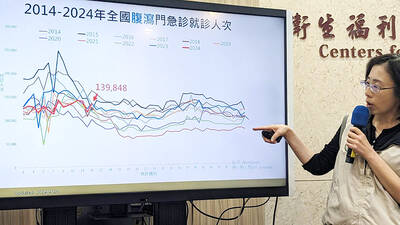
FLU SEASON: Twenty-six severe cases were reported from Tuesday last week to Monday, including a seven-year-old girl diagnosed with influenza-associated encephalopathy Nearly 140,000 people sought medical assistance for diarrhea last week, the Centers for Disease Control (CDC) said on Tuesday. From April 7 to Saturday last week, 139,848 people sought medical help for diarrhea-related illness, a 15.7 percent increase from last week’s 120,868 reports, CDC Epidemic Intelligence Center Deputy Director Lee Chia-lin (李佳琳) said. The number of people who reported diarrhea-related illness last week was the fourth highest in the same time period over the past decade, Lee said. Over the past four weeks, 203 mass illness cases had been reported, nearly four times higher than the 54 cases documented in the same period

A group of Taiwanese-American and Tibetan-American students at Harvard University on Saturday disrupted Chinese Ambassador to the US Xie Feng’s (謝鋒) speech at the school, accusing him of being responsible for numerous human rights violations. Four students — two Taiwanese Americans and two from Tibet — held up banners inside a conference hall where Xie was delivering a speech at the opening ceremony of the Harvard Kennedy School China Conference 2024. In a video clip provided by the Coalition of Students Resisting the CCP (Chinese Communist Party), Taiwanese-American Cosette Wu (吳亭樺) and Tibetan-American Tsering Yangchen are seen holding banners that together read:

UNAWARE: Many people sit for long hours every day and eat unhealthy foods, putting them at greater risk of developing one of the ‘three highs,’ an expert said More than 30 percent of adults aged 40 or older who underwent a government-funded health exam were unaware they had at least one of the “three highs” — high blood pressure, high blood lipids or high blood sugar, the Health Promotion Administration (HPA) said yesterday. Among adults aged 40 or older who said they did not have any of the “three highs” before taking the health exam, more than 30 percent were found to have at least one of them, Adult Preventive Health Examination Service data from 2022 showed. People with long-term medical conditions such as hypertension or diabetes usually do not
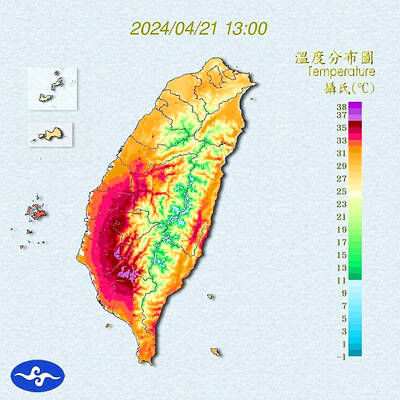
Heat advisories were in effect for nine administrative regions yesterday afternoon as warm southwesterly winds pushed temperatures above 38°C in parts of southern Taiwan, the Central Weather Administration (CWA) said. As of 3:30pm yesterday, Tainan’s Yujing District (玉井) had recorded the day’s highest temperature of 39.7°C, though the measurement will not be included in Taiwan’s official heat records since Yujing is an automatic rather than manually operated weather station, the CWA said. Highs recorded in other areas were 38.7°C in Kaohsiung’s Neimen District (內門), 38.2°C in Chiayi City and 38.1°C in Pingtung’s Sandimen Township (三地門), CWA data showed. The spell of scorching


 RSS
RSS