


Representatives of Aboriginal Tao (
"We here urge President Chen Shui-bian (
Lu also demanded a clear timeframe for the removal of the radioactive material. Currently, 97,672 barrels of low-level radioactive waste are stored at the site.
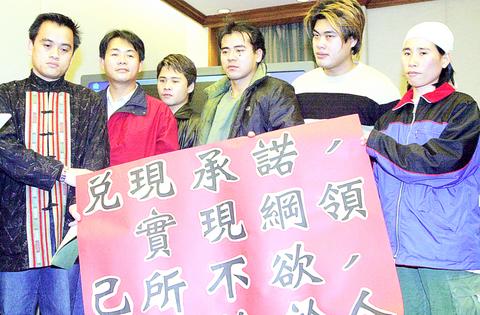
PHOTO: GEORGE TSORNG, TAIPEI TIMES
Tao people said that they were not convinced that the Cabinet's draft laws pertaining to radioactive waste management would ultimately lead to the relocation of such waste.
A draft outlining regulations on choosing the site of final repositories for low-level radioactive waste was passed by the Cabinet on Dec. 4 and was sent to the Legislative Yuan one week later for approval.
The proposed law aims to create legal proceedings which ensure both professionalism and information transparency while choosing permanent repositories sites for domestic low-level radioactive waste.
In mid-December, Premier Yu Shyi-kun vowed that the government would eventually get rid of the waste, but said that the government needs to extend the lease.
A representative of Aboriginal Tao workers, Si-Maraos, said, "Stop lying to us. Our only dream is, when we go home, the waste is gone," said , a representative of Aboriginal Tao.
Si-Maraos told the Taipei Times that one-third of the 3,000 Tao people living on Orchid Island currently work in Taiwan.
The Tao are supported by a diverse range of people from local residents, environmentalists, labor activists, professors, legislators to cultural workers.
Aboriginal Legislator May Chin (
"From now on I will not participate in the government's commissions because the government treats Tao people with no sincerity," Chin said at the press conference.
Hou Hsiao-hsien (
Hou said that the developing nuclear power industry in Taiwan was the government's hasty work and inadvertently hurt his Tao pals, whom he'd known for years since he shot a film on the island.
"It's impossible to build a nuclear-free country if the government has no long-term plan on nuclear related issues," Hou said.
Wu Wen-tung (
According to Taiwan Power Company (Taipower), Taiwan's first permanent repository for low-level radioactive waste would not be available for at least 10 years after the law is passed.
Taipower officials said yesterday that once the law was established, the government would take five years to choose a location for the repositories. Taipower would spend another five-years to design and build the repositories.
The interim repository on Orchid Island was opened in 1982.
The management changed hands from the Atomic Energy Council to Taipower in 1990 under an agreement that required that all waste be relocated by the end of this year.
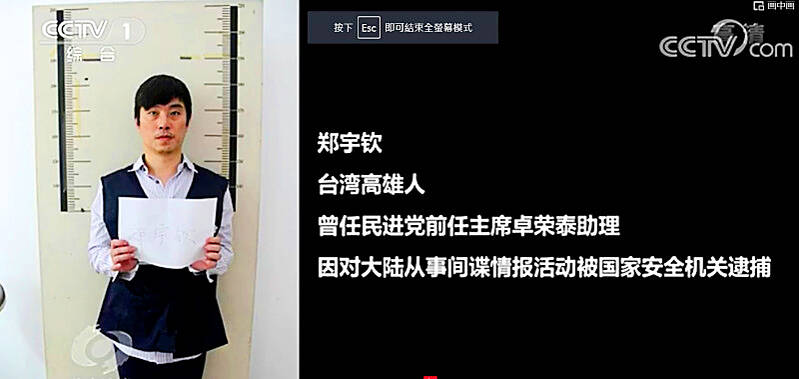
Former Czech Republic-based Taiwanese researcher Cheng Yu-chin (鄭宇欽) has been sentenced to seven years in prison on espionage-related charges, China’s Ministry of State Security announced yesterday. China said Cheng was a spy for Taiwan who “masqueraded as a professor” and that he was previously an assistant to former Cabinet secretary-general Cho Jung-tai (卓榮泰). President-elect William Lai (賴清德) on Wednesday last week announced Cho would be his premier when Lai is inaugurated next month. Today is China’s “National Security Education Day.” The Chinese ministry yesterday released a video online showing arrests over the past 10 years of people alleged to be
THE HAWAII FACTOR: While a 1965 opinion said an attack on Hawaii would not trigger Article 5, the text of the treaty suggests the state is covered, the report says NATO could be drawn into a conflict in the Taiwan Strait if Chinese forces attacked the US mainland or Hawaii, a NATO Defense College report published on Monday says. The report, written by James Lee, an assistant research fellow at Academia Sinica’s Institute of European and American Studies, states that under certain conditions a Taiwan contingency could trigger Article 5 of NATO, under which an attack against any member of the alliance is considered an attack against all members, necessitating a response. Article 6 of the North Atlantic Treaty specifies that an armed attack in the territory of any member in Europe,
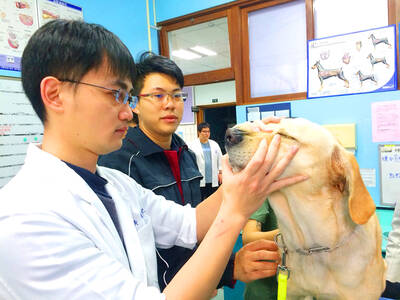
LIKE FAMILY: People now treat dogs and cats as family members. They receive the same medical treatments and tests as humans do, a veterinary association official said The number of pet dogs and cats in Taiwan has officially outnumbered the number of human newborns last year, data from the Ministry of Agriculture’s pet registration information system showed. As of last year, Taiwan had 94,544 registered pet dogs and 137,652 pet cats, the data showed. By contrast, 135,571 babies were born last year. Demand for medical care for pet animals has also risen. As of Feb. 29, there were 5,773 veterinarians in Taiwan, 3,993 of whom were for pet animals, statistics from the Animal and Plant Health Inspection Agency showed. In 2022, the nation had 3,077 pediatricians. As of last
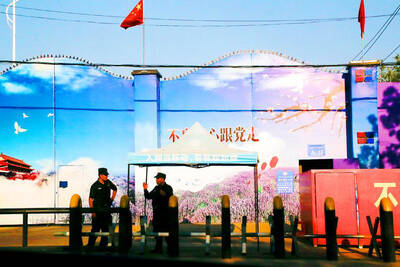
XINJIANG: Officials are conducting a report into amending an existing law or to enact a special law to prohibit goods using forced labor Taiwan is mulling an amendment prohibiting the importation of goods using forced labor, similar to the Uyghur Forced Labor Prevention Act (UFLPA) passed by the US Congress in 2021 that imposed limits on goods produced using forced labor in China’s Xinjiang region. A government official who wished to remain anonymous said yesterday that as the US customs law explicitly prohibits the importation of goods made using forced labor, in 2021 it passed the specialized UFLPA to limit the importation of cotton and other goods from China’s Xinjiang Uyghur region. Taiwan does not have the legal basis to prohibit the importation of goods


 RSS
RSS