


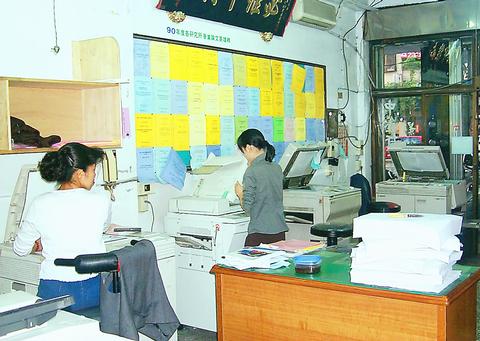
A raid by prosecutors on shops that copy books in Taichung last Tuesday has sparked a legal debate on the issue of intellectual property.
One Singapore and five US-based publishers complained to the Taichung District Prosecutors' Office (
TAIPEI TIMES FILE PHOTO
Nearly 50 prosecutors began their search Tuesday afternoon after obtaining warrants. They discovered pirated copies of hundreds of original publications, as well as invoices for illegal copying services at 10 shops near universities and colleges in the area. The same stores are also suspected of pirating books printed by local publishers.
Prosecutors at the scene arrested the owners of the shops. After being interviewed, the owners were released on bail set between NT$50,000 and NT$100,000.
Local universities acknowledge that piracy is illegal, but school officials and professors said they also hope students can complete their education at a lower cost.
Kwan Shang-jan (
In an effort to help students' pare expenses, Kwan said that the university encourages professors to make transparencies from required textbook chapters.
"Usually, textbooks from a foreign publisher cost a couple thousand dollars," Kwan said. "In Taiwan, due to some legal problems, campus stores cannot work with foreign publishers under a contract relationship and provide a cheaper price or discounts for students.
"This means that students have to spend extra money for their textbooks off campus. That's one of the reasons why most students decided to photocopy these books instead of buy them."
In addition to providing transparencies of assigned chapters, Kwan said that the university library tries to collect as many books as possible. Students are encouraged to check out these books or photocopy parts of them, if necessary.
Two college students, surnamed Roan (阮) from Shih Hsin University (世新大學) and Deng (鄧) from Chinese Culture University (文化大學), said that they would not shell out the cash for expensive foreign textbooks.
"Why? Because the professors wouldn't even go through the entire book most of the time," Roan said.
"When I was a freshman, I would follow professors' instructions to buy the assigned textbooks. Of course, I spent a lot, too," he said.
"But gradually, I realized that professors may just discuss and go through some of the books' chapters. Then, what's the point of me spending that much? I just need the chapters he'll teach."
Roan said that most students understand that it is illegal to photocopy the entire book and will just photocopy the pages they need.
"At least as far as I'm concerned, I don't know anyone who would copy the whole thing," he added.
"Sometimes if the book is thick, copying it won't be any cheaper than buying it."
Deng said that it should be common sense for all college students that piracy is shameful and illegal. However, he strongly suspected that some professors are also pirating students' work.
Deng said that some teachers have collected students' papers, rearranged or rewritten them and turned them into another book. These teachers would then ask students to purchase these books whose contents were pirated from previous students' papers.
"Everybody knows that this phenomenon has existed for years in Taiwan," Deng said. "Why don't prosecutors investigate piracy by professors?"
According to Taiwan's Copyright Law (
Chen Ming-pang (
"Technically, duplicating someone else's intellectual work without their authorization has violated the Copyright Law already," he said. "The motivation itself is wrong."
A librarian at National Taiwan University (NTU,
The note reads, "Please respect the copyright of authors and do not photocopy more than 30 percent of the original work."
Huang Mu-hsuan (黃慕萱), director of NTU's Library Department, said that people's attitude toward the law is the key.
"Students are very smart," Huang said. "I once discovered that a student copied the first two chapters of a book one day, another two chapters the next day and finally finished copying the entire book a few days later. Librarians did not catch him because he copied less than 30 percent of the original work each time he came to the library."
"If a person doesn't have the heart to obey the law and respect copyrights, piracy will still exist no matter what," she added.
Lin Tsung-yao (
"It's just not worth it," he said. "During the economic slowdown, our business was slowing down, too," he said.
"Everybody knows it's illegal. Nobody would risk his neck to pirate books for students for only a few extra bucks."
Meanwhile, Minister of Justice Chen Ding-nan (陳定南) said that the Executive Yuan (行政院) has declared this year the "Year of Intellectual Property Protection."
Chen hoped that in addition to the Taichung District Prosecutors' Office, other local district pro-secutors' offices can carry out a strict crackdown against piracy to get rid of Taiwan's shameful title as "The Kingdom of Piracy."
"Of course I understand it costs a lot to buy books," he said. "However, I don't understand why today's college kids pay lots of money for beautiful cars, motorcycles, scooters or cellular phones, but they won't pay for their books. How come?"
Chen added that students shouldn't make excuses for piracy.
"I don't think that `it's too expensive to buy those books' is a good reason for them to pirate other people's work. It's just an excuse.
"You have to pay for knowledge," he said.
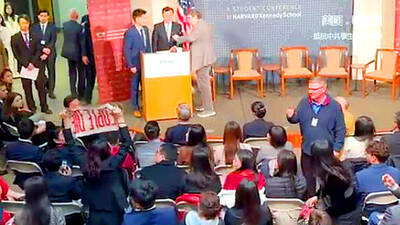
A group of Taiwanese-American and Tibetan-American students at Harvard University on Saturday disrupted Chinese Ambassador to the US Xie Feng’s (謝鋒) speech at the school, accusing him of being responsible for numerous human rights violations. Four students — two Taiwanese Americans and two from Tibet — held up banners inside a conference hall where Xie was delivering a speech at the opening ceremony of the Harvard Kennedy School China Conference 2024. In a video clip provided by the Coalition of Students Resisting the CCP (Chinese Communist Party), Taiwanese-American Cosette Wu (吳亭樺) and Tibetan-American Tsering Yangchen are seen holding banners that together read:

UNAWARE: Many people sit for long hours every day and eat unhealthy foods, putting them at greater risk of developing one of the ‘three highs,’ an expert said More than 30 percent of adults aged 40 or older who underwent a government-funded health exam were unaware they had at least one of the “three highs” — high blood pressure, high blood lipids or high blood sugar, the Health Promotion Administration (HPA) said yesterday. Among adults aged 40 or older who said they did not have any of the “three highs” before taking the health exam, more than 30 percent were found to have at least one of them, Adult Preventive Health Examination Service data from 2022 showed. People with long-term medical conditions such as hypertension or diabetes usually do not
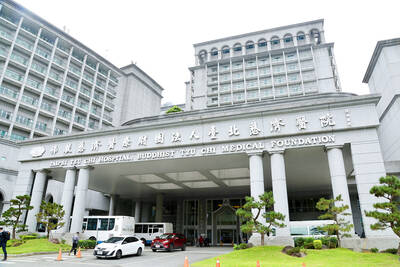
POLICE INVESTIGATING: A man said he quit his job as a nurse at Taipei Tzu Chi Hospital as he had been ‘disgusted’ by the behavior of his colleagues A man yesterday morning wrote online that he had witnessed nurses taking photographs and touching anesthetized patients inappropriately in Taipei Tzu Chi Hospital’s operating theaters. The man surnamed Huang (黃) wrote on the Professional Technology Temple bulletin board that during his six-month stint as a nurse at the hospital, he had seen nurses taking pictures of patients, including of their private parts, after they were anesthetized. Some nurses had also touched patients inappropriately and children were among those photographed, he said. Huang said this “disgusted” him “so much” that “he felt the need to reveal these unethical acts in the operating theater
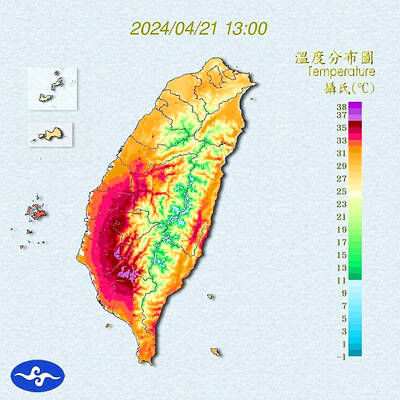
Heat advisories were in effect for nine administrative regions yesterday afternoon as warm southwesterly winds pushed temperatures above 38°C in parts of southern Taiwan, the Central Weather Administration (CWA) said. As of 3:30pm yesterday, Tainan’s Yujing District (玉井) had recorded the day’s highest temperature of 39.7°C, though the measurement will not be included in Taiwan’s official heat records since Yujing is an automatic rather than manually operated weather station, the CWA said. Highs recorded in other areas were 38.7°C in Kaohsiung’s Neimen District (內門), 38.2°C in Chiayi City and 38.1°C in Pingtung’s Sandimen Township (三地門), CWA data showed. The spell of scorching


 RSS
RSS