


Despite yearning to go back to her tribe, for Tsai Yu-lan (
"Reality bites," said Tsai, who has spent the last 19 years in Taipei.

TAIPEI TIMES FILE PHOTO
"In order to earn a living I have no choice but to go on staying in the city because of its job opportunities, which are so often lacking in my tribe."
Another city migrant stays for the same reason.
"Though I often visit my home tribe back in Orchid Island, I stay in the city because of the job I have here," said Simara Os, secretary of the Aboriginal Tribal Party (
Tsai and Os' experiences are not unique. Many Aborigines trade their homes for the nation's cities in search of employment.
Chairman of the Council of Aboriginal Affairs of the Taipei City Government Kung Wen-chi (
Tsai and Os, however, are among a lucky few who have steady jobs in Taipei City.
According to the first annual report released by the Council of Aboriginal Affairs of Taipei City this month, urban Aborigines' unemployment rate reached a record high of 11 percent in Taipei last August.
"The figure is nearly double that of the [non-Aboriginal] public," said Chang Shih-cheng (章世政), a staffer at the council in charge of job consulting for Aborigines.
"It is almost redundant to state the obvious fact that unemployment is a serious problem among urban Aborigines," Chang said.
Tsai Shu-yi (
"Due to the sagging economic environment we have encountered in recent years, there are fewer construction projects and therefore a decrease in the need for construction workers, which is a job many urban Aborigines hold."
"In addition to that, due to their often disadvantaged economic situations, coupled with the massive importation of foreign workers in recent years from mostly southeast Asian countries, urban Aborigines have become increasingly subject to unfair employment opportunities," she said.
Tsai Shu-yi said that the council has recently developed a job training program to redress the problem.
Unlike previous training programs, she said the new program is done in conjunction with several private companies, "such as beauty salons, restaurants, mass media organizations and trade corporations.
"After the trainees complete their training they are automatically granted a spot in these companies according to their interests and specialties."
Because of their disadvantaged educational background, many of the city's Aborigines are engaged in low-level positions, such as security guards, temporary workers and janitors.
"To increase their job opportunities and assist them in keeping up with the pace of mainstream society in today's information era, we hope to enhance job opportunities for the city's urban aboriginal job-seekers by equipping them with up-to-date skills," Tsai Shu-yi said.
Skills in areas such as business management, international marketing, professional knowledge in marketing and design, "are all essential to giving urban Aborigines a competitive edge in today's market economy," she said.
Aside from the unemployment issue, the report also reveals that overall, urban Aborigines' standards of living still lag behind those of other Taiwanese.
"For example," Chang said, "the issue of housing, regarded by many urban Aborigines as too pricey, remains a frequent problem."
According to the report, 43.3 percent of the city's urban Aborigines rent their homes while 36.2 percent own them. The remainder either live with other families or stay in temporary housing.
"Compared to the 80 percent of Taipei's [non-Aboriginal residents] who own their own homes and the of 85 percent of the nation's [non-Aborigines] who own their own houses, the low figure reflects their disadvantaged position," Chang said.
In addition, in comparison to the approximately 80 percent of the public who own personal computers, only 55.7 percent of the city's urban Aborigines own computers.
"With the completion of this report we now can gain a better and a more concrete understanding of the issues confronting the city's Aborigines," Kung said.
"We hope to be able to draw up counter measures to help these urban Aborigines improve their living standards."
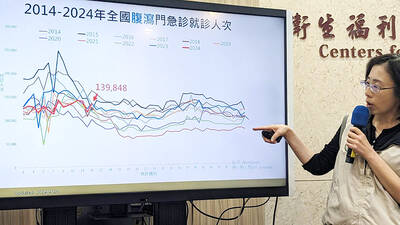
FLU SEASON: Twenty-six severe cases were reported from Tuesday last week to Monday, including a seven-year-old girl diagnosed with influenza-associated encephalopathy Nearly 140,000 people sought medical assistance for diarrhea last week, the Centers for Disease Control (CDC) said on Tuesday. From April 7 to Saturday last week, 139,848 people sought medical help for diarrhea-related illness, a 15.7 percent increase from last week’s 120,868 reports, CDC Epidemic Intelligence Center Deputy Director Lee Chia-lin (李佳琳) said. The number of people who reported diarrhea-related illness last week was the fourth highest in the same time period over the past decade, Lee said. Over the past four weeks, 203 mass illness cases had been reported, nearly four times higher than the 54 cases documented in the same period

A group of Taiwanese-American and Tibetan-American students at Harvard University on Saturday disrupted Chinese Ambassador to the US Xie Feng’s (謝鋒) speech at the school, accusing him of being responsible for numerous human rights violations. Four students — two Taiwanese Americans and two from Tibet — held up banners inside a conference hall where Xie was delivering a speech at the opening ceremony of the Harvard Kennedy School China Conference 2024. In a video clip provided by the Coalition of Students Resisting the CCP (Chinese Communist Party), Taiwanese-American Cosette Wu (吳亭樺) and Tibetan-American Tsering Yangchen are seen holding banners that together read:
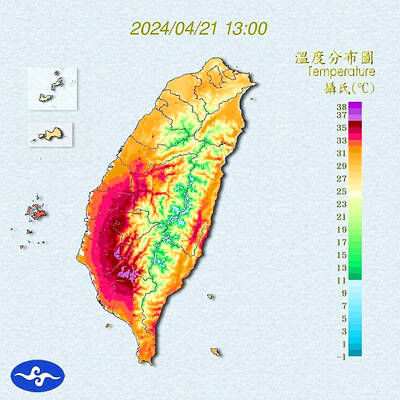
Heat advisories were in effect for nine administrative regions yesterday afternoon as warm southwesterly winds pushed temperatures above 38°C in parts of southern Taiwan, the Central Weather Administration (CWA) said. As of 3:30pm yesterday, Tainan’s Yujing District (玉井) had recorded the day’s highest temperature of 39.7°C, though the measurement will not be included in Taiwan’s official heat records since Yujing is an automatic rather than manually operated weather station, the CWA said. Highs recorded in other areas were 38.7°C in Kaohsiung’s Neimen District (內門), 38.2°C in Chiayi City and 38.1°C in Pingtung’s Sandimen Township (三地門), CWA data showed. The spell of scorching

UNAWARE: Many people sit for long hours every day and eat unhealthy foods, putting them at greater risk of developing one of the ‘three highs,’ an expert said More than 30 percent of adults aged 40 or older who underwent a government-funded health exam were unaware they had at least one of the “three highs” — high blood pressure, high blood lipids or high blood sugar, the Health Promotion Administration (HPA) said yesterday. Among adults aged 40 or older who said they did not have any of the “three highs” before taking the health exam, more than 30 percent were found to have at least one of them, Adult Preventive Health Examination Service data from 2022 showed. People with long-term medical conditions such as hypertension or diabetes usually do not


 RSS
RSS