


Legislators yesterday criticized the Environmental Protection Admin-istration's (EPA) new policy to ban plastic shopping bags and disposable dining utensils from July, saying that the agency lacks concern for the plastics industry and the water shortages in Taiwan.
The EPA finalized its policy in February, announcing that retailers at certain locations would be prohibited from July 1 from offering customers free plastic shopping bags and disposable dining utensils. Meanwhile, disposable dining utensils would also be banned from restaurants from July 1.
The new regulations would affect publicly-operated grocery shops and restaurants at government buildings, public and private educational establishments and military organizations.
Although the policy has provoked a backlash from manufacturers of plastic shopping bags and disposable dining utensils, EPA head Hau Lung-bin (
Hau's resolution received Premier Yu Shyi-kun's support in February. The EPA has announced that the second stage of the anti-pollution campaign would affect all private shopping centers, grocery stores, department stores and fast-food chains from Jan. 1 next year.
Yesterday, TSU lawmaker Liao Pen-yen (
"What if a water crisis happens in the future? How would restaurant operators rinse used dining containers?" Liao asked.
Hau said that the EPA did not ban dinner utensils made from paper and maybe that would be an option.
He also stressed that the policy would result in positive effects for waste management.
"If the first two stages of the policy can be carried out thoroughly, 30 percent of the plastic materials in waste would be reduced," Hau said.
"Plastic materials in waste have been over-burdening incinerators and has led to the prevalence of dioxin pollution in the air."
According to EPA statistics, 20 percent of the nation's garbage is plastic, far higher than the 10 percent of many other developed countries.
Taiwanese consumers use an estimated 20 billion plastic shopping bags per year. On average, each resident uses 2.5 plastic shopping bags daily. Meanwhile, Taiwan consumes 22 million plastic dinner containers per day.
DPP legislators Lai Chin-lin (
They said the move will hurt garbage-collectors, who survive from recycling PET bottles and other reusable materials.
Hau said that the EPA would not cancel the payments until the end of March and people can still receive NT$0.5 for each PET bottle they collect until the end of September.
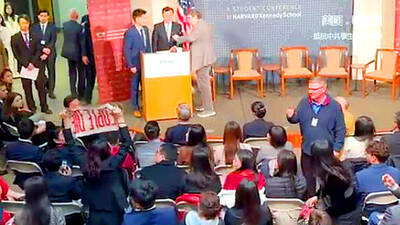
A group of Taiwanese-American and Tibetan-American students at Harvard University on Saturday disrupted Chinese Ambassador to the US Xie Feng’s (謝鋒) speech at the school, accusing him of being responsible for numerous human rights violations. Four students — two Taiwanese Americans and two from Tibet — held up banners inside a conference hall where Xie was delivering a speech at the opening ceremony of the Harvard Kennedy School China Conference 2024. In a video clip provided by the Coalition of Students Resisting the CCP (Chinese Communist Party), Taiwanese-American Cosette Wu (吳亭樺) and Tibetan-American Tsering Yangchen are seen holding banners that together read:

UNAWARE: Many people sit for long hours every day and eat unhealthy foods, putting them at greater risk of developing one of the ‘three highs,’ an expert said More than 30 percent of adults aged 40 or older who underwent a government-funded health exam were unaware they had at least one of the “three highs” — high blood pressure, high blood lipids or high blood sugar, the Health Promotion Administration (HPA) said yesterday. Among adults aged 40 or older who said they did not have any of the “three highs” before taking the health exam, more than 30 percent were found to have at least one of them, Adult Preventive Health Examination Service data from 2022 showed. People with long-term medical conditions such as hypertension or diabetes usually do not
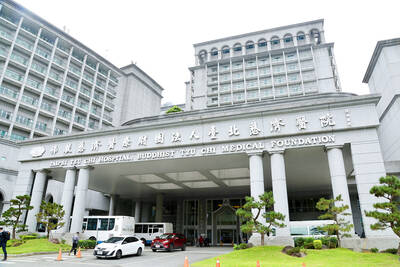
POLICE INVESTIGATING: A man said he quit his job as a nurse at Taipei Tzu Chi Hospital as he had been ‘disgusted’ by the behavior of his colleagues A man yesterday morning wrote online that he had witnessed nurses taking photographs and touching anesthetized patients inappropriately in Taipei Tzu Chi Hospital’s operating theaters. The man surnamed Huang (黃) wrote on the Professional Technology Temple bulletin board that during his six-month stint as a nurse at the hospital, he had seen nurses taking pictures of patients, including of their private parts, after they were anesthetized. Some nurses had also touched patients inappropriately and children were among those photographed, he said. Huang said this “disgusted” him “so much” that “he felt the need to reveal these unethical acts in the operating theater
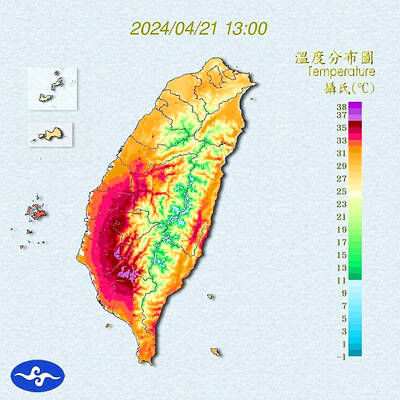
Heat advisories were in effect for nine administrative regions yesterday afternoon as warm southwesterly winds pushed temperatures above 38°C in parts of southern Taiwan, the Central Weather Administration (CWA) said. As of 3:30pm yesterday, Tainan’s Yujing District (玉井) had recorded the day’s highest temperature of 39.7°C, though the measurement will not be included in Taiwan’s official heat records since Yujing is an automatic rather than manually operated weather station, the CWA said. Highs recorded in other areas were 38.7°C in Kaohsiung’s Neimen District (內門), 38.2°C in Chiayi City and 38.1°C in Pingtung’s Sandimen Township (三地門), CWA data showed. The spell of scorching


 RSS
RSS