


A demonstration organized by pro-Taiwan political and social groups will be held today in Taipei City to protest the lifting of the ban on Taiwanese companies investing in eight-inch chipmaking plants in China.
The march, organized by the Taiwan Association of University Professors (
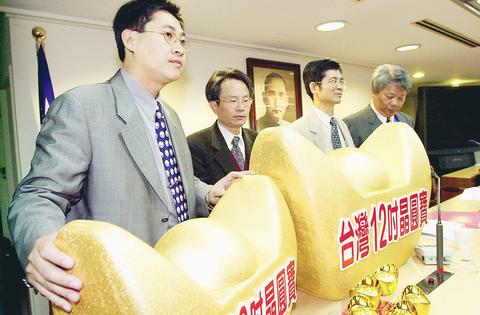
PHOTO: GEORGE TSORNG, TAIPEI TIMES
Organizers said thousands of the people are expected to participate in the event.
Chen I-shen (陳儀深), deputy director of the Taiwan Association of University Professors, stressed that march organizers are not against chipmakers going to China, but rather hope to convince the government to postpone the changes. He said demonstrators hope the march will ignite more in-depth discussion on the matter.
TSU lawmaker Chen Chien-ming (
Hollowing out
"Taiwan will be left empty if [the government] gives away its eight-inch plants to China before it can build the 12-inch plants," Chen said.
Opponents of the ban's lifting argued that Taiwan should wait until the manufacturing of 12-inch wafers stabilizes before it approves the request by Taiwan Semiconductor Manufacturing Co (
Critics said the successful rate for 12-inch wafer production is only 50 percent, while that of eight-inch wafers is 95 percent -- the highest in the world.
Economic worries
Chen said that relaxing the regulations would cripple Taiwan's economy, exacerbate unemployment and cause the country to lose its competitive edge by giving first-rate technology to China.
But according to TSMC Chairman Morris Chang (張忠謀), Taiwan-based companies must to go China to survive due to its gigantic market.
Chang found an ally in Vice President Annette Lu (
Lu said she endorsed the Cabinet's explanation that some of the 23 eight-inch chip plants in Taiwan are already sitting idle.
"Based on the policy of `active opening, effective management,' I support the Cabinet's decision to permit the equipment of eight-inch chipmakers to go to China because some of these plants are idle," she said.
Cooperative effort
But Lu said that both the government and the companies have to work together to come up with measures to prevent high-tech business secrets from being stolen.
Reports Thursday said that a former manager of TSMC was suspected of having stolen trade secrets related to 12-inch wafer manufacturing and given them to a competing company in Shanghai.
Lu said that the US has been more willing to transfer high-technology to Taiwan than China -- which it considers a political rival.
She said Taiwan should be careful with its trade secrets and prevent them from being leaked to China because any leaks would affect the US' willingness to have its technology transferred to Taiwan.
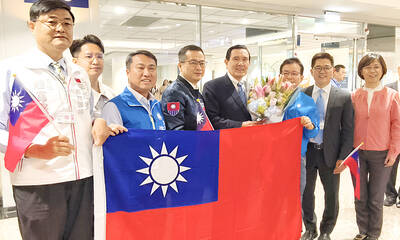
Former president Ma Ying-jeou’s (馬英九) mention of Taiwan’s official name during a meeting with Chinese President Xi Jinping (習近平) on Wednesday was likely a deliberate political play, academics said. “As I see it, it was intentional,” National Chengchi University Graduate Institute of East Asian Studies professor Wang Hsin-hsien (王信賢) said of Ma’s initial use of the “Republic of China” (ROC) to refer to the wider concept of “the Chinese nation.” Ma quickly corrected himself, and his office later described his use of the two similar-sounding yet politically distinct terms as “purely a gaffe.” Given Ma was reading from a script, the supposed slipup
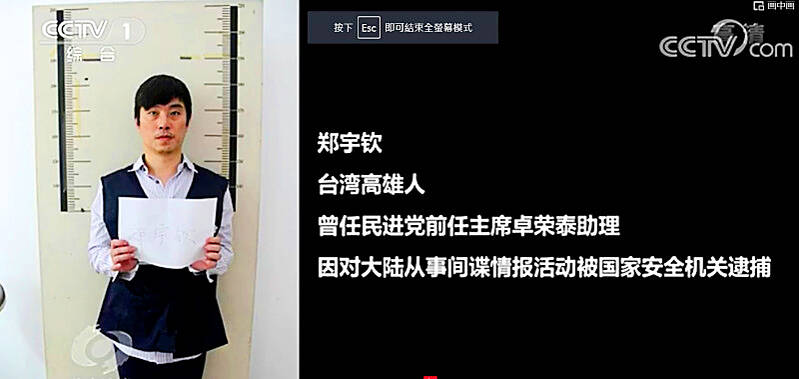
Former Czech Republic-based Taiwanese researcher Cheng Yu-chin (鄭宇欽) has been sentenced to seven years in prison on espionage-related charges, China’s Ministry of State Security announced yesterday. China said Cheng was a spy for Taiwan who “masqueraded as a professor” and that he was previously an assistant to former Cabinet secretary-general Cho Jung-tai (卓榮泰). President-elect William Lai (賴清德) on Wednesday last week announced Cho would be his premier when Lai is inaugurated next month. Today is China’s “National Security Education Day.” The Chinese ministry yesterday released a video online showing arrests over the past 10 years of people alleged to be
THE HAWAII FACTOR: While a 1965 opinion said an attack on Hawaii would not trigger Article 5, the text of the treaty suggests the state is covered, the report says NATO could be drawn into a conflict in the Taiwan Strait if Chinese forces attacked the US mainland or Hawaii, a NATO Defense College report published on Monday says. The report, written by James Lee, an assistant research fellow at Academia Sinica’s Institute of European and American Studies, states that under certain conditions a Taiwan contingency could trigger Article 5 of NATO, under which an attack against any member of the alliance is considered an attack against all members, necessitating a response. Article 6 of the North Atlantic Treaty specifies that an armed attack in the territory of any member in Europe,
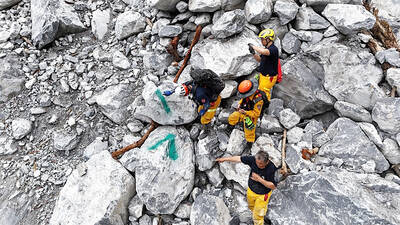
The bodies of two individuals were recovered and three additional bodies were discovered on the Shakadang Trail (砂卡礑) in Taroko National Park, eight days after the devastating earthquake in Hualien County, search-and-rescue personnel said. The rescuers reported that they retrieved the bodies of a man and a girl, suspected to be the father and daughter from the Yu (游) family, 500m from the entrance of the trail on Wednesday. The rescue team added that despite the discovery of the two bodies on Friday last week, they had been unable to retrieve them until Wednesday due to the heavy equipment needed to lift


 RSS
RSS