


An influential and senior exiled Tibetan lama yesterday received the Mongolian and Tibetan Affairs Commission's (
The lama, Kunzig Shamar Rinpoche (
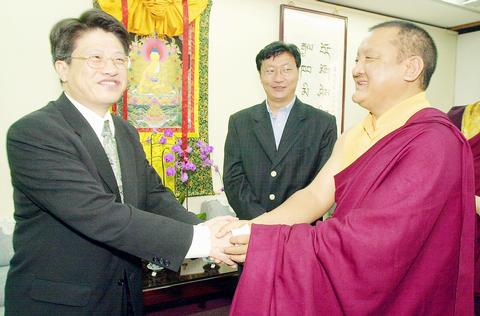
PHOTO: CHIANG YING-YING, TAIPEI TIMES
They were received by the commission's chairman, Hsu Chih-hsiung (
The delegation is visiting Tai-wan to preach Tibetan Buddhism. Shamar Rinpoche is a senior lama and one of four bodyguards to Karmapa Rinpoche, the head of one of the four branches of Tibetan Buddhism.
Hsu agreed at the meeting, attended by members of the press, that Tibetan Buddhism has many supporters in Taiwan who need spiritual guidance.
"It is necessary to simplify the visa application process for lamas," he said.
Currently, for lamas exiled from Tibet since China's 1959 crackdown on Tibetan dissidents and religious activists, the Tai-wan government uses a time-consuming procedure to verify their identities.
The procedure, according to the commission official Hsu Kui-siang (徐桂香), is necessary because most exiled lamas live in South Asian countries such as India, Nepal, and Bhutan where the forging of documents is very common.
"In order for their status as lamas qualified to preach the religion to be confirmed, they have to send their documents to the commission in Taipei to examine, so their visas can be approved by the Ministry of Foreign Affairs," said Hsu Kui-siang yesterday.
According to the commission's statistics, the numbers of lamas (Tibetan Buddhist monks) applying to come to Taiwan to preach the religion has risen from about 900 per year 10 years ago to about 2,000 cases each year now.
Hsu and Shamar Rinpoche also discussed the possibility of the commission being abolished, as reported by the local media recently.
Hsu said that the purpose of the government's downsizing plan was to raise the nation's competitiveness.
"Under this consideration, an adjustment to the position of the commission is necessary," he said.
Hsu Chih-hsiung added, the function of the commission should be retained, but not necessarily at the level of a commission level.
"How the downsizing will be carried out and how it will affect the commission are currently being studied and no final decision has yet been taken," he said.
But according to a Chinese-language media report on Sunday, Hsu has recommended merging it with the Mainland Affairs Council (MAC) to create a "Mainland, Mongolian and Tibetan Affairs Commission."
MAC Chairwoman Tsai Ing-wen (
Government ministers told a press conference held on Saturday that a consensus had been reached at a planning meeting on government reforms on Saturday to aim to reduce the number of ministries and councils to between 20 and 23, down from the current 36.
No changes to the structure of the government will take effect until May 2004.
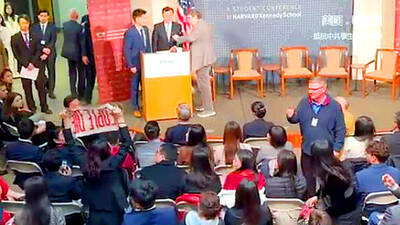
A group of Taiwanese-American and Tibetan-American students at Harvard University on Saturday disrupted Chinese Ambassador to the US Xie Feng’s (謝鋒) speech at the school, accusing him of being responsible for numerous human rights violations. Four students — two Taiwanese Americans and two from Tibet — held up banners inside a conference hall where Xie was delivering a speech at the opening ceremony of the Harvard Kennedy School China Conference 2024. In a video clip provided by the Coalition of Students Resisting the CCP (Chinese Communist Party), Taiwanese-American Cosette Wu (吳亭樺) and Tibetan-American Tsering Yangchen are seen holding banners that together read:

UNAWARE: Many people sit for long hours every day and eat unhealthy foods, putting them at greater risk of developing one of the ‘three highs,’ an expert said More than 30 percent of adults aged 40 or older who underwent a government-funded health exam were unaware they had at least one of the “three highs” — high blood pressure, high blood lipids or high blood sugar, the Health Promotion Administration (HPA) said yesterday. Among adults aged 40 or older who said they did not have any of the “three highs” before taking the health exam, more than 30 percent were found to have at least one of them, Adult Preventive Health Examination Service data from 2022 showed. People with long-term medical conditions such as hypertension or diabetes usually do not
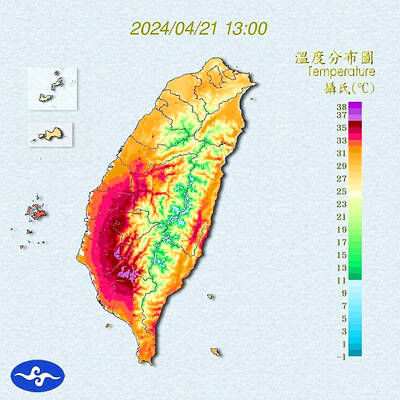
Heat advisories were in effect for nine administrative regions yesterday afternoon as warm southwesterly winds pushed temperatures above 38°C in parts of southern Taiwan, the Central Weather Administration (CWA) said. As of 3:30pm yesterday, Tainan’s Yujing District (玉井) had recorded the day’s highest temperature of 39.7°C, though the measurement will not be included in Taiwan’s official heat records since Yujing is an automatic rather than manually operated weather station, the CWA said. Highs recorded in other areas were 38.7°C in Kaohsiung’s Neimen District (內門), 38.2°C in Chiayi City and 38.1°C in Pingtung’s Sandimen Township (三地門), CWA data showed. The spell of scorching
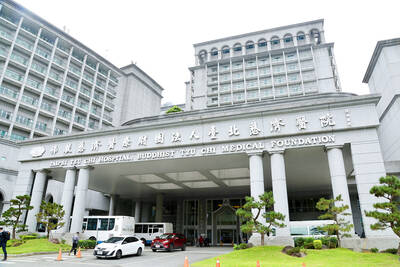
POLICE INVESTIGATING: A man said he quit his job as a nurse at Taipei Tzu Chi Hospital as he had been ‘disgusted’ by the behavior of his colleagues A man yesterday morning wrote online that he had witnessed nurses taking photographs and touching anesthetized patients inappropriately in Taipei Tzu Chi Hospital’s operating theaters. The man surnamed Huang (黃) wrote on the Professional Technology Temple bulletin board that during his six-month stint as a nurse at the hospital, he had seen nurses taking pictures of patients, including of their private parts, after they were anesthetized. Some nurses had also touched patients inappropriately and children were among those photographed, he said. Huang said this “disgusted” him “so much” that “he felt the need to reveal these unethical acts in the operating theater


 RSS
RSS