


The Netherlands is a small country but its flat landscape offers wide, expansive vistas. Can the same be said of the country's intellectual life? Is the Netherlands a good destination for someone wishing to study abroad? Is it a good place to gain international experience?
Dutch higher education institutions aims at international audience
Certain facts speak for themselves. Altogether, the Dutch higher education institutions offer more than 1500 study programmes and courses conducted in English and aimed at an international audience. In 2001, parliament adopted a law that is making it possible for the institutions to replace the traditional, uniquely Dutch system of degrees and titles with the more internationally familiar bachelor'-master's model. Each institution is now working hard to introduce the change as soon as possible. Sooner or later institutions throughout the European Union will be doing the same, but for the present the Netherlands is a frontrunner. But is this the only reason for choosing the Netherlands? No, there are more.
Cosmopolitan tradition
In the 16th and 17th centuries, when the Netherlands founded its first universities, the entire intelligentsia of Europe had its books printed in the Netherlands because ideas could be expressed here so freely. The current spirit of Dutch higher education rests on this foundation of academic freedom. But the Dutch have always been practical, and freedom must also lead to results. If the Netherlands is to maintain its high standard of living, it must continue to operate at the forefront of science and technology.
The country today has 85 higher education institutions that together enroll approximately 455,000 students. Each year more than 80,000 of these students graduate and join the workforce.
A cosmopolitan atmosphere characterizes Dutch society. Newsstands sell newspapers and magazines from all over the world. The Netherlands imports more books from the United States and Britain than any other non-English-speaking country.
Nearly all Dutch people speak English and usually one or more other foreign languages. University libraries build up their huge collections with acquisitions from all over the world. A glance through any of their catalogues tells you that you indeed have access to an international repository of ideas.
Cosmopolitan higher education
Against this cosmopolitan background, it is not surprising that the Netherlands' higher education institutions conduct more than 1,600 of their study programmes in English for the benefit of international students. No other non-English-speaking country in the world offers such a large and varied range of possibilities. The online database of "International Study Programmes and Courses offered in the Netherlands" represents the entire spectrum of knowledge and skills-from civil engineering to music, and from agricultural sciences to communication studies.
Many of the study programmes lead to master's degrees, but the pursuit of a PhD is also possible, and programmes are offered at bachelor's level. In addition, there are many highly specialized short courses that fall outside the system of degrees. But in all of these international programmes and courses, the fact that students come from all over the world is taken into account. In terms of content, the curriculum is presented not just in a Dutch context but in a global context.
An important feature of Dutch higher education offers another advantage for international students. Students in the Netherlands learn to develop their own views and to apply their own creativity. Practicals, project work, and the writing of papers-usually on a topic of one's own choosing-are important elements in all curricula. Students can choose topics that are relevant to their own countries and their own careers.
Quality of higher education
Dutch higher education is at the high level you would expect, given this background. The Ministry of Education, Culture and Science helps ensure this through a system of peer review which enlists independent experts-often from abroad as well as from home-to make periodic assessments of each programme of study. These reports are made public and discussed in the media, making them an effective system of quality control. If the findings are not what they should be, the Minister does not hesitate to intervene.
Modest fees
In relation to what students get, fees are modest. There are two reasons for this. First is the fact that the Netherlands over the last 30 years has chosen to compete in terms of price as well as quality. The 'social partners'-government, trade unions, and employers' associations-have agreed that wage moderation is in everyone's interest.
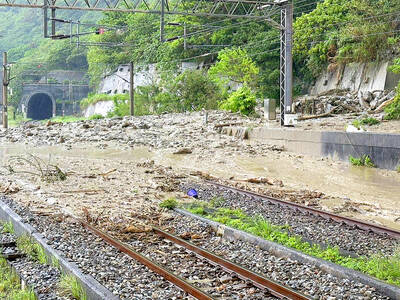
ROLLER-COASTER RIDE: More than five earthquakes ranging from magnitude 4.4 to 5.5 on the Richter scale shook eastern Taiwan in rapid succession yesterday afternoon Back-to-back weather fronts are forecast to hit Taiwan this week, resulting in rain across the nation in the coming days, the Central Weather Administration said yesterday, as it also warned residents in mountainous regions to be wary of landslides and rockfalls. As the first front approached, sporadic rainfall began in central and northern parts of Taiwan yesterday, the agency said, adding that rain is forecast to intensify in those regions today, while brief showers would also affect other parts of the nation. A second weather system is forecast to arrive on Thursday, bringing additional rain to the whole nation until Sunday, it
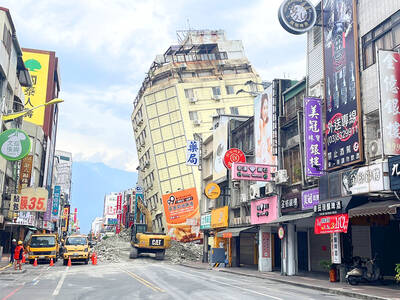
LANDSLIDES POSSIBLE: The agency advised the public to avoid visiting mountainous regions due to more expected aftershocks and rainfall from a series of weather fronts A series of earthquakes over the past few days were likely aftershocks of the April 3 earthquake in Hualien County, with further aftershocks to be expected for up to a year, the Central Weather Administration (CWA) said yesterday. Based on the nation’s experience after the quake on Sept. 21, 1999, more aftershocks are possible over the next six months to a year, the agency said. A total of 103 earthquakes of magnitude 4 on the local magnitude scale or higher hit Hualien County from 5:08pm on Monday to 10:27am yesterday, with 27 of them exceeding magnitude 5. They included two, of magnitude
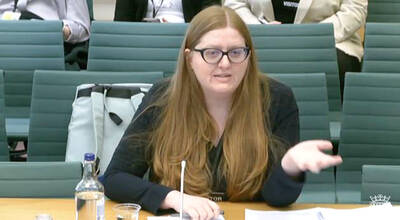
CONDITIONAL: The PRC imposes secret requirements that the funding it provides cannot be spent in states with diplomatic relations with Taiwan, Emma Reilly said China has been bribing UN officials to obtain “special benefits” and to block funding from countries that have diplomatic ties with Taiwan, a former UN employee told the British House of Commons on Tuesday. At a House of Commons Foreign Affairs Committee hearing into “international relations within the multilateral system,” former Office of the UN High Commissioner for Human Rights (OHCHR) employee Emma Reilly said in a written statement that “Beijing paid bribes to the two successive Presidents of the [UN] General Assembly” during the two-year negotiation of the Sustainable Development Goals. Another way China exercises influence within the UN Secretariat is

Taiwan’s first drag queen to compete on the internationally acclaimed RuPaul’s Drag Race, Nymphia Wind (妮妃雅), was on Friday crowned the “Next Drag Superstar.” Dressed in a sparkling banana dress, Nymphia Wind swept onto the stage for the final, and stole the show. “Taiwan this is for you,” she said right after show host RuPaul announced her as the winner. “To those who feel like they don’t belong, just remember to live fearlessly and to live their truth,” she said on stage. One of the frontrunners for the past 15 episodes, the 28-year-old breezed through to the final after weeks of showcasing her unique


 RSS
RSS