


It does not require a great deal of imagination to work out the marketing strategy of the Lingerie Football League (LFL), which opened its debut season yesterday.
The underwear-clad female players are hoping, however — probably in vain — to be taken seriously.
The LFL, born out of the commercial success of the “Lingerie Bowl,” a half-time show of women in scanty outfits broadcast during the half-time break in the National Football League (NFL) Super Bowl, has 10 teams competing in seven-a-side full-contact American football, with players dressed in sports bras and the tiniest of shorts.
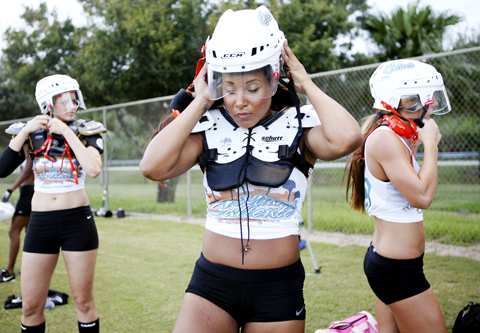
PHOTO: REUTERS
The branding is blatant — the teams have names such as the San Diego Seduction, Dallas Desire and Los Angeles Temptation — and their Web sites and promotional material are more akin to those for NFL cheerleaders than genuine professional sports.
The league’s founder, Mitch Mortaza, has described the venture as “Disneyland for football fans,” but those taking part say they are serious about the sport and about winning.
“I think it is eye candy for one, but it is also football and it is real,” says Kaley Tuning, wide receiver with the Miami Caliente, who opened the season yesterday at the Chicago Bliss.
“There were tryouts for the team and if you couldn’t play you didn’t make the cut,” she said.
“I’ve seen people say it is a joke and it is degrading and it makes me mad. We are real athletes, for them to not take us seriously, well I say wait till you see us play,” she added.
Watching the Caliente practice, at a sports facility in the suburbs of Miami under the charge of former college football quarterback Bob Hewko, the strange clash of glamor girls and sport is quickly evident.
The training is taken seriously and the players work hard and look intense in the huddle, but a Gucci handbag takes its place alongside the helmets on the sideline and one player, who like many is also a model, worries that she has picked up scratches ahead of photo shoot in a few days’ time.
Hewko concedes that looks played a major part in the selection of the squad, but, like everyone involved in the venture, says fans will see real football.
“I was surprised at the level — the level of talent. They can run, they can catch and we have a quarterback that can throw the football 60 yards,” he said.
Thousands of women play organized games of American Football across the US in amateur teams wearing conventional uniforms, and receiving little major commercial interest.
Miami Fury has been a member of the Independent Women’s Football League for all of its 10-year existence and the team’s co-owner Gayla Harrington said she was initially uneasy about the formation of the Lingerie team largely due to the attire.
However, with the Caliente recruiting two of her players, she said the team had become more of a sports project than she initially imagined.
“It is more athletic, a little more serious than I originally thought,” she said, adding that she would support the team in their home games, but was unsure whether the LFL would help her to generate backing for her own team.
“It could be a positive or a negative. It could be that people still don’t take [women’s football] seriously, but then again it might help,” she said.
Feminist writer Courtney Martin has no doubts over whether the LFL will help women.
“This is objectification at its most pernicious — give women an opportunity to participate in a sport that they haven’t had the chance to do for pay and publicly previously, but only let them do it if they are stereotypically pretty and willing to do it in their underwear,” she wrote on Web site feministing.com.
So why not simply play the game in conventional dress?
“But then half the people wouldn’t watch,” Tuning said.
“Sure, some people aren’t going to watch because they think it is degrading or they don’t want to watch it with their kids,” she said. “But then there is going to be a group of people who watch it because of [the attire] and they might say: ‘Wow — this is real, athletic and they know what they are doing.’”

Four-time NBA all-star DeMarcus Cousins arrived in Taiwan with his family early yesterday to finish his renewed contract with the Taiwan Beer Leopards in the T1 League. Cousins initially played a four-game contract with the Leopards in January. On March 18, the Taoyuan-based team announced that Cousins had renewed his contract. “Hi what’s up Leopard fans, I’m back. I’m excited to be back and can’t wait to join the team,” Cousins said in a video posted on the Leopard’s Facebook page. “Most of all, can’t wait to see you guys, the fans, next weekend. So make sure you come out and support the Beer

Revelations of positive doping tests for nearly two dozen Chinese swimmers that went unpunished sparked an intense flurry of accusations and legal threats between the World Anti-Doping Agency (WADA) and the head of the US drug-fighting organization, who has long been one of WADA’s fiercest critics. WADA on Saturday said it was turning to legal counsel to address a statement released by US Anti-Doping Agency (USADA) CEO Travis Tygart, who said WADA and anti-doping authorities in China swept positive tests “under the carpet by failing to fairly and evenly follow the global rules that apply to everyone else in the world.” The

Taiwanese judoka Yang Yung-wei on Saturday won silver in the men’s under-60kg category at the Asian Judo Championships in Hong Kong. Nicknamed the “judo heartthrob” in Taiwan, the Olympic silver-medalist missed out on his first Asian Championships gold when he lost to Japanese judoka Taiki Nakamura in the finals. Yang defeated three opponents on Saturday to reach the final after receiving a bye through the round of 32. He first topped Laotian Soukphaxay Sithisane in the round of 16 with two seoi nage (over-the-shoulder throws), then ousted Indian Vijay Kumar Yadav in the quarter-finals with his signature ude hishigi sankaku gatame (triangular armlock). He
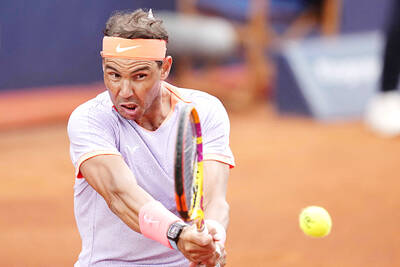
Rafael Nadal on Wednesday said the upcoming French Open would be the moment to “give everything and die” on the court after his comeback from injury in Barcelona was curtailed by Alex de Minaur. The 22-time Grand Slam title winner, back playing this week after three months on the sidelines, battled well, but eventually crumbled 7-5, 6-1 against the world No. 11 from Australia in the second round. Nadal, 37, who missed virtually all of last season, is hoping to compete at the French Open next month where he is the record 14-time champion. The Spaniard said the clash with De Minaur was


 RSS
RSS