


The Japanese word kawaigari means “doting,” but in the grueling world of sumo it is an ironic euphemism for pushing a wrestler to the very limits of his physical and mental endurance.
It can include beatings with bamboo sticks and choking with sand or salt — and in one infamous case led to the death of a teenage recruit who had tried to flee the privations of his sumo stable.
Harumafuji, who last month won Japan’s major tournament, recalled the pain and tears that toughened him up in the nine years since he arrived from his native Mongolia with no money and not a word of Japanese.
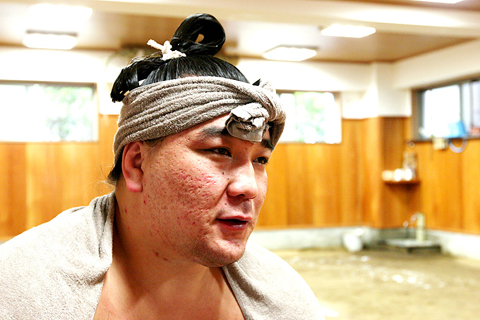
PHOTO: AFP
“It’s a man’s world,” said the 25-year-old champion whose real name is Davaanyam Byambadorj, taking a rest with a sweatband around his head after a recent five-hour morning training session in his Tokyo stable.
“I had to get used to the bullying, beatings, hunger, and then the language and the culture which I did not understand,” he said, recalling how he was singled out for extra torment because he is a foreigner.
“It was rough,” he said. “It’s a world where you either become strong or not. In that sense, as much as it was painful, I felt very strongly that I would do my best to become strong as quickly as possible.”
In sumo, kawaigari means “crying, then being forced to stand, then being beaten again. It’s not simple to express with words because it’s a physical experience,” he said.
But it’s not just the beatings that steel the wrestlers in the quasi-monastic life of the sumo stable, where the fighters forfeit much of their personal liberty and embark on a grueling daily routine.
The younger wrestlers start the day at 3am cleaning the stable, washing their seniors’ loincloths and preparing meals. They are banned from watching television and using cellphones, and receive only modest pocket money.
Harumafuji said he found it toughest to get used to a diet heavy on fish — which has sent some of his mutton-eating compatriots running to the Mongolian embassy to escape Japan — served in huge quantities of 10,000 calories a day.
“Everyone says going on a diet is hard, but I think gaining weight is so many times more difficult,” he said. “Eating was the scariest, and my most painful experience.”
“I’m thin by nature, so I really had a hard time to eat in the beginning. I ate and I vomited. Ate and vomited. Your stomach expands when you do that, so I was forced to eat until I vomited,” Harumafuji said. “When I vomited, there would be someone already waiting with food, and I was forced to eat again.”
The force-feeding helped boost the 1.85m athlete’s weight to 126kg from 86kg — still about 30kg lighter than the average top division wrestler.
Harumafuji has no regrets.
“The sumo ring is very honest. He who really does his best will rise. Man’s efforts don’t lie,” he said. “I’m glad I did sumo, I am very grateful. I have learnt many things inside the ring, about life, the path I’ve chosen, about cherishing people.”
“Any punk who swaggers into a stable will change in one day. He will be cleaning the next day — cleaning toilets, crying. He’d be forced to lick the toilet bowl, because he’d be bullied,” Harumafuji said, smirking. “There are many obstacles, but if you’re able to get over them, you can become stronger than the others. If you rise up, everyone will follow you, thinking, ‘This guy’s tough.’”
Sumo may be as Japanese as samurai and sushi, but foreign-born wrestlers have entered the ring to steal the show in the 2,000-year-old national sport.
Sumo hasn’t had a home-grown champion in more than three years, and in the latest national tournament more than one-third of competitors were foreigners.
As fewer young Japanese sign up for the harsh life of the sumo stable, the sport’s 700-strong elite now include men from China, South Korea, Eastern Europe and as far away as Brazil and the Pacific island state of Tonga.
As sports such as baseball and soccer have gained ground, the number of Japanese sumo recruits has more than halved since its peak in 1992 of 223 local wrestlers.
Traditionally, young wrestlers were recruited from farming and fishing communities in the remote north and south, said Doreen Simmons, a veteran English-language sumo commentator for national broadcaster NHK.
Sumo opened its doors to foreigners decades ago, and spectators still delight when gaijin wrestlers exhibit what are seen by many as the essential Japanese characteristics of modesty, endurance and diligence.
The presence of foreigners will not lead to the internationalization of the sport, Simmons said, as the newcomers must assimilate, learn Japanese and adapt to the local diet, dress, customs and training regime.
“Any foreigner who succeeds in sumo must do it the Japanese way,” she said.

Revelations of positive doping tests for nearly two dozen Chinese swimmers that went unpunished sparked an intense flurry of accusations and legal threats between the World Anti-Doping Agency (WADA) and the head of the US drug-fighting organization, who has long been one of WADA’s fiercest critics. WADA on Saturday said it was turning to legal counsel to address a statement released by US Anti-Doping Agency (USADA) CEO Travis Tygart, who said WADA and anti-doping authorities in China swept positive tests “under the carpet by failing to fairly and evenly follow the global rules that apply to everyone else in the world.” The

Taiwanese judoka Yang Yung-wei on Saturday won silver in the men’s under-60kg category at the Asian Judo Championships in Hong Kong. Nicknamed the “judo heartthrob” in Taiwan, the Olympic silver-medalist missed out on his first Asian Championships gold when he lost to Japanese judoka Taiki Nakamura in the finals. Yang defeated three opponents on Saturday to reach the final after receiving a bye through the round of 32. He first topped Laotian Soukphaxay Sithisane in the round of 16 with two seoi nage (over-the-shoulder throws), then ousted Indian Vijay Kumar Yadav in the quarter-finals with his signature ude hishigi sankaku gatame (triangular armlock). He
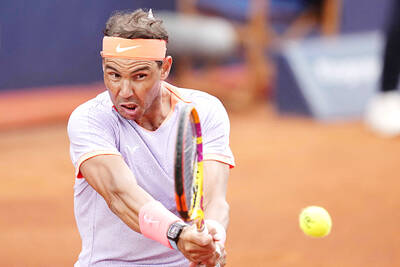
Rafael Nadal on Wednesday said the upcoming French Open would be the moment to “give everything and die” on the court after his comeback from injury in Barcelona was curtailed by Alex de Minaur. The 22-time Grand Slam title winner, back playing this week after three months on the sidelines, battled well, but eventually crumbled 7-5, 6-1 against the world No. 11 from Australia in the second round. Nadal, 37, who missed virtually all of last season, is hoping to compete at the French Open next month where he is the record 14-time champion. The Spaniard said the clash with De Minaur was

RALLY: It was only the second time the Taiwanese has partnered with Kudermetova, and the match seemed tight until they won seven points in a row to take the last set 10-2 Taiwan’s Chan Hao-ching and Russia’s Veronika Kudermetova on Sunday won the Porsche Tennis Grand Prix women’s doubles final in Stuttgart, Germany. The pair defeated Norway’s Ulrikke Eikeri and Estonia’s Ingrid Neel 4-6, 6-3, 10-2 in a tightly contested match at the WTA 500 tournament. Chan and Kudermetova fell 4-6 in the first set after having their serve broken three times, although they played increasingly well. They fought back in the second set and managed to break their opponents’ serve in the eighth game to triumph 6-3. In the tiebreaker, Chan and Kudermetova took a 3-0 lead before their opponents clawed back two points, but


 RSS
RSS