


Gazing down from a helicopter at a huge garbage dump in the middle of Tokyo Bay, architect Tadao Ando had an idea that became part of the city’s Olympic dream — to create a vast new “Sea Forest.”
At the time, the man-made island of trash wasn’t much to look at.
The mega city of Tokyo, the world’s largest with 36 million people, long ago ran out of space for the mountains of rubbish it was producing and had used millions of tonnes since the 1970s as landfill to create the artificial island.
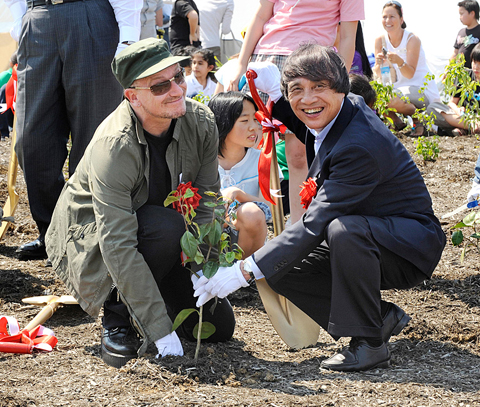
PHOTO: AFP
Looking at the 88-hectare wasteland of garbage and dirt, fenced in and criss-crossed by bulldozer tracks, Ando instead imagined an oasis of natural beauty on the edge of the Japanese capital.
“I wanted to convert the landfill space into a forest,” the renowned architect said. “Japan in the past was covered in forests. But because we have burnt so much, these forests have started to diminish.”
Ando said he wants to send a strong environmental message with the Umi-no-Mori or “Sea Forest”, landfill project — for a return to nature and to boost efforts to counter global warming.
“The Earth is going to face this problem of waste,” he said. “That’s the reason I want to show that waste can be converted into forest. This forest doesn’t belong only to Tokyo but to the world.”
With Tokyo bidding to host the 2016 Olympics and promising the greenest Games ever, the island is among the key features Japan hopes will bring the event to the city.
As part of the green Games plan, Tokyo Governor Shintaro Ishihara has also promised to add 1,000 hectares of green space over a decade, including parks, rooftop gardens and trees planted beside railway tracks.
On the island, tens of thousands of fast-growing tree saplings have already been planted since 2007 to turn it into a forest park that would host the Olympic equestrian and mountain bike and BMX cycling events.
A seawater channel that cuts through the island would be used for rowing, flatwater canoe and kayak competitions as well as marathon swimming.
Part of the design idea is that the forest-island will further cool sea breezes as they head into the concrete jungle that is Tokyo on sweltering summer days and act like a natural air-conditioner.
Rock star and activist Bono has planted trees at the site, as have Nobel laureates and a Japanese astronaut.
“The forest is symbolic,” Ando said. “But it will be realized regardless of whether we win the Olympics or not, because improving the environment is not just for the Olympics.”

Revelations of positive doping tests for nearly two dozen Chinese swimmers that went unpunished sparked an intense flurry of accusations and legal threats between the World Anti-Doping Agency (WADA) and the head of the US drug-fighting organization, who has long been one of WADA’s fiercest critics. WADA on Saturday said it was turning to legal counsel to address a statement released by US Anti-Doping Agency (USADA) CEO Travis Tygart, who said WADA and anti-doping authorities in China swept positive tests “under the carpet by failing to fairly and evenly follow the global rules that apply to everyone else in the world.” The

Taiwanese judoka Yang Yung-wei on Saturday won silver in the men’s under-60kg category at the Asian Judo Championships in Hong Kong. Nicknamed the “judo heartthrob” in Taiwan, the Olympic silver-medalist missed out on his first Asian Championships gold when he lost to Japanese judoka Taiki Nakamura in the finals. Yang defeated three opponents on Saturday to reach the final after receiving a bye through the round of 32. He first topped Laotian Soukphaxay Sithisane in the round of 16 with two seoi nage (over-the-shoulder throws), then ousted Indian Vijay Kumar Yadav in the quarter-finals with his signature ude hishigi sankaku gatame (triangular armlock). He
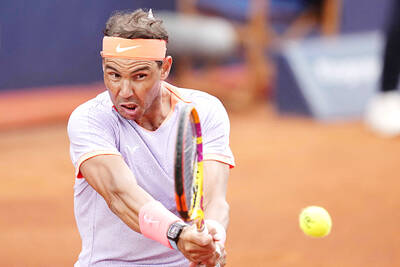
Rafael Nadal on Wednesday said the upcoming French Open would be the moment to “give everything and die” on the court after his comeback from injury in Barcelona was curtailed by Alex de Minaur. The 22-time Grand Slam title winner, back playing this week after three months on the sidelines, battled well, but eventually crumbled 7-5, 6-1 against the world No. 11 from Australia in the second round. Nadal, 37, who missed virtually all of last season, is hoping to compete at the French Open next month where he is the record 14-time champion. The Spaniard said the clash with De Minaur was

RALLY: It was only the second time the Taiwanese has partnered with Kudermetova, and the match seemed tight until they won seven points in a row to take the last set 10-2 Taiwan’s Chan Hao-ching and Russia’s Veronika Kudermetova on Sunday won the Porsche Tennis Grand Prix women’s doubles final in Stuttgart, Germany. The pair defeated Norway’s Ulrikke Eikeri and Estonia’s Ingrid Neel 4-6, 6-3, 10-2 in a tightly contested match at the WTA 500 tournament. Chan and Kudermetova fell 4-6 in the first set after having their serve broken three times, although they played increasingly well. They fought back in the second set and managed to break their opponents’ serve in the eighth game to triumph 6-3. In the tiebreaker, Chan and Kudermetova took a 3-0 lead before their opponents clawed back two points, but


 RSS
RSS