


A year on from a sado-masochistic sex scandal that was the talk of Formula One, motor racing chief Max Mosley is still very much in charge.
Branded a paddock pariah after the News of the World tabloid exposed details of his sex life, the controversial Briton has recast himself as a savior of the sport and looks more entrenched than ever.
It would surprise nobody if, instead of standing down in October as he has said he would, the 68-year-old Mosley decided to seek re-election as president of the International Automobile Federation (FIA).
Over the last year, he has secured a ringing endorsement from the FIA in a confidence vote and won a landmark case in England’s High Court against the newspaper for violation of privacy.
After batting off calls for his resignation, including murmurings from long-time friend and paddock ally Bernie Ecclestone, he is now being urged to stay on after 18 years at the helm.
It would, he has said, be “churlish” of him not to pay attention.
“It [the job] is interesting at the moment and to walk away would be to leave it [the sport] in a state of uncertainty, which is probably not the thing to do,” he told reporters at a lunch in London last month.
“But I don’t think I have to think about that until June or July,” added Mosley, an Oxford-educated lawyer whose father, Oswald, was founder of the pre-World War II British Union of Fascists and whose mother was society beauty Diana Mitford.
Mosley will not be in Melbourne for the start of the season next week, and is unlikely to appear in a grand prix paddock before Monaco in May, but he will still have his hands full.
With the world plunged into recession and carmakers feeling the pain, he has been pushing hard to cut costs and secure a stable future for a sport long associated with profligacy.
“There has been a Formula One bubble which rivals any credit bubble or housing bubble or IT bubble and there seems a reluctance to recognize that,” he said last month, describing the crisis as the worst he had experienced in 40 years’ involvement.
His response has brought him into conflict with some teams and manufacturers who want to save money but have their own ideas about how to do it and where the sport should be heading.
In the past week Mosley has raised the stakes further by presenting what amounts to a full-scale revolution, announcing the introduction of a voluntary £30 million (US$42.74 million) budget cap from next year with far-reaching implications.
Teams who accept it will be granted considerable technical freedom and space to innovate but will have to do so within a tight budget.
Those who reject such a measure will be allowed to spend what they want — in excess of US$300 million a year in some cases — but remain subject to tight technical controls that would level the playing field.
“There is no reason why cost-capped teams could not win races,” Mosley said. “The massive and highly organized unlimited-expenditure teams are perhaps likely to do a better job of going racing.
Seven-time champion Michael Schumacher was “astonished” by Formula One’s decision to alter the way the world championship is decided on the eve of the new season.
The former Ferrari driver said on Thursday on his Web site that the championship was wide open with many “question marks before the first races.”
The season begins at the Australian Grand Prix next Sunday.
“But this is what makes the whole thing so attractive, isn’t it? I doubt the same goes for the new rules given out on such a late moment prior to the season — something which to me is really, well, astonishing,” Schumacher wrote.
The FIA decided on Tuesday that the championship will be given to the driver with the most victories rather than the most accumulated points.
“I cannot imagine those changes to help F1, especially regarding the new system to find the champion,” Schumacher said. “I cannot see how it makes sense to eventually have a world champion who has less points than the driver coming in second, even if I also think it is a good move to try and make wins count for more.”
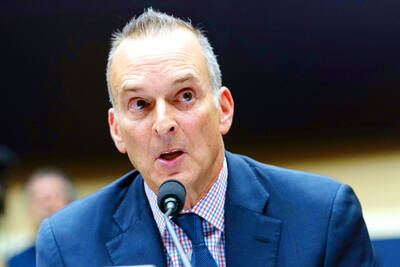
Revelations of positive doping tests for nearly two dozen Chinese swimmers that went unpunished sparked an intense flurry of accusations and legal threats between the World Anti-Doping Agency (WADA) and the head of the US drug-fighting organization, who has long been one of WADA’s fiercest critics. WADA on Saturday said it was turning to legal counsel to address a statement released by US Anti-Doping Agency (USADA) CEO Travis Tygart, who said WADA and anti-doping authorities in China swept positive tests “under the carpet by failing to fairly and evenly follow the global rules that apply to everyone else in the world.” The
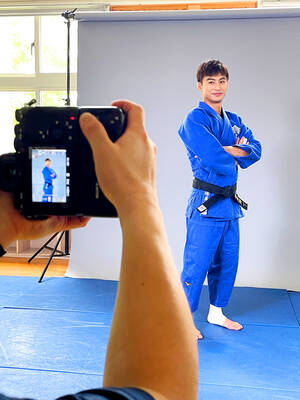
Taiwanese judoka Yang Yung-wei on Saturday won silver in the men’s under-60kg category at the Asian Judo Championships in Hong Kong. Nicknamed the “judo heartthrob” in Taiwan, the Olympic silver-medalist missed out on his first Asian Championships gold when he lost to Japanese judoka Taiki Nakamura in the finals. Yang defeated three opponents on Saturday to reach the final after receiving a bye through the round of 32. He first topped Laotian Soukphaxay Sithisane in the round of 16 with two seoi nage (over-the-shoulder throws), then ousted Indian Vijay Kumar Yadav in the quarter-finals with his signature ude hishigi sankaku gatame (triangular armlock). He
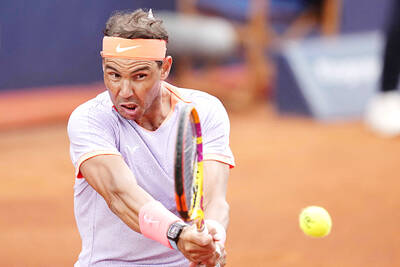
Rafael Nadal on Wednesday said the upcoming French Open would be the moment to “give everything and die” on the court after his comeback from injury in Barcelona was curtailed by Alex de Minaur. The 22-time Grand Slam title winner, back playing this week after three months on the sidelines, battled well, but eventually crumbled 7-5, 6-1 against the world No. 11 from Australia in the second round. Nadal, 37, who missed virtually all of last season, is hoping to compete at the French Open next month where he is the record 14-time champion. The Spaniard said the clash with De Minaur was

RALLY: It was only the second time the Taiwanese has partnered with Kudermetova, and the match seemed tight until they won seven points in a row to take the last set 10-2 Taiwan’s Chan Hao-ching and Russia’s Veronika Kudermetova on Sunday won the Porsche Tennis Grand Prix women’s doubles final in Stuttgart, Germany. The pair defeated Norway’s Ulrikke Eikeri and Estonia’s Ingrid Neel 4-6, 6-3, 10-2 in a tightly contested match at the WTA 500 tournament. Chan and Kudermetova fell 4-6 in the first set after having their serve broken three times, although they played increasingly well. They fought back in the second set and managed to break their opponents’ serve in the eighth game to triumph 6-3. In the tiebreaker, Chan and Kudermetova took a 3-0 lead before their opponents clawed back two points, but


 RSS
RSS