


Taiwan’s world No. 2 ranked golfer Yani Tseng’s (曾雅妮) recent plea to the government for help to establish a top-tier Ladies Professional Golf Association (LPGA) tournament highlights a broader problem of the utter lack of premier international sports events in Taiwan.
A comparison with the other three “Asian tiger” economies, for example, should have local sports fans crying into their beers and hurling their hot dogs in frustration.
Start with Hong Kong: It is home to top-level women’s tennis and men’s golf tournaments plus international rugby and cricket competitions. Taiwan is not.
PHOTO: AFP
It also played host to the equestrian events for last year’s Beijing Olympics and attracts big-name English Premier League soccer teams for pre-season games.
But it gets worse. South Korea teamed up with Japan in 2002 to host one of the world’s greatest sporting events, the soccer World Cup.
In contrast, in November 2007 the Asian Football Confederation (AFC) revoked Taiwan’s right to host the AFC Challenge Cup because of a failure to guarantee that it would meet the standards of Asian soccer’s governing body for the 16-nation tournament.
The Chinese Taipei Football Association (CTFA), local authorities and the Sports Affairs Council pointed the finger of blame at each other for the debacle.
CTFA secretary-general Lin Der-chia (林德嘉) told the Taipei Times the city governments in Taipei and Taoyaun refused to undertake refurbishments to bring two stadiums up to standard for the tournament.
While soccer may not be a big draw in Taiwan, South Korea also plays host to top women’s tennis and golf events and, like Hong Kong, has attracted Premier League sides, including Manchester United.
Tseng’s frustrations become more understandable when one considers that Singapore also hosts an LPGA tournament, as do China, Japan and Thailand.
On the men’s side, there is one annual Asian Tour golf event in Taiwan this year, the US$500,000 Mercuries Taiwan Masters. This compares with three in South Korea, all with more prize money on offer — five times as much, in the case of the Ballantine’s Championship on Jeju Island. The UBS Hong Kong tournament offers US$2.5 million.
In fact, tournaments in Indonesia, Thailand and Malaysia are all richer than Taiwan’s.
In terms of prize money the Taiwan Open is on a par with the Hana Bank Vietnam Masters, although it does offer more than the Cambodian Open.
Not surprisingly, the top players give Taiwan a miss.
Singapore, with a population less than a quarter that of Taiwan, also hosts a Formula One Grand Prix co-funded by its government, which footed 60 percent of the total S$90 million (US$59 million) bill, with Singapore Telecommunications sponsoring the event.
Tseng’s father, Tseng Mao-hsin (曾茂炘), estimated that the cost of staging an LPGA tournament in Taiwan would be about US$6 million.
Despite boasting two female and one male player in the world’s top 100 and some of the world’s leading women’s doubles players, the only tennis tournament of any note held in Taiwan last year was the Taipei Ladies Open, an event sanctioned by the International Tennis Federation, not a top-ranking Lawn Tennis Association (LTA) event, with prize money to match.
As a consequence, the only players in the world’s top 100 in attendance were Taiwan’s Chan Yung-jan (詹詠然) and Hsieh Su-wei (謝淑薇).
The quality of the nation’s major international basketball tournament, the annual Jones Cup, can be gauged by the fact that Jordan, ranked 42nd in the world by the International Basketball Federation, have won the last two events.
On the plus side, Taipei is this year hosting the Deaflympics and Kaohsiung the World Games, an event for sports not included in the Olympics.
While these are steps in the right direction, the global impact of the two will be minimal. How many Taiwanese sports fans will be lining up to watch boules or fistball in Kaohsiung?
Comparing Taiwan’s sports events with those in China and Japan is even more depressing, and they stack up badly with Malaysia and Thailand.
Singapore’s government has seen the value of a major sports event in putting its country in the spotlight in terms of worldwide television exposure and attracting tourists.
It’s also probably no coincidence that the LTA events in Thailand and Indonesia take place in the tourist centers of Pattaya and Bali respectively.
It is time for central and local governments, sports governing bodies and the business community to take hosting and sponsoring major sports seriously. And that means spending money.
Until events offer prize money on a par with others in the region, the stars will continue to stay away. Even worse, the few world-class performers Taiwan has may decide the grass is greener elsewhere and take up offers like those made to Yani Tseng and pool player Wu Chia-ching (吳珈慶) by China and Singapore.
The nation’s long-suffering sports fans deserve better.

Revelations of positive doping tests for nearly two dozen Chinese swimmers that went unpunished sparked an intense flurry of accusations and legal threats between the World Anti-Doping Agency (WADA) and the head of the US drug-fighting organization, who has long been one of WADA’s fiercest critics. WADA on Saturday said it was turning to legal counsel to address a statement released by US Anti-Doping Agency (USADA) CEO Travis Tygart, who said WADA and anti-doping authorities in China swept positive tests “under the carpet by failing to fairly and evenly follow the global rules that apply to everyone else in the world.” The

Taiwanese judoka Yang Yung-wei on Saturday won silver in the men’s under-60kg category at the Asian Judo Championships in Hong Kong. Nicknamed the “judo heartthrob” in Taiwan, the Olympic silver-medalist missed out on his first Asian Championships gold when he lost to Japanese judoka Taiki Nakamura in the finals. Yang defeated three opponents on Saturday to reach the final after receiving a bye through the round of 32. He first topped Laotian Soukphaxay Sithisane in the round of 16 with two seoi nage (over-the-shoulder throws), then ousted Indian Vijay Kumar Yadav in the quarter-finals with his signature ude hishigi sankaku gatame (triangular armlock). He

RALLY: It was only the second time the Taiwanese has partnered with Kudermetova, and the match seemed tight until they won seven points in a row to take the last set 10-2 Taiwan’s Chan Hao-ching and Russia’s Veronika Kudermetova on Sunday won the Porsche Tennis Grand Prix women’s doubles final in Stuttgart, Germany. The pair defeated Norway’s Ulrikke Eikeri and Estonia’s Ingrid Neel 4-6, 6-3, 10-2 in a tightly contested match at the WTA 500 tournament. Chan and Kudermetova fell 4-6 in the first set after having their serve broken three times, although they played increasingly well. They fought back in the second set and managed to break their opponents’ serve in the eighth game to triumph 6-3. In the tiebreaker, Chan and Kudermetova took a 3-0 lead before their opponents clawed back two points, but
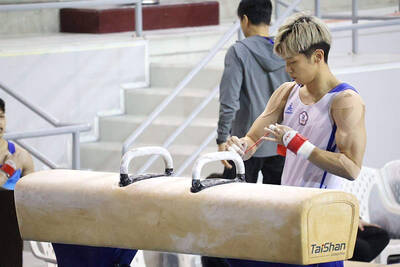
Taiwanese gymnast Lee Chih-kai failed to secure an Olympic berth in the pommel horse following a second-place finish at the last qualifier in Doha on Friday, a performance that Lee and his coach called “unconvincing.” The Tokyo Olympics silver medalist finished runner-up in the final after scoring 6.6 for degree of difficulty and 8.800 for execution for a combined score of 15.400. That was just 0.100 short of Jordan’s Ahmad Abu Al Soud, who had qualified for the event in Paris before the Apparatus World Cup series in Qatar’s capital. After missing the final rounds in the first two of four qualifier


 RSS
RSS