


Taiwan wasn’t among the winners at the Beijing Games, while historical rival China is basking in a golden glow after hosting the event and topping the medal table.
There were few positives to be drawn from this Olympiad in terms of sporting success, while a diplomatic spat over the country’s name before the Games began signaled there would be difficulties ahead.
When Taiwan’s Olympic delegation arrived at the Athlete’s Village, for instance, China’s media emphasized at every opportunity how its members felt “at home,” in an effort to score political points.
This occasionally uncomfortable situation was compounded when Chinese fans supported Taiwan’s athletes by shouting “Go China!”
Even so, a kind of Olympic truce prevailed and the chef de mission of the Taiwan delegation, Tsai Szu-chueh, said the organization of the Games was impressive, if not flawless.
“China has made great efforts over the past seven years. Its hardware development, such as sports venues, will leave a great legacy in the sports industry,” Tsai said. “But on the software front, China should have utilized the International Olympic Committee’s great talent pool and hired more international experts from the cities that hosted Olympics before. After all, it takes experience accumulated from the past to put on a great show.”
On the sporting front, Taiwan’s Games was symbolized by the failure of its vaunted baseball team, that claimed just one win and fell to relative novice China.
In the taekwondo competition, former Olympic champion Chu Mu-yen seemed fazed by the weight of a nation’s expectations and only managed bronze.
His girlfriend and Asian champion Yang Shu-chun, meanwhile, lost to Chinese rival Wu Jingyu, who went on to seal a gold medal victory.
Taekwondo head coach Hou Wei-hsing said pressure rather than a lack of ability or preparation had confounded his athletes.
“They did their best and had the confidence and ambition to win. Of course, Taiwan’s people had high hopes of them, but in the end they couldn’t achieve what they aimed for. We’ll review how we can make progress,” Hou said.
Before the Games, Tsai predicted Taiwan would exceed its Athens haul of two gold medals, a pair of silvers and a bronze, to come 31st in the standings.
Instead, the country slipped to 80th in the rankings, with four bronze medals.
“Of course the result falls short of our expectations … our hopes were dashed. Certainly we feel disappointed, but the important thing is that we note other nations have made greater progress than us,” Tsai said. “Our athletes worked hard, but competing players worked even harder and their basic training was very solid.”
Tsai echoed Hou’s words when he said training systems would be reviewed and there would be improvements for London 2012.
Many countries will be looking at China’s example when it comes to reforming training programs, said Jeff Ruffolo, a senior advisor to the Beijing organizers who has overseen four Olympics.
“The level of competition was so much higher than before and this was seen in the number of records that were broken,” Ruffolo said. “China not only exceeded at what it has traditionally done well, but also sports like archery where it has not done so well. Maybe others will emulate this.”
“John Hancock” is the Taipei Times’ correspondent for the Beijing Olympics.

US track and field athletes have about four dozen pieces to choose from when assembling their uniforms at the Olympics. The one grabbing the most attention is a high-cut leotard that barely covers the bikini line and has triggered debate between those who think it is sexist and others who say they do not need the Internet to make sure they have good uniforms. Among those critical or laughing at the uniforms included Paralympian Femita Ayanbeku, sprinter Britton Wilson and even athletes from other countries such as Britain’s Abigail Irozuru, who wrote on social media: “Was ANY female athlete consulted in

Four-time NBA all-star DeMarcus Cousins arrived in Taiwan with his family early yesterday to finish his renewed contract with the Taiwan Beer Leopards in the T1 League. Cousins initially played a four-game contract with the Leopards in January. On March 18, the Taoyuan-based team announced that Cousins had renewed his contract. “Hi what’s up Leopard fans, I’m back. I’m excited to be back and can’t wait to join the team,” Cousins said in a video posted on the Leopard’s Facebook page. “Most of all, can’t wait to see you guys, the fans, next weekend. So make sure you come out and support the Beer

Former US Masters champion Zach Johnson was left embarrassed after a foul-mouthed response to ironic cheers from spectators after a triple bogey at Augusta National on Friday. Johnson, the 2007 Masters winner, missed the cut after his three-over-par round of 75 left him on seven-over 151 for 36 holes, his six on the par-three 12th playing a big role in his downfall. Television footage showed Johnson reacting to sarcastic cheers and applause when he tapped in for the triple bogey by yelling: “Oh fuck off.” Such a response would be considered bad form in any golf tournament, but is particularly out of keeping
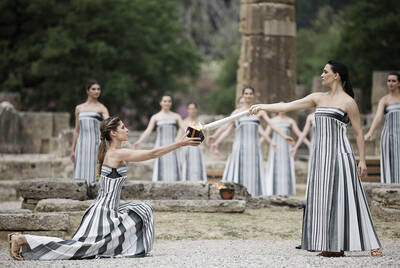
The sacred flame for the Paris Olympics was lit yesterday in Olympia, Greece, the birthplace of the ancient Games, in a ceremony inspired by antiquity and marked by messages of hope amid multiple global crises. “In ancient times, the Olympic Games brought together the Greek city states, even — and in particular — during times of war and conflict,” International Olympic Committee president Thomas Bach said. “Today, the Olympic Games are the only event that brings the entire world together in peaceful competition. Then as now, the Olympic athletes are sending this powerful message — yes, it is possible to compete fiercely


 RSS
RSS