


A short walk from the National Stadium, near a busy coach station, there is a wire fence around a plot of land and a plain white sign with words in Mandarin and English that read: “Military Administrative District, No Admittance.”
It has become a tourist attraction of sorts, where both locals and foreigners gather to take shots of the guards standing to attention in front of a battery of missiles.
On a recent visit, it appeared the soldiers clad in military fatigues were controlling drones. They were fiddling with portable devices and looking heavenward, where a number of kites were also flying.
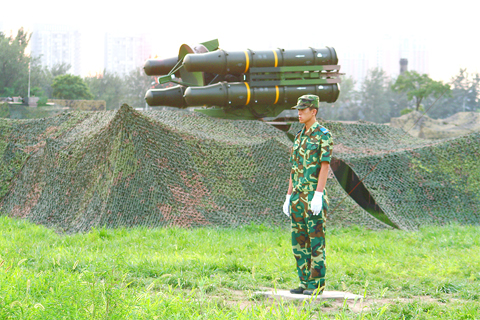
PHOTO: JOHN HANCOCK
While the idea of rocket launchers in such a built-up area is unsettling, it would be inconceivable for an Olympics to take place without a military presence of some sort.
This is especially true after Sept. 11, 2001, when terrorism redefined what was possible in terms of creating destruction. Greek Secretary General of Information Panos Livadas underlined this point on a visit to Beijing last week.
He said the Athens Games were the first after Sept. 11 and security costs were six times greater than had been anticipated because of it. It has set a precedent for all other Olympics, he added.
“Ours was the first Olympics to deal with this problem and that was one reason why there were delays [with our preparations]. Thank God there wasn’t an attack, but you have to be ready,” he said.
The authorities in Beijing keep reminding us of this. Earlier this week the director of security for the Games, Ma Zhenchuan (馬振川), said the East Turkistan Islamic Movement (ETIM) was targeting Olympic venues.
“It’s not imaginary. We have been focusing on the ETIM and it has been labeled a terrorist group not only by our country, but also the international community,” Ma told China Central Television.
At the beginning of the month security forces uprooted five “terrorist groups” that were preparing to launch attacks, and said that 82 people had been detained.
Additionally, state media claimed, more than 40 Islamist training bases were smashed.
The security clampdown is becoming increasingly evident as we count down to the big day. There are three security rings around Beijing and police cars patrol the intersections of major roads.
There are 40 anti-terrorism units in the capital and 110,000 security guards have been mobilized to keep the streets safe. About 300,000 surveillance cameras have also been deployed to keep track of suspicious behavior, while neighborhood watch teams are on guard.
During the subway rush hour bags are X-rayed and examined for suspect items, despite the inevitable delays. At bus terminals in far-flung provinces packages are examined if they are headed for the capital. Packs of dogs sniff around for trouble at Beijing Airport’s brand new Terminal 3.
“Safety first” seems to be the approach, and though some critics are saying this is a cover to crack down on dissent and is taking the fun out of the Games, Beijing has international support.
Interpol and more than 80 countries are involved in anti-terrorism measures for the Games, in conjunction with the International Olympic Committee, said Liu Shaowu (劉紹武), director of security for the Beijing Organizing Committee, on Wednesday.
“The common enemy of [the] international community is terrorists … so we have to upgrade the security level,” Liu said at the press conference. “We want to have both safety and festivity.”
If there is an incident the organizers will be blamed for not doing enough, so precautions are necessary.
Athens faced the same criticism four years ago and anti-terrorism measures in London 2012 will likely be even tighter. The price of security is inconvenience and missiles based downtown.
But there is little to suggest so far that this will be the “killjoy” Games that some news organizations are trying to depict.
On the contrary, as the crowd of tourists gawking at and photographing the missile installation suggests, “measured approach” seems a more accurate description.
“John Hancock” is the Taipei Times correspondent for the Beijing Olympics.
Also See: BEIJING OLYMPICS: China’s shuttlers won’t have it all their own way

US track and field athletes have about four dozen pieces to choose from when assembling their uniforms at the Olympics. The one grabbing the most attention is a high-cut leotard that barely covers the bikini line and has triggered debate between those who think it is sexist and others who say they do not need the Internet to make sure they have good uniforms. Among those critical or laughing at the uniforms included Paralympian Femita Ayanbeku, sprinter Britton Wilson and even athletes from other countries such as Britain’s Abigail Irozuru, who wrote on social media: “Was ANY female athlete consulted in

Four-time NBA all-star DeMarcus Cousins arrived in Taiwan with his family early yesterday to finish his renewed contract with the Taiwan Beer Leopards in the T1 League. Cousins initially played a four-game contract with the Leopards in January. On March 18, the Taoyuan-based team announced that Cousins had renewed his contract. “Hi what’s up Leopard fans, I’m back. I’m excited to be back and can’t wait to join the team,” Cousins said in a video posted on the Leopard’s Facebook page. “Most of all, can’t wait to see you guys, the fans, next weekend. So make sure you come out and support the Beer

Former US Masters champion Zach Johnson was left embarrassed after a foul-mouthed response to ironic cheers from spectators after a triple bogey at Augusta National on Friday. Johnson, the 2007 Masters winner, missed the cut after his three-over-par round of 75 left him on seven-over 151 for 36 holes, his six on the par-three 12th playing a big role in his downfall. Television footage showed Johnson reacting to sarcastic cheers and applause when he tapped in for the triple bogey by yelling: “Oh fuck off.” Such a response would be considered bad form in any golf tournament, but is particularly out of keeping
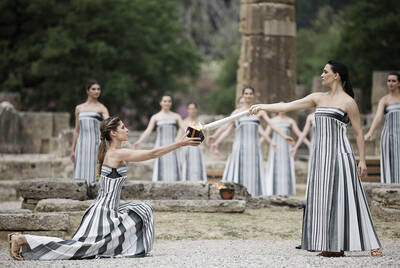
The sacred flame for the Paris Olympics was lit yesterday in Olympia, Greece, the birthplace of the ancient Games, in a ceremony inspired by antiquity and marked by messages of hope amid multiple global crises. “In ancient times, the Olympic Games brought together the Greek city states, even — and in particular — during times of war and conflict,” International Olympic Committee president Thomas Bach said. “Today, the Olympic Games are the only event that brings the entire world together in peaceful competition. Then as now, the Olympic athletes are sending this powerful message — yes, it is possible to compete fiercely


 RSS
RSS