


Defending champion Lance Mackey was the first musher to leave the Nikolai checkpoint and took the lead in the Iditarod Trail Sled Dog Race on Tuesday
Mackey, who last year became the first to record consecutive wins in the 1,600km Yukon Quest International Sled Dog Race and the even longer Iditarod, rested his team for nearly five hours before getting back on the trail.
Norway's Kjetil Backen was the first musher to reach the Nikolai checkpoint, checking in at 10:39am with 15 dogs. Backen coasted into the checkpoint, 645km into the race. Told he was in the lead, he said, "I can see that."
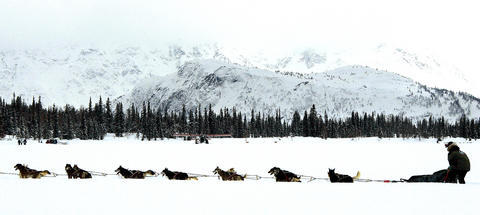
PHOTO: AP
Backen told onlookers that the going was relatively rough on the frozen Kuskokwim River.
"I fall over but it's all right," he said. "No problem."
Veteran Gerry Willomitzer was second in to Nikolai, population 109, the first of many Native villages along the trail to Nome. Willomitzer, a veteran in the Yukon Quest International Sled Dog Race, clocked in at 11:17am with 14 dogs.
Last year's runner-up, Paul Gebhardt, was next, arriving at 11:33am with all 16 dogs. He was followed three minutes later by defending champion Lance Mackey with 15 dogs.
Ten minutes behind Mackey was four-time winner Jeff King with all 16 dogs.
Less than an hour later, three more mushers were in. Three-time Yukon Quest winner Hans Gatt beat Hugh Neff by a minute. Next came 2004 Iditarod winner Mitch Seavey.
Rick Swenson -- the only five-time Iditarod winner -- arrived at 1:13pm with a full team.
Approaching Nikolai was four-time winner Martin Buser.
Mushers will next head west to McGrath, a Kuskokwim River community of 400 in Alaska's interior. The 87km stretch is mostly flat, passing through stands of spruce and alders, as well as the river itself. It's a fairly easy run if the weather cooperates.
But race organizers said unusually high temperatures along the early stretch of the trail are the main concern in the Iditarod so far.
Race spokesman Chas St. George said some areas were reporting temperatures around 1oC to 2oC, which "is too hot for the dogs to run in." A stretch between the checkpoint at Rainy Pass and Nikolai reported a high of 7oC, the National Weather Service said.
St. George said last year about this time temperatures were around minus 18oC in this part of the trail.
At the same time, teams are dealing with heavy snow all along the trail.
"But there are no blizzard conditions," St. George said, "Everybody's moving."
About 20 dogs have been dropped so far, but there are no serious casualties, St. George said.
He said the numbers were tapering off.
"Usually in the first third of the race, mushers expect to drop a lot of dogs. This is an area for a lot of opportunities for sprains or other injuries."
Two mushers scratched on Tuesday. Tom Roig dropped out, citing concern for his health and the health of his team. Joe Garnie also quit, citing health issues with his dog team. A record field of 93 mushers remains in the running.
Until mushers begin taking a mandatory 24-hour layover and two eight-hour rests, the race is fluid.
In its 36th running, the race commemorates a run by sled dogs in 1925 to deliver lifesaving diphtheria serum to Nome.
The modern-day Iditarod trail crosses frozen rivers, dense woods and two mountain ranges, then goes along the dangerous sea ice up the Bering Sea shore to the finish line under Nome's burled arch. Along the way, mushers can encounter temperatures far below zero, blinding winds and long stretches of frigid overflow.

Tainan TSG Hawks slugger Steven Moya, who is leading the CPBL in home runs, has withdrawn from this weekend’s All-Star Game after the unexpected death of his wife. Moya’s wife began feeling severely unwell aboard a plane that landed at Taiwan Taoyuan International Airport on Friday evening. She was rushed to a hospital, but passed away, the Hawks said in a statement yesterday. The franchise is assisting Moya with funeral arrangements and hopes fans who were looking forward to seeing him at the All-Star Game can understand his decision to withdraw. According to Landseed Medical Clinic, whose staff attempted to save Moya’s wife,

Wallabies coach Joe Schmidt yesterday backed Nick Champion de Crespigny to be the team’s “roving scavenger” after handing him a shock debut in the opening Test against the British and Irish Lions Test in Brisbane. Hard man Champion de Crespigny, who spent three seasons at French side Castres before moving to the Western Force this year, is to get his chance tomorrow with first-choice blindside flanker Rob Valetini not fully fit. His elevation is an eye-opener, preferred to Tom Hooper, but Schmidt said he had no doubt about his abilities. “I keep an eye on the Top 14 having coached there many years

ON A KNEE: In the MLB’s equivalent of soccer’s penalty-kicks shoot-out, the game was decided by three batters from each side taking three swings each off coaches Kyle Schwarber was nervous. He had played in Game 7 of the MLB World Series and homered for the US in the World Baseball Classic (WBC), but he had never walked up to the plate in an All-Star Game swing-off. No one had. “That’s kind of like the baseball version of a shoot-out,” Schwarber said after homering on all three of his swings, going down to his left knee on the final one, to overcome a two-homer deficit. That held up when Jonathan Aranda fell short on the American League’s final three swings, giving the National League a 4-3 swing-off win after

Seattle’s Cal Raleigh defeated Tampa Bay’s Junior Caminero 18-15 in Monday’s final to become the first catcher to win the Major League Baseball Home Run Derby. The 28-year-old switch-hitter, who leads MLB with 38 homers this season, won US$1 million by capturing the special event for sluggers at Atlanta’s Truist Park ahead of yesterday’s MLB All-Star Game. “It means the world,” Raleigh said. “I could have hit zero home runs and had just as much fun. I just can’t believe I won. It’s unbelievable.” Raleigh, who advanced from the first round by less than 25mm on a longest homer tiebreaker, had his father


 RSS
RSS