


It's always been impossible to witness the entire length of the Iditarod Trail Sled Dog Race except, of course, for the competitors. Many top contenders like it that way.
But organizers say fans will get the next best experience in the 36th running of the 1,770km race, which begins with a ceremonial start on Saturday in Anchorage. Race buffs around the world will be able to follow online the virtual progress of 20 veteran mushers whose sleds are rigged with technology derived from instruments used to track oil-pipeline inspection tools.
"Basically, it winds up looking like a video game, but it's a way to watch a representation of an event that's happening many thousands of miles away -- in real time," said Jerry Miller with IonEarth, a satellite race tracking company based in Traverse City, Michigan.
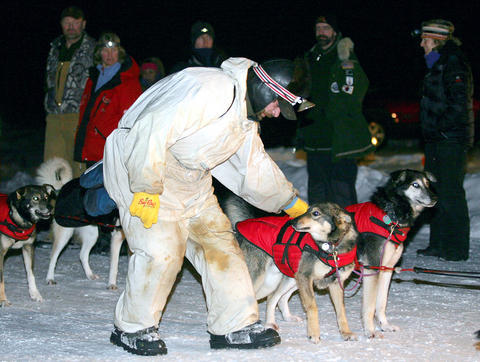
PHOTO: AP
The company is teaming up with the Iditarod and Iridium Satellite LLC for the test run they hope will become an annual feature involving all mushers. Among mushers and fans, however, the concept is generating some mixed reviews.
The 850g units carried by mushers will emit logistical data every 15 minutes that will instantly be processed by Iridium's global network of satellites and wind up as a free service this year on the Iditarod's Web site. Iditarod and IonEarth officials say the Web link will be up and running by the time the competitive race begins on Sunday in Willow, about 80km north of Anchorage.
The tracking system is a slightly simplified application of technology used in highly complex devices that monitor "smart pigs," tools sent through oil pipelines to assess their condition.
Race personnel equipped with similar devices and working in remote locations will be able to monitor the mushers. Fans will see where the dog teams are along the trail. Also posted will be speed, direction, altitude and temperature, as well as supplementary musher bios.
But the idea of closely tracking the race is not entirely embraced by some mushers and contributors to a new fan forum on the Iditarod Web site.
Many mushers closely guard their strategies involved in running the world's longest sled dog race. For example, they can use rest times along the trail to conceal their true speed.
And for many fans, not knowing where mushers are between checkpoints adds to the mystery.
Last year's champion, Lance Mackey of Fairbanks, said that as a competitor, he understands the worries. But they're negligible concerns, considering the benefit to fans, said Mackey, who last March became the only musher to win both the Iditarod and the 1,609km Yukon Quest International Sled Dog Race in the same year.
"If it wasn't for the people following the race, there wouldn't be a race at all," said Mackey, who won his fourth consecutive Yukon Quest last Wednesday. "It's minimal what we're being asked to do, so I'm all for it. It doesn't mean anyone can catch me."

US track and field athletes have about four dozen pieces to choose from when assembling their uniforms at the Olympics. The one grabbing the most attention is a high-cut leotard that barely covers the bikini line and has triggered debate between those who think it is sexist and others who say they do not need the Internet to make sure they have good uniforms. Among those critical or laughing at the uniforms included Paralympian Femita Ayanbeku, sprinter Britton Wilson and even athletes from other countries such as Britain’s Abigail Irozuru, who wrote on social media: “Was ANY female athlete consulted in

Forget Real Madrid, Manchester City or Paris Saint-Germain, the world’s best soccer team — statistically speaking — might be a little-known outfit from the closed central Asian nation of Turkmenistan. Founded last year, Arkadag, named in honor of former Turkmen president Gurbanguly Berdimuhamedow, have been unstoppable, notching up 36 consecutive domestic victories in a run still ongoing. The side have not lost a single competitive match and swept to a league and cup double in their inaugural season — success unthinkable almost anywhere else. However, in Turkmenistan, it could hardly have gone any other way. The energy-rich country is one of the most closed

Former US Masters champion Zach Johnson was left embarrassed after a foul-mouthed response to ironic cheers from spectators after a triple bogey at Augusta National on Friday. Johnson, the 2007 Masters winner, missed the cut after his three-over-par round of 75 left him on seven-over 151 for 36 holes, his six on the par-three 12th playing a big role in his downfall. Television footage showed Johnson reacting to sarcastic cheers and applause when he tapped in for the triple bogey by yelling: “Oh fuck off.” Such a response would be considered bad form in any golf tournament, but is particularly out of keeping

Taiwan’s Lee Jhe-huei and Yang Po-hsuan on Saturday won the men’s doubles bronze medal at the Badminton Asia Championships in Ningbo, China, after they were bested by the hosts in their semi-final. The Taiwanese shuttlers lost to China’s Liang Wei Keng and Wang Chang, who advanced to yesterday’s final against Malaysia’s Goh Sze Fei and Nur Izzudin. The Chinese pair outplayed Lee and Yang in straight games. Although the Taiwanese got off to a slow start in the first game, they eventually tied it 14-14, before Liang and Wang went on to blow past them to win 21-17. In the second game, Lee and


 RSS
RSS