


Even if Major League baseball and the players union agreed to every recommendation in the Mitchell Report tomorrow, stemming the use of performance-enhancing drugs will be a long-term project with no easy solutions.
Experts devoted to eliminating drugs in sports say its a three-part problem, one that involves finding an effective test for human growth hormone, staying ahead of those creating new illegal drugs and, most important, changing the drug culture in baseball.
Don Catlin, one of the world's foremost scientists in the fight against doping, said he has made some headway with the US$500,000 that MLB gave him to begin work on finding an effective urine test to detect HGH.
HGH was identified in the Mitchell Report as one of the biggest problems, in large part because it's nearly undetectable. Only blood tests can detect signs of HGH use, and they aren't considered advanced enough to catch cheaters who use any measure of sophistication.
A urine test is thought by some to be years away, though Catlin is trying, and has had enough success that he is considering asking for more money to move the studies forward.
"But let's say we get that contained tomorrow," Catlin said. "The next day, there's going to be another one."
For instance, Catlin said he was starting to get word of new designer types of EPO that are essentially undetectable to a type of testing that MLB doesn't currently perform anyway.
EPO is a banned substance that increases the amount of oxygen that blood can carry to the body's muscles.
A number of experts were most encouraged by the report's recommendation that MLB find ways to investigate and punish drug users who don't test positive, but are linked to receipt and use of drugs nonetheless.
Going after these so-called "non-analytical" cases is an increasingly important step in the US Anti-Doping Agency's effort to keep drugs out of Olympic sports. Sprinter Marion Jones lost her five medals from the 2000 Sydney Olympics as the result of legal issues and evidence that did not include a positive doping test.
But Catlin believes as long as athletes are looking for an edge, people will find new pharmaceuticals to give them that edge.
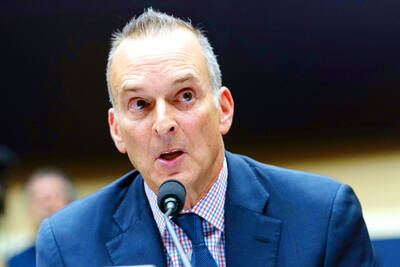
Revelations of positive doping tests for nearly two dozen Chinese swimmers that went unpunished sparked an intense flurry of accusations and legal threats between the World Anti-Doping Agency (WADA) and the head of the US drug-fighting organization, who has long been one of WADA’s fiercest critics. WADA on Saturday said it was turning to legal counsel to address a statement released by US Anti-Doping Agency (USADA) CEO Travis Tygart, who said WADA and anti-doping authorities in China swept positive tests “under the carpet by failing to fairly and evenly follow the global rules that apply to everyone else in the world.” The

Taiwanese judoka Yang Yung-wei on Saturday won silver in the men’s under-60kg category at the Asian Judo Championships in Hong Kong. Nicknamed the “judo heartthrob” in Taiwan, the Olympic silver-medalist missed out on his first Asian Championships gold when he lost to Japanese judoka Taiki Nakamura in the finals. Yang defeated three opponents on Saturday to reach the final after receiving a bye through the round of 32. He first topped Laotian Soukphaxay Sithisane in the round of 16 with two seoi nage (over-the-shoulder throws), then ousted Indian Vijay Kumar Yadav in the quarter-finals with his signature ude hishigi sankaku gatame (triangular armlock). He
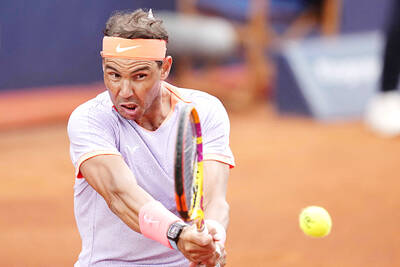
Rafael Nadal on Wednesday said the upcoming French Open would be the moment to “give everything and die” on the court after his comeback from injury in Barcelona was curtailed by Alex de Minaur. The 22-time Grand Slam title winner, back playing this week after three months on the sidelines, battled well, but eventually crumbled 7-5, 6-1 against the world No. 11 from Australia in the second round. Nadal, 37, who missed virtually all of last season, is hoping to compete at the French Open next month where he is the record 14-time champion. The Spaniard said the clash with De Minaur was

RALLY: It was only the second time the Taiwanese has partnered with Kudermetova, and the match seemed tight until they won seven points in a row to take the last set 10-2 Taiwan’s Chan Hao-ching and Russia’s Veronika Kudermetova on Sunday won the Porsche Tennis Grand Prix women’s doubles final in Stuttgart, Germany. The pair defeated Norway’s Ulrikke Eikeri and Estonia’s Ingrid Neel 4-6, 6-3, 10-2 in a tightly contested match at the WTA 500 tournament. Chan and Kudermetova fell 4-6 in the first set after having their serve broken three times, although they played increasingly well. They fought back in the second set and managed to break their opponents’ serve in the eighth game to triumph 6-3. In the tiebreaker, Chan and Kudermetova took a 3-0 lead before their opponents clawed back two points, but


 RSS
RSS