


Over the next month, thousands of high school and college football teams will get ready for fall by practicing in torrid conditions where heatstroke is a constant danger.
That has some trainers and doctors worried about increasingly popular thermometers that, in their view, sacrifice accuracy for convenience.
The devices use infrared light to scan heat radiation in the ear or on the forehead.
The infrared thermometers have produced lower readings in athletic settings -- or in lab tests meant to simulate them -- than rectal thermometers or other devices.
Forehead scanner
After testing a forehead scanner that is made by Exergen, researchers with the Institute for Exercise and Environmental Medicine at Presbyterian Hospital in Dallas, Texas, warned that low readings from the device could deprive patients of critical, perhaps lifesaving medical care.
In the test in the journal Medicine and Science in Sports and Exercise, the infrared thermometer gave readings below 37.8oC when rectal thermometers topped 40oC, a temperature at which some patients begin to become vulnerable to heatstroke.
Douglas Casa, the director of athletic training education at the University of Connecticut who completed a study of 10 types of thermometers used in intense training situations, said the infrared forehead and ear scanners were among those producing misleadingly low readings in his test.
Similar conclusions
And William Roberts, a University of Minnesota researcher and former president of the American College of Sports Medicine, said his tests of the forehead device on runners in the Medtronic Twin Cities Marathon led him to similar conclusions.
Both have submitted their results to peer-reviewed journals.
Exergen said that it was apparent from the report on the Texas test, which used healthy subjects in heated wet suits, that the researchers did not duplicate realistic conditions for athletes.
Exergen also said that the thermometer, the Temporal Scanner, was not marketed for use in athletic settings and came with instructions specifically stating that it was not for outdoor use.
That goes for both the consumer version, which costs US$30 to US$50 at drugstores and other chains, and a more durable model sold for about US$350 to doctors' offices and hospitals, it said.
Boston Marathon
The company Web site includes a 2005 news release noting that its thermometers had been used for 17 years at the Boston Marathon.
But Francesco Pompei, the company president, said the release made it clear that the device had required special handling at the marathon.
The changes, including use of a piece of film to deal with perspiration, have been shared with a small number of trainers who sought more information for their own studies, Pompei said.
"We use sports medicine for research," he said. "But we are not selling into the athletic market."
He added that the association with the Boston Marathon, which began in 1989, ended last year with the retirement of Marvin Adler, longtime medical director of the race.
Something simpler
Critics said the device might attract coaches looking for something simpler than rectal thermometers and less costly than the most accurate devices available outside of hospitals -- radio-transmitting temperature-sensing pills that athletes swallow.
Pompei said his company would be glad to work with critics to discourage using the Temporal Scanner in athletic settings.
But a broader battle may loom.
Benjamin Levine, a physician who took part in the Dallas test, said the scanner should not be used in any setting, even though 30 percent of Texas hospitals now use it or a similar device.
Novation, a hospital purchasing group, said its members bought more than US$1 million worth of them last year and had not heard any complaints.
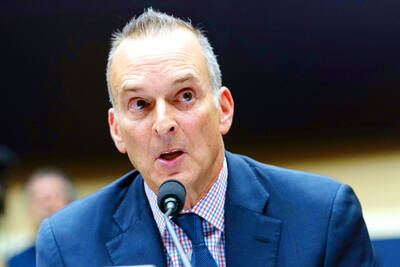
Revelations of positive doping tests for nearly two dozen Chinese swimmers that went unpunished sparked an intense flurry of accusations and legal threats between the World Anti-Doping Agency (WADA) and the head of the US drug-fighting organization, who has long been one of WADA’s fiercest critics. WADA on Saturday said it was turning to legal counsel to address a statement released by US Anti-Doping Agency (USADA) CEO Travis Tygart, who said WADA and anti-doping authorities in China swept positive tests “under the carpet by failing to fairly and evenly follow the global rules that apply to everyone else in the world.” The
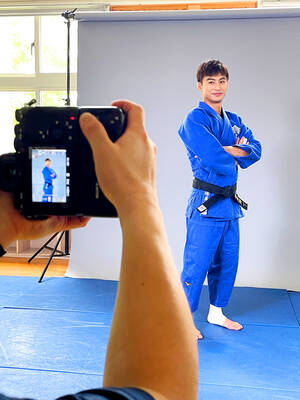
Taiwanese judoka Yang Yung-wei on Saturday won silver in the men’s under-60kg category at the Asian Judo Championships in Hong Kong. Nicknamed the “judo heartthrob” in Taiwan, the Olympic silver-medalist missed out on his first Asian Championships gold when he lost to Japanese judoka Taiki Nakamura in the finals. Yang defeated three opponents on Saturday to reach the final after receiving a bye through the round of 32. He first topped Laotian Soukphaxay Sithisane in the round of 16 with two seoi nage (over-the-shoulder throws), then ousted Indian Vijay Kumar Yadav in the quarter-finals with his signature ude hishigi sankaku gatame (triangular armlock). He
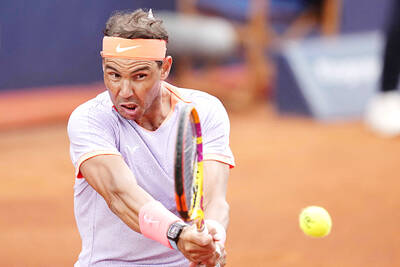
Rafael Nadal on Wednesday said the upcoming French Open would be the moment to “give everything and die” on the court after his comeback from injury in Barcelona was curtailed by Alex de Minaur. The 22-time Grand Slam title winner, back playing this week after three months on the sidelines, battled well, but eventually crumbled 7-5, 6-1 against the world No. 11 from Australia in the second round. Nadal, 37, who missed virtually all of last season, is hoping to compete at the French Open next month where he is the record 14-time champion. The Spaniard said the clash with De Minaur was

RALLY: It was only the second time the Taiwanese has partnered with Kudermetova, and the match seemed tight until they won seven points in a row to take the last set 10-2 Taiwan’s Chan Hao-ching and Russia’s Veronika Kudermetova on Sunday won the Porsche Tennis Grand Prix women’s doubles final in Stuttgart, Germany. The pair defeated Norway’s Ulrikke Eikeri and Estonia’s Ingrid Neel 4-6, 6-3, 10-2 in a tightly contested match at the WTA 500 tournament. Chan and Kudermetova fell 4-6 in the first set after having their serve broken three times, although they played increasingly well. They fought back in the second set and managed to break their opponents’ serve in the eighth game to triumph 6-3. In the tiebreaker, Chan and Kudermetova took a 3-0 lead before their opponents clawed back two points, but


 RSS
RSS