


Thanks to Wayne Davis and his fine-feathered friends, raindrops are the only thing that Wimbledon fans have to worry about dropping from the sky and into their bowls of strawberries and cream.
The All England Club would seem a wonderful place to be a pigeon. There are nooks, crannies and overhangs. There are trees and grass. And, for two weeks out of the year, there is litter and food and people to hassle, which seems to be what pigeons do best.
But there are no pigeons here, apart from the occasional wayward straggler.
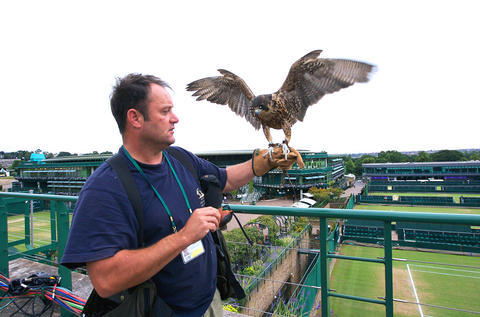
PHOTO: NY TIMES IMAGES
Davis stood on the terrace atop the Broadcast Center, several stories high, about even with the top of Center Court. From there you could see the tennis courts below, the suburbs that surround them, and downtown London in the distance.
And, above, was one of his Peregrine falcons, circling the sky, issuing a silent warning that being a pigeon and being here is not a good idea.
Davis swung a rope like a lasso. At its end was a meaty piece of quail attached to a leather lure. The falcon, this one named Callisto, dived toward the food and swooped past, like a bull to a matador. After a few passes, Davis dropped the decoy to his feet, and the brown falcon with a speckled chest came down to earth and feasted.
"I've been doing this 25 years," said Davis, smiling at the spectacle of the bird's flight.
For years pigeons flocked to Wimbledon's grass courts. They would eat the grass seed in the spring and nest under the Center Court roof. Every year, workers would try to remove the nests before the tournament. Still, the pigeons would flutter about the courts, and bomb the fans with unpleasant surprises.
"In the old, old days, they probably used to shoot them," Wimbledon spokesman Johnny Perkins said of the pigeons. "But in these touchy feely times, they probably decided that wasn't the best option. This seems to be the best compromise, really."
Helping Wimbledon limit its spectators to ticket-holding humans was the idea of Davis' wife. She was watching the tournament on television a few years ago, and saw players shooing pigeons with rackets. So Davis called the All England Club and offered a demonstration of his services. The club liked what it saw, and Davis was hired beginning in 1999.
Davis owns a company called Avian Control Systems. With his small flock of hawks, falcons and owls, he shoos other birds using little more than fright tactics. Lesser birds see his birds soaring around, and they find somewhere else to go.
"Falconer," Davis said, chewing on a suggestion for his job title. "I like that. I get called bird man, but falconer is nice, isn't it?"
Davis does much of his work at airports and military airfields, where geese, gulls and other unsuspecting birds can pose safety risks if they find their way into jet engines.
Other clients see birds as a nuisance, not a danger. Davis has contracts with Westminster Abbey and Canary Wharf, a glass-and-steel business district along the Thames. Like the All England Club, they wanted a non-messy way to get rid of the mess-making birds, particularly the feral pigeon.
Pigeons, it seems, have memories that last at least a couple of days. At Wimbledon, Davis and his birds come a few times a week, throughout the year. That is enough to keep them from roosting in the rafters of the show courts and from eating the grass seed when it is planted in the spring across nearly 40 courts.
"It's analogous to cleaning," he said. "You solve the problem with an intensive period, and keep it up with maintenance."

US track and field athletes have about four dozen pieces to choose from when assembling their uniforms at the Olympics. The one grabbing the most attention is a high-cut leotard that barely covers the bikini line and has triggered debate between those who think it is sexist and others who say they do not need the Internet to make sure they have good uniforms. Among those critical or laughing at the uniforms included Paralympian Femita Ayanbeku, sprinter Britton Wilson and even athletes from other countries such as Britain’s Abigail Irozuru, who wrote on social media: “Was ANY female athlete consulted in

Forget Real Madrid, Manchester City or Paris Saint-Germain, the world’s best soccer team — statistically speaking — might be a little-known outfit from the closed central Asian nation of Turkmenistan. Founded last year, Arkadag, named in honor of former Turkmen president Gurbanguly Berdimuhamedow, have been unstoppable, notching up 36 consecutive domestic victories in a run still ongoing. The side have not lost a single competitive match and swept to a league and cup double in their inaugural season — success unthinkable almost anywhere else. However, in Turkmenistan, it could hardly have gone any other way. The energy-rich country is one of the most closed

Four-time NBA all-star DeMarcus Cousins arrived in Taiwan with his family early yesterday to finish his renewed contract with the Taiwan Beer Leopards in the T1 League. Cousins initially played a four-game contract with the Leopards in January. On March 18, the Taoyuan-based team announced that Cousins had renewed his contract. “Hi what’s up Leopard fans, I’m back. I’m excited to be back and can’t wait to join the team,” Cousins said in a video posted on the Leopard’s Facebook page. “Most of all, can’t wait to see you guys, the fans, next weekend. So make sure you come out and support the Beer

Former US Masters champion Zach Johnson was left embarrassed after a foul-mouthed response to ironic cheers from spectators after a triple bogey at Augusta National on Friday. Johnson, the 2007 Masters winner, missed the cut after his three-over-par round of 75 left him on seven-over 151 for 36 holes, his six on the par-three 12th playing a big role in his downfall. Television footage showed Johnson reacting to sarcastic cheers and applause when he tapped in for the triple bogey by yelling: “Oh fuck off.” Such a response would be considered bad form in any golf tournament, but is particularly out of keeping


 RSS
RSS